
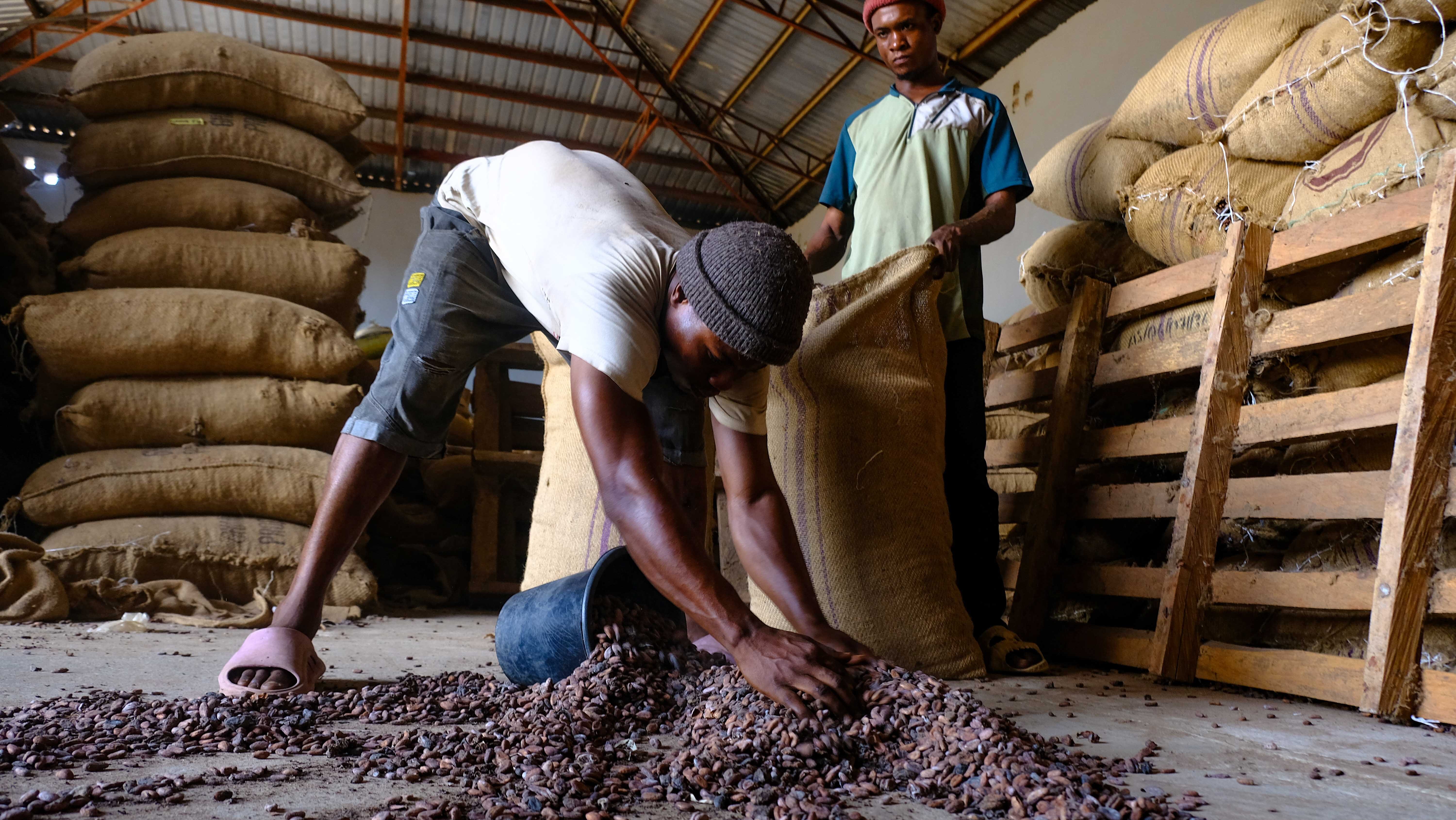
Image credit : Ei’eke. This file is licensed under the Creative Commons Attribution-Share Alike 4.0 International license.

Combined, Ghana and Côte d’Ivoire supply almost 60% of the world’s cocoa. The bean is Côte d’Ivoire’s primary export and, by volume, makes up about half of the country’s agricultural exports.
One might therefore think that the explosion of the chocolate industry in recent decades would have caused new riches to come spilling into West Africa, bringing economic growth and prosperity to the lives of cocoa farmers and their employees.
This has not been the case. Instead, despite the fact that the price of cocoa has risen drastically in the last few years, many farmers are earning less than $1 a day (£0.73). And when this is the case for business owners, there is little hope of a decent wage for the children they employ.
The International Labour Organisation (ILO) has condemned the child labour in West Africa as some of “the worst forms of child labor”. This includes practices which are “likely to harm the health, safety, or morals of children”.
In West Africa, children employed on farms are often required to perform dangerous activities such as climbing trees to cut cocoa beans down with a machete, using chainsaws, and carrying heavy bags of cocoa. Aly Diabate, a former slave child reported that “some of the bags were taller than me. It took two people to put the bag on my head. And when you didn’t hurry, you were beaten”.
It is estimated that approximately 1.6 million children in Côte d’Ivoire and Ghana work on cocoa farms. Most are between the ages of 12 and 16, but some are as young as five. Children are often sold to traffickers or farm owners by their families from neighbouring countries such as Burkina Faso and Mali, sometimes for around $34 (£24.92).
They are made to sleep on wooden planks in small windowless buildings, with no access to clean water or sanitary bathrooms. Around 30% are prevented from attending school.
Many families are deceived into selling their children into slavery. One boy, Abou Traore, came from Burkina Faso to work on a farm in the Côte d’Ivoire in order to be able to attend school. “I haven’t been to school for five years now,” he told reporters. At the time he was fifteen.
Abby Mills, campaigns director for the International Labour Rights Forum states, “every research study ever conducted shows that there is human trafficking going on, particularly in the Ivory Coast”. Furthermore, a study found that in Ghana 23% of surveyed cocoa labourers reported having performed work without compensation.
This is undeniably shocking and yet, somehow, it gets worse.
One might think that a fair trade certificate would ensure reasonable conditions for those producing the cacao. It does not. As the Food Empowerment project states, “no single label can guarantee that the chocolate was made without the use of exploitive labour”. Third party inspectors for fair trade certifications are usually only required to visit fewer than 10% of farms and auditors’ visits are usually announced in advance.
In 2011 a Danish journalist filmed illegal child labour occuring on farms which were certified by UTZ and Rainforest Alliance as free trade. In May 2017 a similar case of trafficked children working on Fair Trade certified cocoa farms in Côte d’Ivoire was uncovered. Although UTZ has rules against child labour, it co-sponsored a report in 2013 and 2017 which concluded that child labour was even more prevalent on UTZ certified farms in Côte d’Ivoire than other farms. Children on these certified farms were also more likely to be engaged in hazardous tasks, such as working with agricultural chemicals and machetes, the report found.
Charity Ryerson, a co-founder of a corporate accountability nonprofit states that, “From our experience talking to farmers certification meant almost nothing. It’s an open secret in the Ivory Coast that no one checks the certified farms for compliance”.
Co-operatives are also unreliable. A member of the World Cocoa Farmers Organisation revealed that, “what we have in most producing countries especially in West Central Africa is cooperatives put in place by one of the chocolate companies so they can say to people ‘we buy from cooperatives’”. The member stated that out of 20 cocoa cooperatives in the Côte d’Ivoire, you won’t even find two that are driven by the cacao farmers themselves.
It is not as if these chocolate companies are working with tight profit margins either. For example, the chocolate company Ferrero could provide a living income for all 90 000 cocoa farms producing its chocolate and still pay the Ferrero family $233 million a year (£171 million).
There is, however, if not a light, then perhaps attempts at igniting a candle, in this dark story. Côte d’Ivoire’s government has opened three centres, enabling some children to escape farm labour and be trained in better jobs. Karim Soura was approached at the age of 13 by a charity worker, who helped him to enroll in a centre for victims of child labour in the nearby city of Soubré. In the first four years of its existence, the centre at Soubré worked with over four hundred children, training them in vocations such as hairdressing, sewing, or breeding rabbits (a popular meat in Côte d’Ivoire).
In 2020, six regional police units were established with the specific aim of fighting child trafficking and child labour. In 2022, 392 traffickers were arrested and 2116 children rescued.
Nevertheless progress is always slow, and the problem of slave and child labour remains prevalent. The centre in Soubré’s work is undeniably valuable, but a study revealing that around 790 000 children still work in Côte d’Ivoire’s cocoa industry puts things into perspective. As Luc Zaka, chief of the police unit charged with the fight against child trafficking explains: “The situation has improved [in the cocoa sector] … but we must all continue to fight against the phenomenon of child labour. We need to modernise our borders and know who comes in and goes out.”
For those of us buying this chocolate a question remains. What can we do about this? With the legitimacy of Fair Trade stickers and companies who say they buy from cooperatives now brought into question, how can we ensure that the chocolate we buy has not passed through children’s and/or slaves’ hands?
The Food Empowerment Project runs a chocolate list. They research companies which produce vegan products to find out if they source their chocolate from areas where child labour and/or slavery are present. This list includes cafés and bakers as well as wholesalers.
Markedly, very few household names are companies they feel comfortable recommending. However, brands such as ‘Billie Eilish Happier Than Ever Chocolate’, ‘Brown Sugar Baking Company’, and ‘Montezuma’s’ each make the list.
Be Slavery Free also produces a Chocolate Scorecard that ranks major brand names such as Toblerone, Mars, Lindt, as well as major supermarkets, to reveal who is making progress and who is falling behind on human rights and environmental sustainability. Their scorecard system ranks two medium to large companies, HALBA and Tony’s Chocolate, as green. This means they are “leading the industry on policy and implementation”. Smaller companies are doing better, with four companies – Original Beans, Chocolate Makers, Malmo Choladfabrik and Bennetto – scoring high enough to also be considered in the green. A few surprises are in there too. Oxfam Fair Trade falls into the “needs significantly more work on policy and implementation” category, as does Lindt and Hershey’s. Notably, Magnum and Starbucks were not willing to be assessed. In terms of retailers Co-op is the only company in the green, whilst Lidl, Marks and Spencer, Tesco and Sainsbury’s were all unwilling to be assessed.
In essence, there is no way to ensure that the chocolate you’re eating has not been harvested by slave children in West Central Africa. The best practice would be to stop buying the stuff altogether. However, if we’re being completely honest, that is quite unrealistic. Nevertheless, you can research and take steps to limit the damage your chocolate purchases might be causing. For instance, for those of you reading this in Oxford, there’s a Montezumas right on your doorstep, at the crossroads of Cornmarket and Queen Street.