
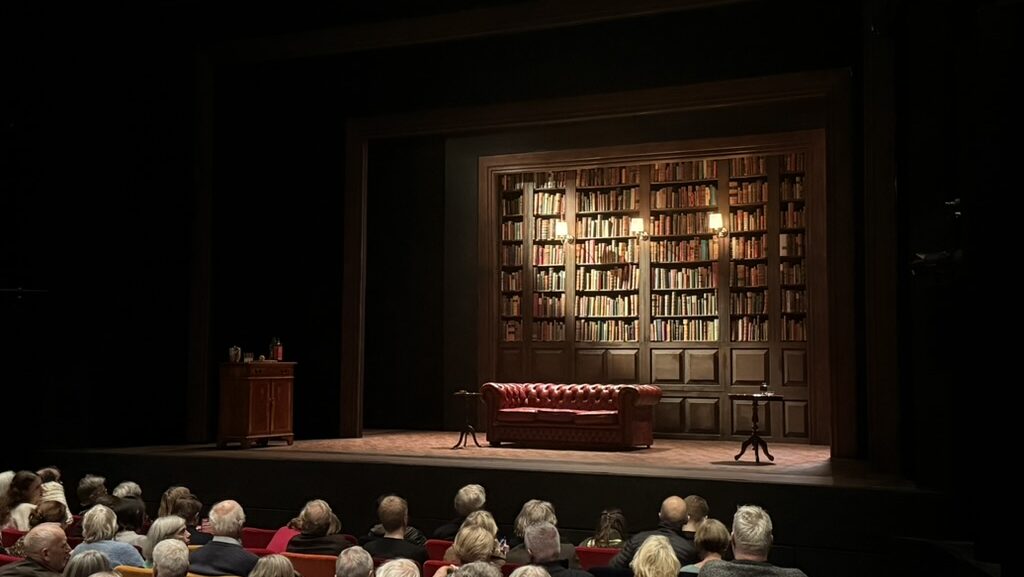
The rivalry between the Labour and Conservative parties in the late 20th century is a key part of British history, filled with myriad characters who contribute to the political sphere. The Gang of Three brings life to the titular characters – Roy Jenkins, Anthony Crosland, and Denis Healey – and their role in the Labour elections throughout the 1970s. This production is an incredible work that takes its audience through time, as its protagonists vie for power against the Conservatives, and one another. At this, it does a remarkable job.
The Gang of Three follows Labour’s leadership elections in 1972, 1976, and 1980, and the protagonists’ reactions to these events. An engaging plot throughout, where, in the words of the characters themselves, “the orchestra may change, but the music stays the same” in the battle for power amongst the egos and loyalty of these party members. It covers key events in this period, including Wilson’s resignation, the decline of the economy, and Thatcher’s rise to power – who was deemed, at the time, “not a real choice”.
Jenkins, Crosland, and Healey had an engaging characterisation, reflective of their actions and their shared history at Oxford, regularly gaining laughs from their audience on this opening night. What I quickly noticed was Jenkins’ – played by Hywel Morgan – speech impediment. A somewhat subtle addition at the beginning, this is a testament to Morgan’s skill in the role, and the attention paid in accurately representing these figures. The same can be said for Denis Healey – played by Colin Tierney – who, even at first glance, looked uncannily similar to the real politician. It is evident to me that much time and thought went into the process of portraying these figures. Tierney’s quick wit, frequent use of French expression, and, most notably, the make-up artist’s rendition of Healey’s (iconic) eyebrows make this apparent.
Meanwhile, I found Crosland – played by Alan Cox – to be the most endearing of this gang, captivating his audience with his both direct and subtle humour. Cox’s delivery had the theatre erupt in laughter at any given moment. From here, he went on to nicely capture Crosland’s ego. Cox did this not only in his delivery, but in his expressions and movements. For example, he sat casually while repeating a story that his fellow politicians had evidently heard on various occasions, as they were able to tell his wartime tales in unison. In particular, in a flashback scene of 1940, Cox replicates Crosland’s schoolboy charm and flamboyance, whilst also providing a compelling backstory to his and Jenkins’ long-time relationship.
One of the key themes of this play is the relationship between Jenkins and Crosland, built from their time at Oxford together in the early 1940s. Even before their shared flashback, Morgan and Cox bounced off one another so naturally to the point where it was obvious that these characters had a friendship of nearly thirty years. In fact, I was left wondering if these actors had a similar relationship themselves – again, a testament to their skill, alongside Robert Khan and Tom Salinsky’s excellent writing. Despite the fact that Healey is then introduced after the audience is brought to 1976, their relationship remains dominant. A smaller detail comes as Healey, at points, refers to Crosland as “Anthony”, while, to Jenkins, he is “Tony”.
More directly, however, their relationship – and its Oxford origins – is addressed by all three protagonists. Healey claims Crosland spent more time with Jenkins at Balliol than in his own college; Healey notes he won Oxford Union presidency on his first attempt, while Jenkins lost twice; and Jenkins and Crosland frequently refer to one another as “[their] oldest/best friend in politics” or as “friends for life”. These notes at their university lives emphasise their loyalty and dependence on each other as they grew into politics and the production shows the end result of this journey. We see their strong bond beneath the irritation and conflict with one another, hence Crosland’s confusion when, at one point, Jenkins storms out in genuine anger. Cox, Morgan, and Tierney also master their schoolboy charm within their performance – with Oxford-related jokes, and drawing lots to decide genuine political strategy.
Nonetheless, The Gang of Three also provides an interesting insight into the politics of the 1970s, and in the wider opinions of Labour MPs. One of the ways that the characters express their political views is in their reactions to their fellow MPs: a groan at the mention of Tony Benn, a scoff at Thatcher, and saying James Callaghan is “far too common” to win the party election. A significant theme throughout revolves around political power. Despite the relationship between the gang, each character enjoyably has egotistical undertones of their individual hunger for power.
Khan and Salinsky put this forward nicely, as, on the surface, the gang advocate for party unity, but Cox, Tierney, and Morgan highlight their ulterior motives through their performance. This makes for conflict throughout, and it is a vastly engaging one, as their political beliefs differ: Jenkins, who “ran the 1960s” with his legislation on abortion, homosexuality, and Europe; Crosland, who believes his 1956 book remains modern and relevant; and Healey, who has no intention of helping the others gain power. The Gang of Three explores this complexity incredibly well, referring to politics as a drug, to which the gang are all deeply addicted to, no matter personal or political allegiances.
The play’s production is also worthy of praise. The passing of time is portrayed convincingly through the radio voice-over and the shift in the characters’ behaviour, to the point where I could believe that Cox and Morgan were genuine university students. The use of the radio in giving context – alongside each character’s internal monologue – is an interesting device, which I feel greatly immerses the audience into the 1970s political scene. Similarly, the lighting is a clever aspect of production. Through the passing of time, there is a deep red light cast over the stage, set to represent the renowned Labour red. However, in the Oxford flashback, this lighting transitions into a famous Oxford blue.
A final aspect worth noting is the humour in Khan and Salinsky’s writing that came from the pure irony of the gang’s discussion of the future. The actors portray these beliefs genuinely, with modern political goings-on being impossible, as they were at the time. While they claim to be modern, they repeatedly come across as old-fashioned, to the amusement of their audience: Crosland insists Europe is “fundamentally settled”; Healey makes a joke at “Gerard Corbyn”; and they agree that there is “no future is tech”.
The combination of these ironic, throwaway comments, the expression of their political beliefs, egotistical personalities, and Oxford-based loyalties greatly compels The Gang of Three’s audience to thoroughly enjoy this truly brilliant performance. In all aspects, this production left me with absolutely nothing to criticise, acting as an exceptional portrayal of this era in British history. While the characters claim that “you’re never bored when you’re drunk”, you will by no means be bored at this show perfectly sober. I strongly recommend immersing yourself into the 1970s through this production, and wish luck to The Gang of Three on the remainder of its run!