
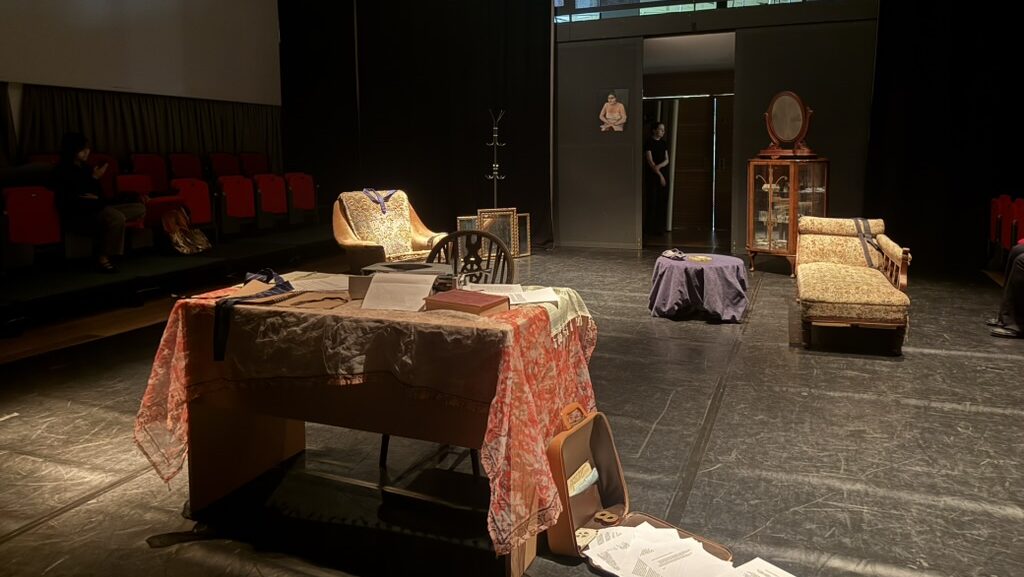
This production of I Am A Camera is nothing short of brilliant and vastly engaging. The show follows struggling writer Christopher Isherwood – the titular ‘camera’ – on the eve of the Nazi rise to power and the beginning of World War Two. This play captures the lives of English, German, and American bohemians through their financial instability and hunger for hedonism. As the inspiration for Joe Masteroff’s Cabaret, this production is an excellent interpretation of John Van Druten’s 1951 play and Christopher Isherwood’s 1939 classic novel, Goodbye to Berlin, bringing life to its characters and energy to such a dark period of history.
The story begins with Isherwood (played by Alex Innes) who, whilst living in Berlin, has procrastinated writing his second novel. This only continues upon his introduction to the iconic Sally Bowles (played by Sally Sheridan), with whom his bohemian lifestyle expands, filled with gin, parties, and passivity in the face of their financial struggles. Throughout the first act, this is developed by the arrival of American hotshot, Clive Mortimer (played by Jack Prior). Prior nicely portrays Mortimer’s American swagger as he offers a glimpse of another life to the protagonists, before his sudden disappearance in Act 2. It is this that leads our protagonists into a deepening spiral, in which they are forced to take a real look at the way they are living. As this unfurls, the audience feels like Chris – acting as a camera – watching the development of these characters in their increasing despair at their situations.
I Am A Camera’s intriguing story is greatly portrayed in this production, and it is a testament to the skill of the actors. Upon leaving the theatre, my friends and I could not stop discussing how well-cast this production was, with such talent that is worthy of significant praise. Sheridan’s interpretation of Bowles matches her renowned dramatism and exaggerated persona. This was obvious in every word she spoke, as Sheridan captivated her audience in every line, as her dialogue was filled with frivolity and allure. Still, I would be remiss not to mention a genuinely jaw-dropping expression of her commitment to the craft: the scene where Bowles makes and eats a prairie oyster. I simply couldn’t tell if Sheridan, alongside Peter Heller (who played Fritz Wendel), genuinely ate a raw egg right in front of our eyes. This is a commitment that showed Sally Bowles truly present on that stage – carefree, joyful, and fascinating.
This portrayal of Bowles contrasted with the character of Natalia (played by Rachel Wadie). Wadie’s impressive interpretation of Natalia emphasised her uptight nature, shown through strict movements, and her interrogation of the other characters on any passing comment. At first, these two characters appear to be so different, and yet, Natalia develops her relationship with Fritz and she confides in Bowles, their discussion eliminates their differences even if only for a brief moment. Instead of characters with conflicting views and lifestyles, at this moment, Sheridan and Wadie portrayed them as nothing more than two girls that needed one another’s advice.
Nonetheless, a most admirable feat was carried out by Heller (Fritz), Wadie (Natalia), and Beth Hunt (Fraulein Schneider); the whole play was performed with convincing German accents. But, not only this, on occasion, their characters slipped into speaking German; for example, Fritz, whilst in a panic, slipped into his native tongue, having forgotten the word for ‘fainting’. This appeared to come naturally to these actors, with detailed pronunciations that immersed the audience into 1930s Germany.
In spite of this, to me, the character that truly stole the show was Innes’ Isherwood. In every scene, he proved extremely expressive and his character demonstrated an appealing charm. Thanks to the costume designers, he came across as a genuine 1930s English gentleman, which was complemented by his style, voice, and behaviours. In moments where subplots took the forefront – such as Fritz and Natalia’s complex romance or the revelation of Sally and her mother’s relationship – his reactions were delightfully charming. While acting as a camera in these scenes, it felt like a real interpretation of Isherwood’s novel, Goodbye to Berlin, as, even when he was not involved in the drama, Innes’ expressions preserved Isherwood’s position as the narrator of the story. Despite Sally Bowles’ allure and romantic personality in this production, Innes made Isherwood the most compelling character, in my opinion.
Similarly, Innes’ Isherwood’s character came across especially well in his interactions with Fritz and Mrs Watson-Courtneidge (played by Isabelle Beck). In reality, Christopher Isherwood was openly gay throughout his life, and this production let that come through without an explicit mention. Beyond Isherwood’s flamboyance, his and Fritz’ shared looks and (close) interactions with one another highlighted this: brief pauses in the conversation, not-so-subtle touches, and their eyes locking.
In regard to Mrs Watson-Courtneidge, despite her somewhat brief appearance in Act 2, her interactions with Isherwood were some of the most entertaining of the show. Both matched each other’s sass, as Beck expressed her character’s disapproval of her daughter’s lifestyle. This then resulted in criticism of Isherwood, to which Innes’ humorously mocked, which marked a transition for Bowles as we understood more of her background. From here, Sheridan shifted from being, in Bowles’ words, “funny and flippant” into replicating Beck’s lady-like persona. Alongside Clive’s disappearance, this provoked a development in the characters’ romantically tragic bohemian lifestyle. The actors took to this nicely, where the final conflict between Isherwood and Bowles marked a clear shift in their relationship. The production’s lighting aided this conflict, as it dimmed when the elements of the story became more serious, as opposed to just playful.
Still, this was not the only shift as we went into Act 2, but also as history began to influence the story. Fraulein Schneider is an embodiment of this, as Hunt’s authentic confusion at Isherwood’s defence of Jewish Germans exemplified. She represents the political tensions within which I Am A Camera takes place, as she rejects Natalia – a Jewish woman, who protests the anti-Semitic riots – and her presence in her boarding house. These tensions were also seen in the set, as the story engrossed the audience from within Schneider’s boarding house, so any reference to this was only in relation to the characters themselves. Isherwood and Bowles were so wrapped up in their own problems – seen in their dismissal of Fritz and his troubles – that the Nazi rise to power could almost be forgotten. Yet, since the Keble O’Reilly theatre has the audience sit around the stage, we also had a focus on what goes on inside the house itself, just like the characters. In this, Isherwood only observes from his window, acting detached from the events, as a self-described camera.
The set itself was, too, exemplary of the bohemian lifestyle: paper scattered beside an open briefcase, the miscellaneous clothing items on the furniture, and gin bottles tucked away in the cupboard. Meanwhile, this was only advanced through the choice of music. I particularly enjoyed the choice of “Puttin’ on the Ritz” – a song about dressing up and acting wealthy, rather than genuinely being rich – after hotshot Clive begins paying for the protagonists’ newly expensive tastes. Likewise, playing “Mack the Knife” at the beginning of the show – a song which premiered in Berlin in 1928 – fully immerses us into this era of history and shows the passing of time.
These specific details of production went hand in hand with the wonderful talent of the cast to create a magnificent performance. In all aspects, I was left without a bad word to say about this production. At the end of the show, my friends and I hardly felt we could call it a ‘student production’ because the talent and stylistic choices felt closer to professional. I strongly recommend seeing this show, immersing yourself into 1930s Germany, and witnessing this skill in action. And, to the I Am A Camera cast and crew, I wish you the best of luck on the remainder of your run!