
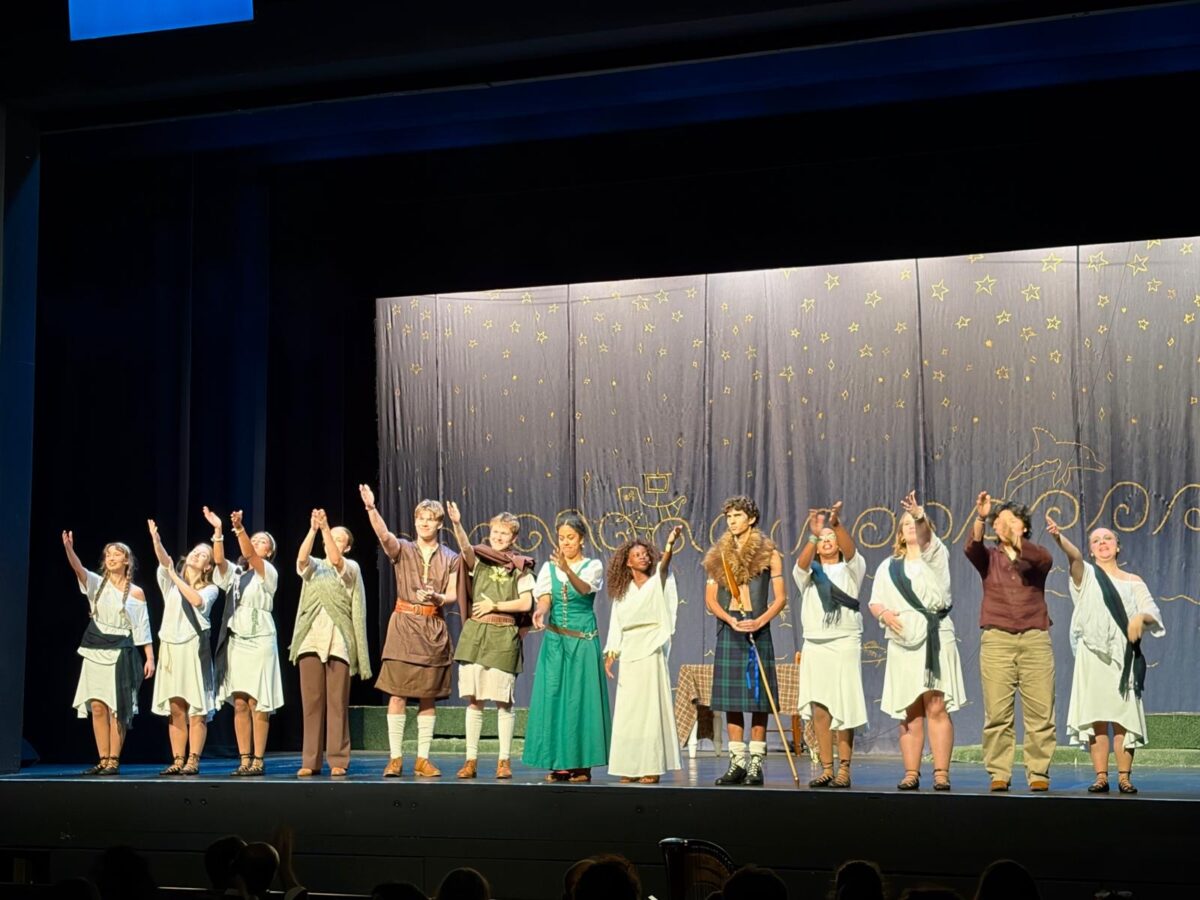
A Greek tragedy meets the Celtic world: the Oxford Greek Play’s production of Euripides’ Iphigenia at Aulis is an ambitious and striking reimagining of an ancient tragedy.
Written in the fifth century BC, Iphigenia at Aulis centres on one of Greek mythology’s most devastating moral dilemmas. The Greek fleet, assembled at Aulis and preparing to sail for Troy, is stranded due to the absence of wind. The goddess Artemis demands a terrible price for its release: Agamemnon must sacrifice his own daughter, Iphigenia. Caught between his duty as commander and his love as a father, Agamemnon must confront the consequences of a decision that will tear his family apart.
The Oxford Greek Play takes this ancient story in a new direction, drawing on the visual and musical language of Celtic Ireland. Tartan costumes, Irish-inspired dress, traditional instruments and an original musical score give the production a very interesting aesthetic, while its new bilingual translation lets the characters move between Ancient Greek and English. It is an imaginative approach to a tragedy concerned with war, national identity, sacrifice, and the devastating choices people make in the name of something greater than themselves.
There is certainly much to admire in this production. Its visual and musical world is beautiful, its performances are frequently exceptional, and, above all, it succeeds in making characters from an ancient myth feel immediate, vulnerable, and profoundly human.
This is especially true for the character Agamemnon. Directors Wally McCabe and Kelly Yu explain their intention to move beyond a conventional image of Agamemnon as an imperialist general, instead examining how a people who feel their culture and values have been threatened might come to justify terrible acts in their defence. Seb Foster’s portrayal of Agamemnon is not only stunning but succeeds in bringing this remarkable vulnerability to the character; Agamemnon is conflicted, emotionally exposed and, at times, sympathetic. This makes the tragedy’s moral questions all the more difficult, because rather than watching an uncomplicated villain commit an atrocity, we are confronted with a man whose intentions and actions are painfully at odds.
Michelle Rodrigues is equally extraordinary as Clytemnestra. Her desperation and maternal grief are utterly convincing; she makes the prospect of losing her daughter feel immediate and devastating. There is such an emotional authenticity to her performance that one almost forgets the distance between the ancient myth and the contemporary stage.
At the centre of this tragedy, however, is Iphigenia herself. Ademide Obagun is exceptional in the role; she delivers her lines with great assurance and simply has the voice of an angel. Her performance becomes particularly powerful towards the end, where she brings an extraordinary strength to Iphigenia’s fate. The final moments are deeply moving, and Obagun makes her character’s transformation all the more affecting.
Tristan Morse is entirely convincing as Achilles, inhabiting the role with such naturalness that it is difficult to imagine anyone else playing him, while James Harper-Jones brings considerable charm and emotional expressiveness to Menelaus.
However, the wider cast deserves recognition too: Grace Yu and Martha Thompson give remarkably strong performances as the Old Man and the Messenger, respectively, and both are actors whose future work I would be keen to see. The Chorus, consisting of Georgia Graham, Becca Harper, Madi Bouchta, Nicole Palka, Clara Woodhead and Sammah Fadalla, is also a crucial part of the production’s visual and musical identity, bringing movement, texture and a sense of dynamism to the stage. The choreography and shifting formations, with performers standing, sitting and dancing across different levels, create some particularly striking stage pictures. Their individual contributions are often especially effective, although some of the collective sequences are occasionally a little less assured. The unison delivery and choreography are not always quite in time with one another, and at points the music threatens to drown out the chorus’s voices. I also occasionally struggled to grasp the emotional force of their passages, even with the subtitles. However, this may also reflect the nature of the material they are given, as well as the considerable demands of coordinating speech, singing and movement across six performers. I would be more than reluctant to attribute these occasional inconsistencies to any lack of individual ability; rather, they seem to be the sort of technical details that could become more assured with further rehearsal. Indeed, there were a lot of moments when the ensemble worked together beautifully, particularly in the final sequence alongside Iphigenia.
Given the ambition of the production, I think it is only fair to consider it with equally serious critical expectations; and frankly, I am left with some questions about the production’s Celtic influences. The visual language is amazing, but I was not always sure how it related to the world of the play. The characters continue to speak of Greece and Troy, while the costumes and musical choices draw on Celtic Ireland. I sometimes felt that the production’s conceptual ambition was more apparent in its programme notes than in the theatrical experience itself. I would have welcomed a little more development of this connection, particularly given how interesting the directors’ underlying ideas are.
Nevertheless, I do very much like the fact that the production is bilingual, with approximately half the dialogue performed in Ancient Greek and half in English. The actors handle the Greek impressively well, and Alexander Lafferty, Evelyn Watterson, and Nathaniel Denton deserve considerable recognition for their work on the translation. As they explain in their translators’ note, their task was to balance fidelity to the original with the need to make the text accessible and natural for contemporary audiences. As someone studying translation, I know of the difficulties they must have faced, and the result is a translation that retains a poetic quality without sacrificing clarity or dramatic immediacy. The fact that the production moves so fluidly between the two languages is a considerable achievement in itself.
If I had one further reservation, it would be that some of the more emotionally intense moments occasionally place considerable emphasis on vocal intensity and volume, when a little more restraint might have been equally, if not more, affecting. The tragedy is devastating not only in its moments of anguish, but in the tenderness and love that make that anguish so unbearable.
Ultimately, however, what stays with me most is the sheer talent and humanity at the heart of this production. From Foster’s vulnerable Agamemnon to Rodrigues’ desperate Clytemnestra and Obagun’s strong Iphigenia, the cast make an ancient tragedy feel immediate and deeply personal. Combined with the ambition of the direction, the beauty of the music and staging, and the remarkable achievement of the bilingual performance, this is a production that deserves considerable admiration. It is an ambitious undertaking, and one that succeeds most powerfully in reminding us that the emotional conflicts of Greek tragedy are not so distant from our own.