
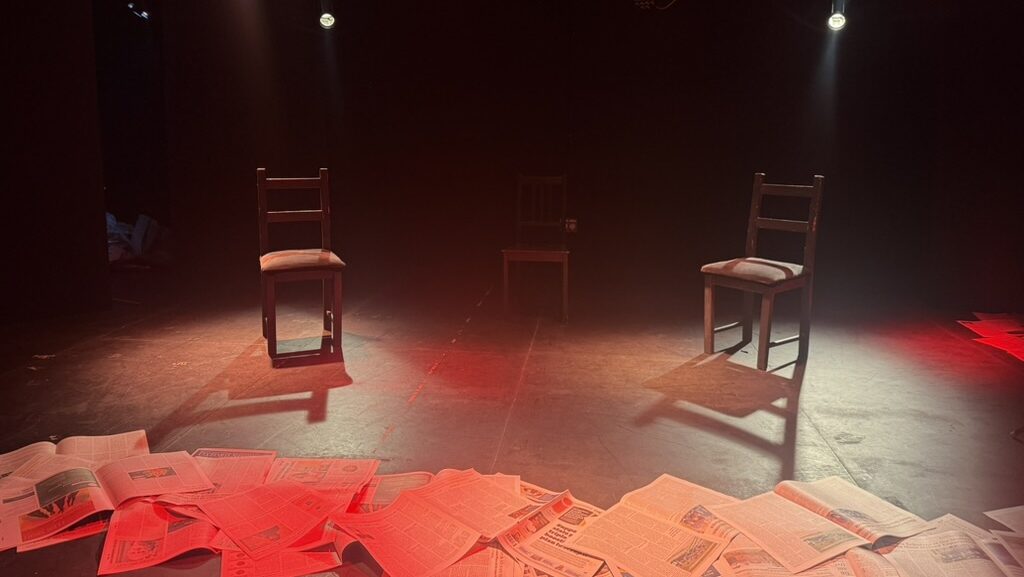
And Red All Over is a genuinely remarkable production, written and directed by Sam Drury, who provided a deeply impressive insight into the modern journalism scene – with all its problems and its triumphs. The show follows the fictional ‘Oxfordshire Chronicle’ in its mission to prevent closure, looking at journalism through both a traditional and Gen Z lens through the protagonists, Jim and Lucy. These characters nicely represent the double-sided coin of modern journalism, and And Red All Over makes its audience question the ever-changing role of (social) media in how we view the world.
The play takes place on Christmas Eve, 2026, in which the ‘Oxfordshire Chronicle’ faces closure. Eccentric ‘traditional’ journalist, Jim Cloud, refuses to admit this fact, in stark contrast with his 25-year-old co-worker (and social media expert), Lucy Shepherd. The audience travels through 36 hours, in which an obsessive Jim and a reluctant Lucy seek the truth within an allegedly ‘boring’ story about the local council and their proposed child welfare reforms. The council cancels measures set to substantially improve child welfare in the area, and Jim takes it upon himself to uncover the ‘real’ reason for this – even where his boss, Clem Kelly (played by Mimi Berridge Shea), deems this vastly unnecessary. This story remains engaging throughout, not least because of Jim and Lucy’s humorous dynamic, but also the gradual reveal of the council’s secrets. I felt as though I was part of an investigative story, immersed in an interesting expression of modern journalism.
One of the highlights of this production was the talent of this group of actors, as the casting of the show’s protagonists simply could not have been better. Jim (Bailey Finch), from his first entrance on stage, caught his audience’s attention and truly stole the show. In his interpretation of Jim, it was clear that there was a master at work, with such a great display of passion and obsession, with his Sherlock-esque, conspiracy ideas. From their archival discovery of the council’s budget to the final divulgence of the council’s emphasis on political reputation over child welfare, Finch proved, without a doubt, to be captivating.
This goes hand in hand with Taeja Dawson-Smith’s portrayal of Lucy, whose talent is evident through her character’s growth. Yet, this is also true in how these protagonists interact with one another. Their relationship follows a classic trope: the ‘traditional’ older man who doesn’t understand technology, and the modern woman who seeks to bring him to the 21st century. Nonetheless, in Drury’s writing, their relationship goes beyond this. They toe the line between who is babysitting who, which only adds to the significant comedic value of the production.
Praise is owed to the costume decisions, as it highlights the characters’ differences; Jim wears a sweater-vest and a trench coat, while Lucy sports a ‘White Fox’ hoodie and joggers. This is the foremost expression of these characters’ diametrically opposed views, which becomes prevalent later: Lucy wonders why Jim reads a newspaper over scrolling on his phone, they debate the book vs. film superiority of Fantastic Mr Fox, and Lucy appears extremely shocked at Jim printing out Facebook pages – which also surprises the audience and triggers an uproar of laughter.
Even so, it is essential to note the role of social media in this story. Not only does it contribute to this generational gap, but also emphasises Drury’s take on modern journalism. While Lucy insists the ‘Oxfordshire Chronicle’ requires 100,000 views to avoid closure, Jim exclaims joy at the prospect of 1,000 people caring about his council report. This is enough for him to set the events of the play in motion, whereas, to Lucy, this isn’t even worthy of note.
Dawson-Smith greatly expresses Lucy’s cynicism, concurrent with her typical Gen Z sarcasm and wit. Her expressions and eye-rolls at Jim’s devotion to the cause are entertaining. However, this makes her character’s growth all the more intriguing. Following several interviews (or, in Jim’s eyes, interrogations), Jim and Lucy come into conflict over both the methods and the relevance of journalism. It is Jim’s obsession in the name of a (believed-to-be) pointless cause that brings her to the question, “What’s the point of journalists?”.
Before this, Drury presented her character as not being fond of children, nor wanting to fight for change. Yet, following a visit to her mother, Gloria (played by Calypso Lewis), and a neighbour’s young son, her view is substantially changed. Here, she discovers Jim’s tragic backstory regarding his drunkenness and his family’s reaction to it, which ultimately changes her attitude towards him. Meanwhile, her interactions with the neighbour’s son, Ozzy, mark a new perspective entirely. It also highlights an excellent production choice, in which Ozzy’s voice is shown through chimes and music tones, expressing the babbling and joy of childlike whimsy. I enjoyed this thoroughly. It really seized my attention, being both a wholesome stylistic choice and relevant to advancing the story.
Here on out, Dawson-Smith makes an evident shift in Lucy’s behaviour. At this point in the story, Jim hands over the baton to Lucy, as he starts drinking again and removes himself from the investigation. She, in turn, starts to mimic his earlier actions: she becomes proactive, interrogates key politician Nina Radalescu (played by Isabel Wright), and actually uses paper documents – mind-blowing, right?
This struck a chord on the emphasis on what journalism is really for. By the end, both Lucy and Jim remind the audience that journalism is truly there to help people by telling them about what they uncover – in this case, the council’s corruption. It contrasts significantly with Lucy’s earlier beliefs, where she ‘reports’ on celebrities (most notably, Jeremy Clarkson – repeatedly), and only thinks about views, Search Engine Optimisation, and glamour in articles. On the other hand, Jim focuses on truth and justice, accepting its occasionally uncomfortable and vulnerable nature.
In And Red All Over, we don’t see the Gen Z focus on social media, nor the care about feelings in any and all situations, especially not in Jim’s interrogation. Instead, we see the pursuit of ‘real’ journalism, as Jim makes teacher Esme (played by Mimi Berridge Shea) upset, receives a stark ‘no comment’ from the council’s press officer, Lisa Carlyle (played by Emma Liang), and is refused the truth by councilwoman, Nina. He prioritises these efforts over saving the paper, as Lucy did, to the point that it becomes mentioned in passing. At least, to me, I almost forgot that this was even a worry, as Finch’s erratic investigation involved me fully into any slight hint or revelation. As this dawned on me, I realised just how impressive the writing is to have drawn me away from one central conflict into another.
Additionally, I would be remiss not to mention (and applaud) the production of this play. The music and sound choices, especially, added to the quality of this play; with Tubthumping – “I get knocked down, but I get up again” – after the rejection of Jim’s council story, or an investigative overture when Jim’s theories prove to be true. Not to mention Ozzy’s vocal chimes, which comedically hit a low note after a failed cartwheel. These aligned with the regard given to the set. It was incorporated into the story as archives, through which Jim and Lucy dive, since a variety of newspapers are scattered across the stage.
Ultimately, Drury’s writing certainly awakens the audience to ‘real’ journalism, and this is something I greatly appreciate. It tackles the problems of 21st century journalism, and its relation to the growth of social media. The writing went far beyond a student production, with an expert approach to the themes presented. Jim saying to Lucy that all newspapers are dying, but some are “dying very slowly indeed” really spotlights this change in the times. And this is a change that is embodied by the play’s tragic end: the closure of the newspaper. Despite efforts to prevent this, my friends and I, on leaving the theatre, agreed that this was such a tragic fate because it is a real one.
And Red All Over is an extremely enjoyable production, with meticulous details and expressions of modern journalism that wholly engage a 21st century audience. Drury’s writing, accompanied by the melancholy final scene, brought its audience both to laughter and to tears. I can do nothing more than praise and strongly recommend this incredible production. To its cast and crew, I wish the best of luck on the remainder of your run!