
“Let’s try and understand each other” is a seemingly straightforward suggestion in Lillian Hellman’s play, The Children’s Hour (1934). However, it seems that Helmen’s array of complex and often apathetic characters shows that true understanding is near impossible. Indeed, it is constantly complicated and sometimes completely neglected. This sentiment flourishes in the meaningful and moving adaptation by Silly Snails Productions of The Children’s Hour, running at The Michael Piltch Theatre.
Set in an American boarding school for girls, Hellman’s play explores the effects of gossip and manipulation, the covert subject and scandal of lesbian relationships in the 1930s, as well as the use of power – and how it is sustained by lies and deceit. Even though the play was received well upon premiering, it challenged the zeitgeist of the time through its nuanced themes of same-sex love; and, today, it resonates with its audience through the theme of belonging, whilst also speaking to the ever-present obstacles that non-heteronormative relationships still face.
The opening scene of The Children’s Hour is an ensemble tableau, where the girls in the boarding-house are playing, jesting, and bickering – the fluidity and relaxed interplay of the characters immediately suggested that the following scenes would be captivating and cohesive. And, luckily, I was not disappointed.
The play initially follows the young and mischievous protagonist, Mary (played by Zoe Lim), who is gradually caught in a web of her own lies, and persistently negligent of the devastating consequences that even the most sporadic and flippant of rumours can have. Lim effectively conveys Mary’s excessive need for attention; her convincing portrayal leaves the audience irritated and shocked by her influence and manipulation of the other girls. Even at such a young age, she seems unhappy and dissatisfied, a characteristic that resonates throughout her portrayal; despite her harmful lying and gossiping, we pity her naivety and her innocence. All the girls – Rosalie (Nayana Crowe), Peggy (Kaiden Roque), Agatha (Anne Hensley Young) and Evelyn (Xinmi Zhou) – rendered idiosyncratic but truly childlike characters that were equally naive and vulnerable.
These children contrasted the self-indulgent Mrs Mortar (played by Daphne Husson), whose vanity and aspiration to act was intensified through her exuberant blue dress, pearls, and fantastic faux-fur jacket in Act 3. Moreover, Husson, alongside Hensley Young, who played the gossiping maid, also offered comedic relief which was well needed as a contrast to the dramatic, question-filled interrogations in Act 2. In general, her performance alongside Mrs Tillford (played by Izzy Goldberg) provides a portrait of a self-interested woman, who, although not acting maliciously, often lacks empathy. I enjoyed Goldberg’s poignant monologue towards the end of Act 2; we hear her on the phone, and are given a personal insight into her overwhelming sense of ‘duty’ to act on Mary’s gossip – to act in a way that she justifies as best for the children. This example acts as a facet of Hellman’s multi-layered character profiles, which Silly Snail Productions nicely emphasises in this production.
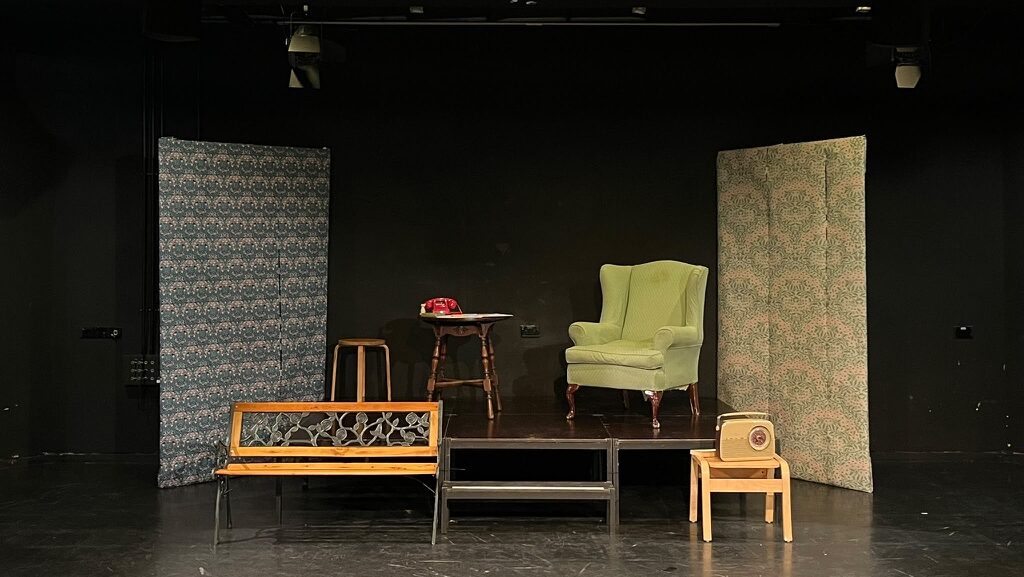
Martha Dobie (played by Elouise Wills) and Karen Wright (played by Mayah Savjani) were incredibly compelling. I especially thought that Wills’ raw and heartbreaking performance in Act 3, in which she confesses her true romantic love for Karen, was devastating as she pleads, “I am guilty!”. We witness her courage, but also her shame and her guilt as she comes to terms with the truth of her love during a period where it was not accepted – what a truly powerful moment captured by these actors! Wills’ transformation and descent into sadness were contrasted by Savjani’s beautifully quiet pain and confusion. I particularly liked the static radio that opened the more vulnerable scene between Martha and Karen, as Martha turns it off to silence. I thought that the light and sound worked harmoniously to create rising tension, but I felt this worked more effectively than aesthetically.
The set was relatively minimalist and naturalistic. A particular strength was the raised platform, varied levels, and use of the bench, which worked well in complementing the power balances within the school system. I similarly liked how the armchair as a nuanced symbol of control: for example, Mrs Mortar sits in the armchair commanding the children, and this parallels Mary who likewise commands Peggy and Evelyn. However, in a couple of scenes, I felt that the characters’ reactions to emotionally intense moments were a little static. For example, the scene in which Rosalie and Mary confess in Mrs Tilford’s house which could have been enriched by making greater use of the set. Regardless, the ensemble moments brought together the generations very seamlessly, from the set through to the dialogue, which led an audience to question who relishes the power, who neglects truth, and how age does not negate morality.
The word “unnatural” recurs in Hellman’s play; it is used to perpetuate the homophobic rhetoric of Mrs Tilford, and also used to describe Martha. This production highlights this exclusionary and judgemental society through language and action, which, although upsetting, is so important. This play is thoroughly effective in making us think; it gradually reveals the truths behind its characters’ seemingly dissonant but deeply personal relationships. There is an irony, however, as the “silly secrets” that the children circulate hold such weight and truth, and ultimately deeply affect other characters and their lives. I thoroughly enjoyed watching The Children’s Hour, and I was struck by the cruel injustices of uncommunicative and blunt mindsets and the influence of others – be that children or adults. I can only congratulate the director, the cast, and the crew for this remarkable and exceptional adaptation.