
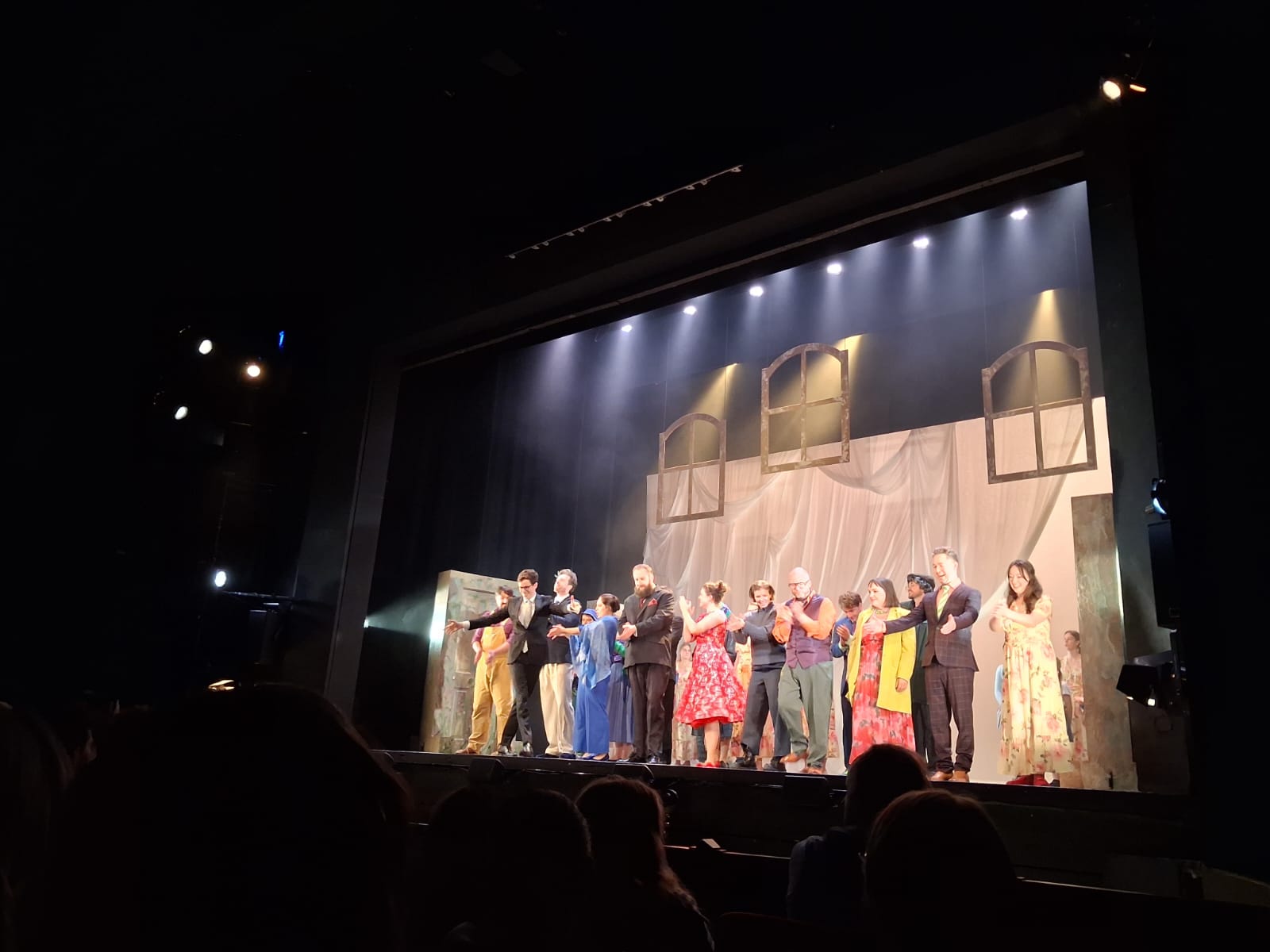
Oxford Opera’s latest Marriage of Figaro is a production concerned with immediacy. Sung in George Robarts’ English translation and staged by various talented individuals, Mozart’s familiar comedy feels strikingly direct. The translated text makes the characters’ exchanges understandable, but it is their gestures and expressions that give their relationships a lively operatic presence. From the opening mime to the final reconciliation, this is an opera in which singing and acting are rarely separable. And, ultimately, its greatest successes come precisely when the two become one…
Writing to his father in 1781 with his plans for his other opera Il Seraglio, Mozart commented that, ‘As we have given the part of Osmin to Herr Fischer, who certainly has an excellent bass voice… we must take advantage of it, particularly as he has the whole Viennese public on his side’. At first glance, this quote follows a logical train of thought: Ludwig Fischer was a popular bass during his time, and so including him in an opera almost guaranteed an enticed audience awaiting to hear him once more. But what does this show us about the operatic singer themselves?
With this question, it is made apparent that Mozart’s utterance is not quite what it seems. Rather, it reveals something that is poignant to this very day: the voice, manifested in the duality of the singer-actor, is the heart of the organism that we call opera. Chemistry, tension, drama – all embodied within this minute agent. Yet, it makes all the difference.
Nowhere was this felt more than in Oxford Opera’s take on Mozart’s Marriage of Figaro, which had the audience enraptured by the lure of the voice. So much so that even in the mimes of the characters in the opening overture, the voice’s absence felt like no absence at all. Rather, the buzzing, electric energy created by the brilliant orchestra provided an animated voice that set the scene for the ensuing drama.
As the audience adjusted to the effectively simple background drapes and doors that were to be the setting, the English rendition of Figaro’s aria ‘Cinque, Dieci, Venti’ as ‘One foot, Two foot, Three foot’ was delightful. It established the production’s playful English vernacular, making the domestic comedy feel truly genuine. Hugo Herman-Wilson’s Figaro responds in kind: his gestures and physical ease make the translated text feel less like an English substitute than the natural language of this particular Figaro. In the subsequent aria, ‘If You Would Like to Dance’, that union of word, voice and movement becomes still clearer, as Herman-Wilson turns Figaro’s challenge to the Count into something simultaneously musical and theatrical.
It is after this that Marcellina and Bartolo burst onto the scene, donning their stark, jarring, colourful outfits that seemed oddly suited to the characters. It was a welcome contrast to Figaro and Susanna’s costumes, which were unfortunately slightly too formal and out of place. Furthermore, the production’s emphasis on physical comedy was less convincing in its treatment of Cherubino. In ‘his’ later introduction, played by Gabriella Giulietta Noble, ‘his’ beautiful soprano voice and the womaniser personality that was trying to be portrayed often seemed oxymoronic, relying on (at times) exaggerated actions. Here, the voice and body seemed to be offering competing versions of the character, as opposed to completing one another. Regardless, listening to Cherubino’s voice was a pleasure that was not to be taken for granted.
But perhaps the best part of the entire opera had to be in the beginning of Act 2, when the Countess’ original ‘Porgi, amor’ is heard here as ‘Sigh No More’. Nikolett Mraz’s (the Countess) angelic soprano voice dominated the stage, hooking the audience on her every word. As a brief moment of tender longing amidst the opera’s whims, it was perfect in every single way.
It was also pleasing to hear the trio between Susanna, the Count, and the Countess afterwards in this act. Despite the fast-paced nature of the scene, the voices complimented and meshed well with each other as equals. It is here that we witness the entry of Antonio, the gardener. Aaron Holmes (Antonio) does an excellent job with this, adding freshness and lightness to the company before him with this accented singing and drunken semblance.
This freshness almost continues in the duet between the Count and Susanna after the interval in the third act. Yet the main aspect that shone through in this duet was how phenomenal Jack Holton (the Count) and Rachel Speirs (Susanna) were as actors, heightened only by the Count’s later aria as he brings a sense of power and force beyond his voice. As various other characters enter the scene, culminating in the famous point where Marcellina is discovered to be Figaro’s mother, the charm, lightness and wit of this moment was nothing short of magical. It is a decision well made and executed by the actors. From their facial expressions, to their actions, to the Count’s funny frustrated ‘buffo’ interjections, it was a scene that incited much joy and laughter.
As these episodes effortlessly led up to Act 4, darkness for the first time shrouded the stage, bringing forth Barberina and her fantastic aria from its mysterious midst. Everything about this aria was executed perfectly, as the terror of losing the pin was complimented in Erin Alexander’s (Barberina) aghast expressions, creating a sense of real panic. In stark contrast, Rachel Spiers’ (Susanna) sweet ode to the hidden Figaro in the subsequent aria softened this frantic anxiety into a tender outpouring of love, leading gracefully onto the ensuing scenes and the opera’s ultimate finale. The only point of contention, for the entirety of the opera rather than in just Spiers’ aria, is that there was a tension between the volume of the orchestra and the singers. At times, there really seemed to be a battle between the two, with the latter not necessarily winning all the time…
What ultimately distinguishes Oxford Opera’s Marriage of Figaro, then, is not simply that it gives Mozart an English voice, but what its performers were able to do with that voice. Robarts’ translation brings the comedy closer; the production’s physicality gives it momentum; and the cast makes the distinction between singer and actor disappear altogether. Mraz’s tender ‘Sigh No More’, Alexander’s terrified Barberina, Herman-Wilson’s irrepressible Figaro, and Holton’s commanding Count succeed for various reasons, but each show their character being created simultaneously through sound and presence.
Mozart’s remarks about Ludwig Fischer consequently acquire a particular resonance. To ‘take advantage’ of a great voice is not merely to give a singer impressive music to sing. It is to recognise what an individual performer can make that music become. Oxford Opera’s adaptation is most compelling when it trusts this alchemy: familiar music, newly immediate words, and singers capable of turning both into living theatre. Bravo, Oxford Opera!