
Content Warning: contains mentions of suicide
What are your associations with an ‘empty packet of cigarettes’? Maybe graphic photos, rubbish, or perhaps even slight disappointment. In all eventualities, I’d say relatively confidently that your answer would not be your life. Yet, in Lighthouse Productions’ new adaptation, based on Simon Stephens’ translation of Anton Chekhov’s The Seagull, life is painted as equally hopeless as this.
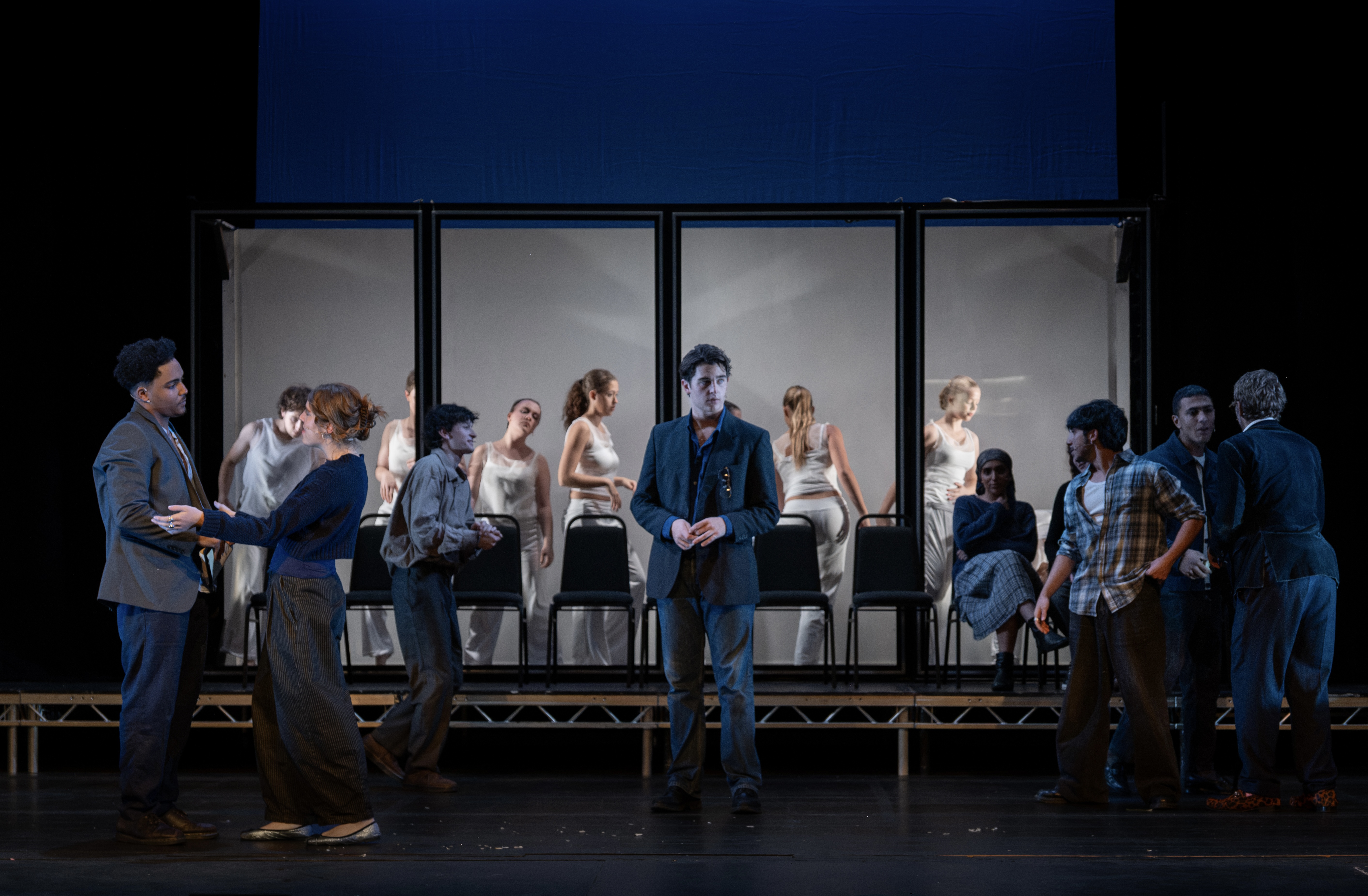
In a spellbinding and shocking interpretation of Chekhov’s work, this adaptation emphasises the timelessness of human egoism, unrequited love, and the tragedy of apathy, which is all shown through the lens of a persistent, innate bleakness. Chekhov’s The Seagull focuses on the loneliness of life, as he illustrates a series of interwoven, but wholly unsatisfactory, relationships. Rooted in a modern-day setting, Lighthouse Productions’ vision is creative and clever. Director Alys Young uses the vast playhouse stage to her full advantage; she creates moments of quiet intimacy, but also chaotic character filled tableaus – illustrating the web of discordant relationships and the characters equally selfish attempts to kindle love and acceptance.
Lucian Ng’s soundtrack is utterly disturbing and completely absorbing; it retains moments of real beauty that complements the rising action in the dance scenes. The austere, fragmented and discordant string refrains mirror the desperate tension and destabilised characters. It is a testament to Ng and the pit band that I found myself gradually blindsided by the creeping soundscape. There is a beautiful connection between the set, the lighting, and the sound that really enhanced this adaptation. Max Antoniou’s design centres around a large glass box divided by often colourfully lit frames – this corridor allows the characters to appear on stage in the backdrop, becoming distanced from the action. In a technique that worked very effectively, I particularly like the beautiful, symmetrical framing of the scene between Nina (Danya Griver) and Konstantin (Ezana Betru) towards the end of the second half. Kit Rush’s puppet Seagull further complements the minimalism of the set and the tenderness of their relationship. Admittedly, my one small critique of this brilliantly executed set is the smaller stylistic choices – I felt the additions of the chaise longue and the bare pillow were a little discordant. Regardless, the set works evocatively as a stark contrast to the fluidity of the dancers, where Anya Fuller’s choreography transports us into a visual dreamscape.
Rather ironically, given that most characters either desperately loved unrequitedly, or disliked one another entirely, the cast of The Seagull united harmoniously in their interactions and every actor clearly had true passion and devotion for their characters. The comedy of The Seagull really shines through in this version; Leo (Ediz Atilla Ozer) and Marcia (Georgina Cotes) create portraits that are both engaging and darkly funny. Moreover, I could genuinely be persuaded that Peter (Alexander Lloyd-Elliot) was actually 80 years old rather than 60; not only because of his dedication to his trusty cane, but also in Lloyd-Elliot’s total embodiment of Peter’s fragility. Lloyd-Elliot’s performance was captivating and despite both snoring and singing, I thought his character was one of the few that offered sympathy to Konstantin. By contrast, Simeon (Cohen Rowland) was comical in his subtlety – in his sunscreen session by the lake especially, and his truly awkward disposition. Rufus Shutter’s convincing portrayal of Hugo is carefully considered, he offers comedic relief but also profound reflection – for instance, he compliments Konstantin’s play and, in turn, highlights his true and nuanced appreciation of art. I would have liked to have seen his relationship with Pauline (Sanaa Pasha) explored further; despite being brilliant, her character, alongside the recurring stagehand Jacob (Esmer Somerside Gregory), was somewhat overshadowed by the sheer time given to the protagonists.
Griver’s portrayal of Nina is entirely compelling – her transformation from a naive, but happy, girl into a broken, hopeless woman is emotive and tragic. Her unfaltering delivery transforms Chekhov’s traditionally famous motifs, such as the moon and the lake, into an embodiment of her romanticised and idealised view of life. Konstantin’s (Ezana Betru) monologues are extremely moving, and his first suicide sequence alongside the dancers is visually immense despite being completely heartbreaking. In the second half, his return to a vulnerable, childlike state in his mother’s arms is a testament to his range as an actor. Rowan Brown’s portrayal of Irina was incredible; in just one scene we are compelled from sheer irritation and loathing of Irina as a neglectful mother to almost sympathy and understanding for her as a woman. Irina’s cruelty, vanity, and comedy alongside her simultaneous necessity to be loved is exceptionally balanced by Brown. Her emotional scene shared with Samuel Gosmore, who superbly played the sleaze-bag writer Hugo, was the epitome of tragedy and reveals another side to the obsessive artists in Chekhov’s play. Chekhov leaves us unable to work out why and even whether we feel sympathy for these self-centred characters, captured through their genuine and gut-wrenching performances.
The costumes shine as they reflect the façades and idiosyncrasies of the characters; for example, Irina’s blue evening gown shows her self-indulgence and Simeon’s rolled sleeves and shorts emblematised his quirkiness. Nina’s costumes – the blue trim in her flowing skirt as well as her polka dot dress – feel both like a nod to Chekhov’s lake motif and also a continuation of the recurring blue lightning. As the scenes unravelled, there was a slight dissonance in how the characters were presented on stage as some costumes changed and others didn’t.
Even though I felt a few of the scenes were quite long and dragged in moments, Young imbues this play with a radical new sense of life. It was shocking and it was tragic, yet it held onto an intense appreciation of art and theatre through the set, the costume, the performance and Chekhov’s themes. This production captures a poignant portrait of the mundanity and circularity of self-indulgence and jealousy, questioning the purpose of life and the importance of listening and understanding. The Seagull is incredibly bleak, but this bleakness is contrasted by both uplifting comedy and despairing tragedy. It is an incredible, intimate depiction of complicated people misaligning and misunderstanding each other, whilst they navigate the effects of their unsatisfying lives. Walking out of the theatre, I was struck by this detailed and thoughtful portrayal of Chehkov’s The Seagull and I can only applaud Young, the cast, and Lighthouse Productions, for this brave, mesmerising adaptation.