
How developed is your frontal lobe? I’ve been to Rozana’s in the Covered Market so many times since the start of term that they now remember my order (falafel box, no vine leaf, no tabbouleh, all the salad – in case you were asking), and my Fanta lemon/Marlboro Gold addiction (depending upon whether it’s before or after lunch) is becoming more crippling by the day. It’s okay, though, because my frontal lobe is still developing. In first year, the man in Rozana’s also had my dietary requirements down pat, so I’m making progress, at least. And I’m only 21, so I’ve got another four years’ worth of bad decisions before I have to lock in… right?
The science behind the frontal lobe is slightly more complex than this, of course. My friends and I joke about it all the time; one guy I know maintained before he turned twenty-five that, come that fateful day, now a couple of months ago, everything would click into place. I should check in with him on that one. But behind this lightheartedness is a veiled reminder that we are, perhaps against our will, growing up. The truth of this looms larger than life to a fourth-year returning to an Oxford devoid of familiar faces and customs, where Plush is suddenly in (?!) and Waterstones is now a Mountain Warehouse (still baffled by this one), where a decent chunk of my friends have already sold their souls to the corporate machine, another chunk are applying to do so, and all are coming to terms with a new year and an even newer dynamic.
The idea for this column came to me, as all good ideas do, in the shower of my studio flat in a tiny town in the south of Germany. I had a lot of time to think (it was a sehr tiny town, ja) and got to mulling over how I could flesh out in writing some of the disparate musings my friends and I have on growing up in the modern world. Facetiously, but also somewhat seriously, what do we talk about that shows our frontal lobes are developing?
A day later, I attended a talk by the German author Julia Franck, discussing her new book on the poet Rilke and his last love affair. One thing she said in particular stood out: although the woman, Baladine Klossowska, was certainly more ‘down bad’ than her lover, she didn’t love the person of Rilke so much as the author. She was in it for the intellectual stimulation; she liked to read him. Although Franck was referencing in this case her enjoyment of the poet’s works, the use of the word ‘read’ got me thinking about how we so often use literary metaphors to describe our relationships with people. Someone can be an ‘open book’; you can ‘misread’ someone; if you are incapable of hiding anything from someone, they can ‘read you like a book’.
This is not just a modern idea. The notion of using reading as a metaphor for the interpretation of people has been around since at least the Middle Ages. Devotional authors like Margery Kempe and Julian of Norwich used to ‘read’ images of Christ’s body and his gaping wounds to help them interpret him and his story better (they take the metaphor too far and start wishing they could get inside the wounds, but we don’t need to go there). Or, in medieval saints’ lives, such as that of St Aethelthryth, the female body is an object to be read, translated – the word used to describe the transportation of a dead saint’s body to its final resting place – and written down by others.
This reading to translating to writing matrix as a way of analysing people can of course also go wrong. The metaphor engenders the possibility of misinterpretation, of misreading someone. I’ve been tackling the start of term head-on with a daily fix of my new favourite coping mechanism, Sex and the City. When Carrie and Big get back together the first time (I would mark this as a spoiler alert but I fear it is so predictable that it would be an insult to anyone’s intelligence), she drastically misreads his character and his intentions, mistranslates them to her disbelieving friends, and in doing so writes a new version of him that does not reflect the truth of his nature. This is a more extreme example of the universal truth that a person can never truly be an open book. How do we read those around us? I see a side to my best friend that others will probably never have access to; neither better nor worse, just different. Our relationships with others are only ever the sum of our shared experiences; a facet of their personality may never become evident to us if we never find ourselves in the position to view it.
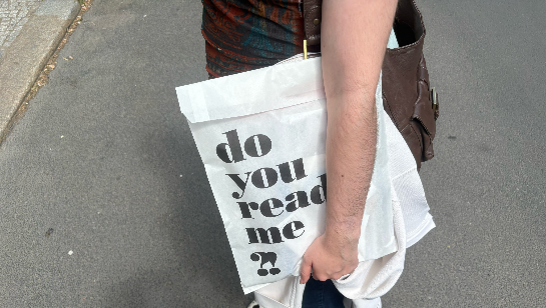
I’ve just come back from a year abroad in Berlin. A staple of its artsy I-drop-forty-euros-of-daddy’s-money-on-a-zine set that anyone hailing from East London will be familiar with is the bookshop ‘Do you read me?!’ (merch modelled lovingly by a friend). The answer to this question is obvious if you’ve got to this point (how meta), but perhaps, to finish, one word should be added: How do you read me?
Writing a column is a bit exposing. In sharing a little of my life, I open myself up to any number of readings. What if you don’t like what I write? How will you mentally translate my writing? What if you misread me? These thoughts, while daunting, have a flip side: What if you do like reading me? What if everyone reads me differently and interprets me in a manner relevant to their own experiences, to their own conversations with friends? The idea is both frightening and alluring. I can’t wait to dive in.