
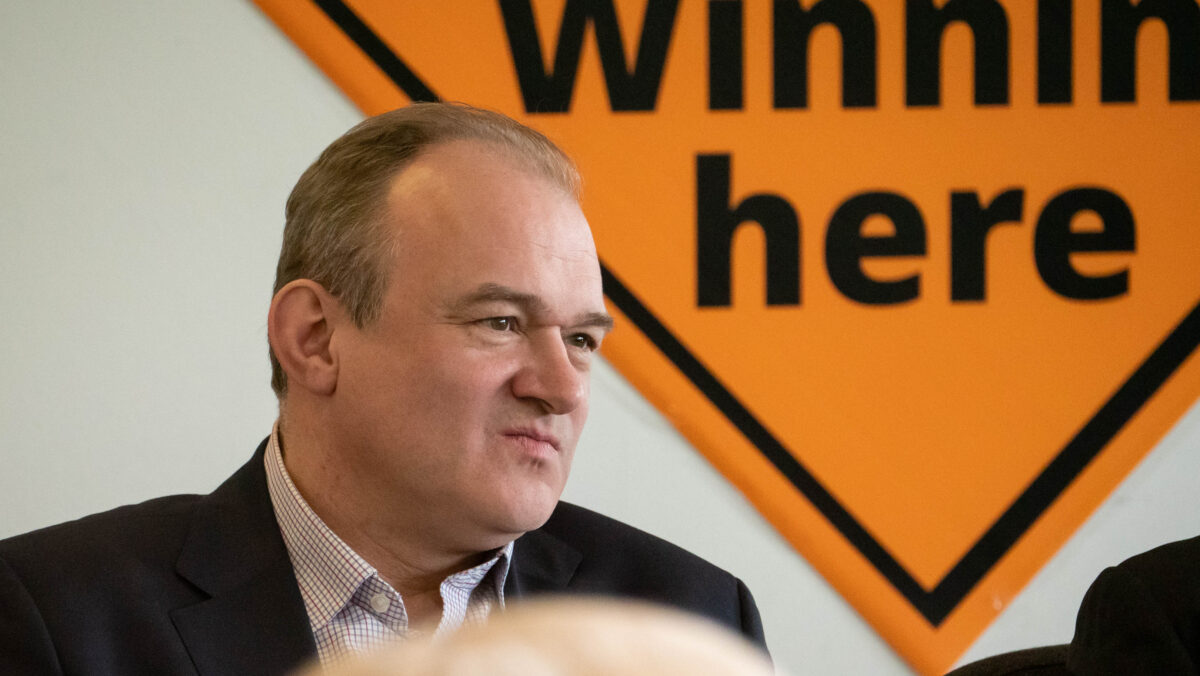
In the 1906 General Election, the Liberal Party achieved a landslide victory with an increase of 214 seats, wiping out the Conservatives and unseating Prime Minister Arthur Balfour in the process. Flash forward to 2024 and many of the same conditions were present – a crumbling Conservative government, an economic crisis, concerns over Britain’s place in the world, immigration protests, and a country desperate for change. The Liberals, now the Liberal Democrats, gained their best result since the merging of the two centre parties (the Liberals and the Social Democrats) in 1988, of 72 seats. Yet, two years later, the Liberal Democrats have entered into a political no man’s land: not in catastrophic collapse, not in the ascendancy. The most apt conclusion might be that they just exist, inoffensive but also ineffective.
The Liberal Party of 1906 obviously was not the same as the Liberal Democrats of 2024. Britain has since been through two world wars, multiple economic crashes, decolonisation, Thatcherism and the tech bubble (with a World Cup victory along the way). Ed Davey is no Henry Campbell-Bannerman, nor would he wish to be. The role of nostalgia in British politics – and its dangers – is a whole other discussion. The Liberal Democrat party of today is stronger, more united, and by all accounts a much kinder place to work when compared to some of its rivals. By traditional metrics, Ed Davey and his team have done an admirable job rescuing the party from seemingly total degeneration.
With three ineffective leaders since the almost Shakespearean fall of Nick Clegg, the Liberal Democrats have found themselves in a profound identity crisis. The last of these, Jo Swinson, proved so inept at providing a clear national vision that she suffered the same fate as Balfour when the party was left with a mere eleven seats in 2019. By contrast, Davey has been in position for over six years. But longevity cannot equal effectiveness, and there are mutinous rumours that the party might have to get rid of “nice guy” Ed before the next election. Presumably, they would seek to replace him with a more charismatic leader of liberalism, as Labour has done. Someone who does not have to (attempt to) windsurf on Lake Windermere or bungee jump in order to attract the media’s fleeting attention.
Why then is the party noted more for punchlines than policies, more for stunts than stances? In an interview for the BBC’s Sunday with Laura Kuenssberg on 20 September 2026, when Davey was shown a cloud of words frequently associated with the Liberal Democrats, the adjective “pointless” was heavily featured. In a recent episode of Saturday Night Live UK, the presenters refused to joke about the party conference in Brighton, on the grounds that there was nothing of any substance to mock. An astute reader might well ask whether the “centre ground” even exists anymore, politically and personally. Is it possible to be “neutral” in a culture war? If everybody is assigned a side, a community of supposedly like-minded souls and an easily identifiable enemy to fight from birth, is there really anyone left in the centre?
In this six second society, where friends can be made and wars can be started from your phone keyboard, the “local champions” promoted by the Liberal Democrats serve a reduced purpose. Arguably, the 21st century is a liberal paradise. The Internet has allowed for an “add-to-cart” mentality, where consumerism and free speech are blossoming. You can see everything, say anything, and be anyone – all from the comfort of your bedroom. The once vital role of MPs as representatives for minority groups has been altered. Now, these groups can represent themselves as well as any elected official. Such is the argument – that liberalism has finally reached its sell-by date.
However, that optimism, primarily conservative in origin, fails to do justice to liberalism, specifically the Liberal Democrats. True, more people can share more opinions and reach a wider audience, but they are able to exercise those rights securely thanks to liberal thinking. Liberalism isn’t just an excess of rights, but making sure that those rights which have been gained can be exercised in safety. This is what the Liberal Democrats do, behind the allure of the camera.
Look past the “pointless” stunts, and a party of precaution shows itself. Ed Davey and his team were outspoken on the risks of AI long before any of the other major parties. They have kept support for Ukraine in UK political dialogue, even when Parliament and the media was completely consumed by the situation in the Middle East. Regarding domestic policy, Davey has argued for an overhaul of the unpaid care system and mental health, but stated, reasonably, that such changes cannot be implemented until the finances are considered. Minorities have consistently been treated with respect in Davey’s tenure, perhaps not at the forefront of representation, but never as political footballs.
The Liberal Democrats of today may be sidelined and laughed at, but they are not “pointless”. The assumption is that if the centre is not visible, if the middle is not glamorous, then it does not exist. On the contrary, the centrist parties work hardest of all, attempting to represent all points of view and treat everyone with respect. “Nice guy” Ed will never be Prime Minister, and may not even lead his party to the next election. But in this increasingly polarised world of slogans, slurs and soundbites, isn’t a “nice guy” what we need?