
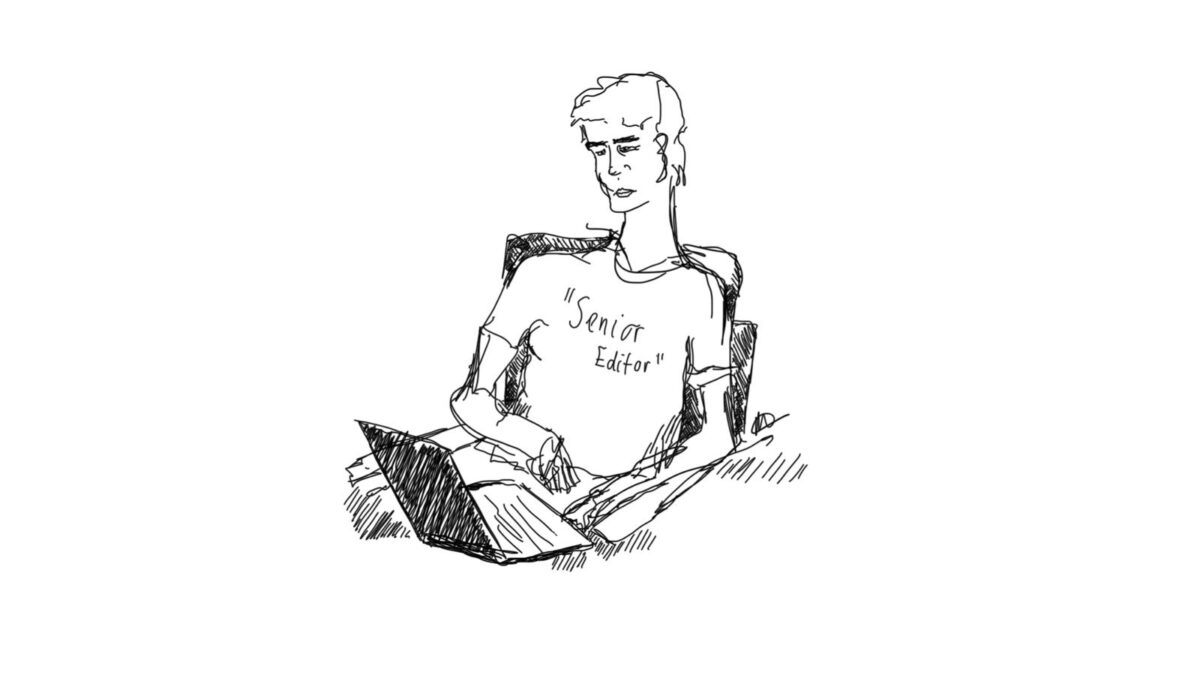
I was promoted to Senior Editor of The Blue this term. Nobody has explained why, and I have been careful not to ask. That much is true. What follows is not. The core voice used and pieces / people mentioned are caricaturised and completely fictional.
Greetings, reader. Through this column I hope to relay a taste of my extreme trials and tribulations as a Senior Editor of a student newspaper. This first instalment takes you through my ‘in-tray’; the pieces I receive to edit and publish. Be warned, I shall survey the good, the bad, and the ugly. Make no mistake, my job is an arduous one that I often approach with the utmost trepidation. I have selected two excerpts from my large and incredibly taxing pile produced by my underlings, two excerpts that clearly demonstrate the right and wrong ways to go about student journalism. But by far the most benefit will be found, I’m sure you’ll agree, in my attached editorial musings.
Exhibit A: The Right Way
Opinion: Why the Patterns Mown onto the Grass Outside the Radcliffe camera are Elitist
The Rad Cam. Let’s talk about it. You know it. You love it. I hate it.
Partially excuse the bombast of my words. I sometimes find myself hopelessly impassioned when dealing with this topic. Yet my artful, and hopefully alluring, use of sharp clauses and sparse, dramatic paragraph separation accurately betrays my feelings on this topic that is, in my view, a real issue terribly underreported.
That bastion of the ‘lock-in’ session, the Radcliffe Camera, has always been a place of paradox. Its namesake, John Radcliffe, was famed for taking pride in his aversion to academic reading, remarking once of some vials of herbs and a skeleton in his study: “This is Radcliffe’s library.” Samuel Garth commented that his endowment was “about as logical as if a eunuch should found a seraglio.” Drawing on this disjunct between John Radcliffe, his herbs, and the building’s modern ostensible purpose of study, I contend the Radcam has long had a troubling relationship with greenery. The culmination of this divide between intents and appearances sprouts viciously when elaborate patterns are carefully mown onto the grass that surrounds the famous library.
To quote T.S. Eliot, in this sense “April is the cruellest month”. Every Easter, art is divorced from the masses. By this I mean no hyperbole. Fully appreciable only via expensive drone shot (to then be spun out over the university’s Instagram to lure in more walking nine-grand paydays), the intricate shapes are rendered incomprehensible for the layman trudging his way on the ground to work, the patterns overstimulatingly clashing in their contrast. I firmly call on the gardening powers that be to stop this most un-egalitarian of practices. Time and resources can and must be spent in a way that avoids allowing elitism to corrupt art and our beloved libraries.
Verdict
Now here was something with legs. Great stuff. Having ploughed through a mountain of rejected pieces consisting of non-existent problems aggrandised for the sake of authorial self-indulgence and the chance of hopefully bolstering one’s journalistic CV, finally a piece of real merit. I mean, really, who are those patterns for, apart from the Exeter College lot. I’ve seen enough Instagram dumps featuring that angle from their terrace to brand them all insufferable. That’s not to mention those supercilious so-and-so’s who monopolise the Rad Cam’s top-level, getting to peer down on us lower level-ers and indulgent gardening shape forms. Note, moreover, the stylistic voice, the careful citation of extremely relevant figures and quotations, how the writer’s argument flows seamlessly out of Radcliffe’s anecdote. Certainly, I’d like to update Garth’s quip (besides, who even knows what a seraglio is anymore – the man’s clearly been spending too much time reading up on Ottoman concubine politics). The patterns mown onto the Radcam’s pitiful patches of grass are about as inclusive as a fascist’s garden party. Yes, I’m sure you’ll agree, dear reader, that the whole thing stinks of elitism worse than the marinated loafers of those prancing toffs from the Bullingdon Club after doing a shoe of port. (I’ll assume your naivety on this subject: I refer to the now ‘disbanded’ men’s club who specialised in all things wankery, not to be confused with the Oxford music venue that operates today, cradle of dutty tunes though it is).
It’s editing pieces like these that reminds you of the privileges that come with the job. There truly is no better feeling than being solely responsible for the dismantling of egregious systems of oppression like that considered above.
Regrettably, however, we must now move onto the next excerpt. I offer it unto you with my utmost apologies.
Exhibit B: The Wrong Way
News: Student Newspaper ‘The Al-Qaeda’ Concerned that New Faculty Building Shares Name With “Totally Disreputable Entity”
Prestigious student publication ‘The Al-Qaeda’ has placed itself at the forefront of a new media storm surrounding the finished construction of a new academic hub for the Humanities. Railing against the “wholly inappropriate” nature of the new building’s name, journalistic freedom fighters have written a flurry of articles protesting on behalf of the facility’s appellative sovereignty, following its christening / reverse exorcism as the multi-purpose ‘Schwarzman centre’, so named in honour of private equity firm Blackstone’s founder and CEO Stephen Allen Schwarzman, who donated £150 million to the project. Responding to probes about the existence of potential ironies in the case, ‘The Al-Qaeda’ spokesperson Hugo Angstrom replied “Don’t be absurd. We were here first, and our online recruitment drives are only slightly less popular”. ‘The Al-Qaeda’’s protestations concerning the ethical vagaries involved in large donations and the subsequent brand conflations that can arise between distinct personages / organisations was similarly echoed by Stairwell, The Oxford Engineer, PHASED, Keep On the Grass and Agriculture magazines. The Chairperson of Student Oxford Publications Limited praised the widespread outcry and noted their glad surprise at the activism, observing “It just reminds you of the level of unity that’s possible when everyone is printed and funded by the same publishing group and everything is written by the same recurring cycle of people”.
Verdict
This one really had me questioning if the writer was alright in the head. Mentioning other publications is very risky business. For me to even think about putting this out I would have to slap a big disclaimer of ‘satirical fiction’ on it. I can’t afford another defamation case. The proctors of Lincoln College were not happy last time. But reading this, my head was well and truly in my hands. By God, the writer didn’t even think to approach the Thames for comment on its choice of pseudonym in Oxford. Calling yourself ‘Isis’ in one little stretch of your stream is the real scoop here. That would have been a far better place to start. My journalistic ethos, refined over many academic terms, is that one must really get down to the root cause of things, go upstream, find the spring of the story, and bottle it. To speak candidly, I was shocked at this blatant attempt to sacrifice the cherished competitive atmosphere of tight-lipped contrived cordiality that permeates this city’s student journalism scene – at the altar of producing a meaningful piece no less. The gall. Needless to say, I sent the writer packing back to the drawing board.
Closing Remarks
If you’ve made it this far, I thank you terribly. Alas I must get back to it, for a Senior Editor must not rest on his laurels for long. There are thought-provoking opinion pieces to be pored over, deconstructing exposés to be considered, the burning appetites of Oxford’s student body to be catered to. Until next time,
Senior Editor