
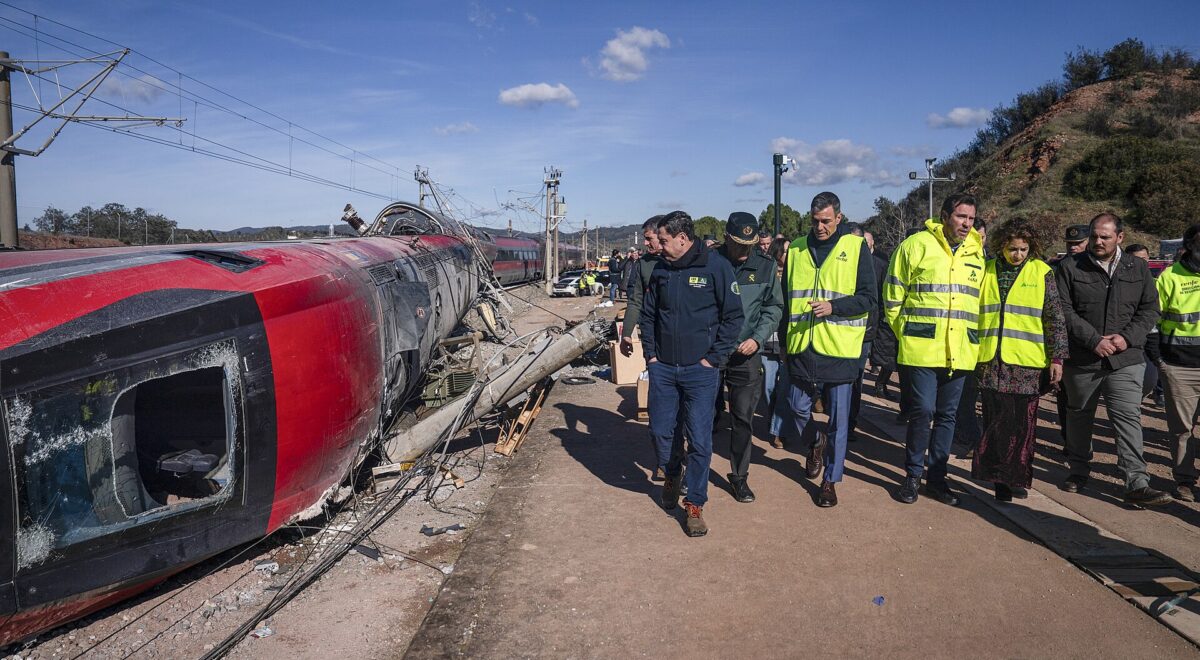
Image credit : Junta de Andalucía. This file is licensed under the Creative Commons Attribution-Share Alike 4.0 International license.

Over the last fifteen years, nearly 200 people have died in Spain as a result of high-speed railway accidents. The deadliest was in 2013, when an Alvia train derailed near Santiago de Compostela and killed 79 people. More than a decade of relative safety later, two fatal collisions—the first in Seville this past January and the second in Urda, Castilla la Mancha in October—claimed 115 lives in the space of just ten months.
Compared to the 120,000 deaths attributed to COVID-19, it might not seem like the country’s most glaring public-infrastructure failure. Yet the transport sector’s sheer theatricality, including the Gotham-esque trials and swift resignations of former ministers like José Luis Ábalos or Óscar Puente, raises the question: how and why did this beacon of once-national pride go so wrong? Was the loss of human life the price of political subterfuge, or policy decisions that go back to 2008?
Prosecutors at the European Union seem to be asking similar questions. The European Public Prosecutor’s Office (EPPO) opened its second investigation into Administrador de Infraestructuras Ferroviarias (ADIF), Spain’s railway infrastructure manager, in early November, over potential fraud related to EU funding. The inquiry alone suggests a link between mishandled recovery funds (originally part of a post-Covid spending plan to stimulate economic recovery) and failed safety measures on the high-speed line where both fatal crashes took place.
Reporters have centered on the role of what an initial investigation into the Urda crash identified as a ‘German-made train signaling system’ from 1992; technology that predates the iPhone, The Sopranos, the Toyota Prius, and virtually every mainstay of twenty-first-century life. However, like other forms of public transportation, railways depend on a web of interlocking safeguards, from train-detection equipment to block-control procedures that prevent the kind of single-trigger catastrophe we normally associate with analog engineering.
So when this kind of infrastructure produces several fatal crashes in the same year (and this is just speculating), it may be a structural, not isolated, issue. Untangling the Gordian knot behind Spain’s modern development strategy means tracing the fiscal and political kabuki that informed these same policy decisions.
For pragmatism’s sake, we can start by constructing a purely financial genealogy of Spain’s public infrastructure expansion, only to find that 2008 becomes a sort of Stunde Null: a year zero that inaugurated a period of monetary conservatism that can only partly explain why these civic projects were systematically neglected.
For example, just before the financial crash in February 2008, Spain inaugurated its landmark high-speed connection between Madrid and Barcelona, following nearly two decades of construction. By 2024, Spain’s public investment stood at less than half of those pre-2009 levels, with railway investment taking a particularly sharp tumble during what are now known as ‘the austerity years.’
And while spending remains ‘well below’ that pre-crisis level, this has not stopped the country from committing billions in railway investment at the expense of fiscal discipline.
Between 2018 and 2022, an average of €1.5 billion a year went toward new high-speed rail infrastructure despite post-2008 budgetary constraints. Separately, ADIF committed an additional €8.64 billion since 2018 for networks across the Iberian Peninsula, more than two-thirds of which has already been carried out.
But increased spending, particularly in a liberal holdout like Spain, does not necessarily translate into more functional railways. In fact, the political and economic point is to build anew: to stage the relentless spectacle, or glittering hype, of ‘modern’ infrastructure. Think data centres, semiconductor plants, renewables, or new freight facilities for e-commerce giants like Amazon.
Or consider the roughly 914 kilometres of new high-speed track added to Spain’s network since 2018, and how only 16% of the high-speed-rail budget over that period was allocated to maintenance and renewals, according to Politico. Maintenance that could have updated the AVE line where both crashes took place.
Budgeting for public services has always been, and will always be, a high-stakes exercise. High-stakes in the sense that it determines whose lives are considered worthy or expendable. In other words, choosing how and where services like water, electricity, or, in this case, mobility are provided means deciding who deserves these resources, and what quality they will be administered.
The ‘availability of finance ’ and ‘problems of governance ’ should therefore not be taken as two competing explanations for the cause of Spain’s crumbling infrastructure—one reinforces the other, and both play a role in mediating relationships between individuals, institutions and the state.
Of course, alongside spending cuts, José Luis Ábalos was found guilty of ‘criminal organisation, bribery and embezzlement’ after four years on the job. And yes, Óscar Puente, the transport minister at the time of the Urda crash, recently cited, ‘political dignity, consistency and empathy for the victims’ as reasons for his resignation.
But is it enough to vilify individual politicians, or even austerity itself? Building infrastructure involves a constellation of choices so diffuse that assigning responsibility becomes a wild goose chase. It’s a process so ambiguous that rival political parties can readily, and in fact often times do, exploit it.
In The Promise of Infrastructure, Nikhil Anand, Akhil Gupta, and Hannah Appel write that infrastructure is ‘an articulation of materialities’, where ‘institutional actors, legal regimes, policies, and knowledge practice’ constantly form across time and place’ (12).
Because infrastructure cuts across so many sectors and experiences, ruin and abandonment often unfold in slow motion, almost imperceptibly, until it is so commonplace that people stop asking questions.
Nearly a decade ago, Anand, Gupta and Appel observed that the proliferation of unfinished major public works was not only confined to the Global South, but was increasingly contributing to a ‘creeping sense of decay’ spreading across the Global North (6).
To them, it was a widespread rebellion against the Keynesian emphasis on public works that enabled the close to ‘thirty years of privatization’, which robbed countries like the United States and the United Kingdom of their welfare legacy.
In this fashion, you would think critics would go back to accusing Mariano Rajoy’s conservative People’s Party–largely responsible for sweeping austerity cuts post-2011—for the enduring state of public affairs in Spain today, but unsurprisingly, blame knows no prejudice.
Prime Minister Pedro Sanchez’s Socialist Workers’ Party, in power since 2018, is now taking the heat for both AVE crashes, as corruption scandals pile on and balance sheets continue to expose lavish spending on unfinished projects.
I reiterate this point to suggest that because infrastructure is so bound up with the function and breakdown of daily life, it regularly becomes a site of political contestation for both those from above (insert partyocrats and Eurocrats) and those below (workers, passengers).
It is only natural, therefore, that right-wing skeptics have taken full advantage of Sánchez’s coalition, editorializing the crashes ad infinitum ahead of the November elections. But perhaps the tragedy’s subtler effect is how the Socialist Party has tried to reclaim a narrative that casts it as the obvious villain.
To circle back to Óscar Puente’s initial response, in addition to citing failures of the computer system, he also pinned October’s crash on the ‘poor judgment’ of an individual traffic controller. The miscalculation of one worker, as opposed to the years and billions of euros involved in generating such a system, seemed a more appropriate scapegoat. Quick to retract that insinuation, he later said, “I have never used the term ‘human error’, although that is not to say that there was no human error”.
Hiding behind the apparent objectivity of facts such as ‘human error’ is not a deflection tactic unique to Puente, but one way in which austerity has supplied a moral language through which to interpret infrastructural decay as the fault of individual people, not de-vestment.
Back in 2013, the driver of the Santiago de Compostela crash was actually charged with 79 counts of homicide for driving too quickly into a turn. His brief lapse of judgement was conflated with murder, a defamatory campaign no less conspiratorial than when Kafka’s Josef K. gets indicted in The Trial (1925).
Precisely, it is how “state- sanctioned infrastructural abandonment’ is framed as ‘the product of financially irresponsible residents on whom austerity and dispossession can justly be visited.” So if one worker fails to perform, the resulting loss of human life seems like an acceptable, and in fact, inevitable consequence of their misstep.
A moral interpretation of the economy, and therefore the material outcomes of state-building projects like infrastructure, tends to fall unevenly on certain classed, racialised and vocational demographics, particularly railway workers and, to a different extent, commuters who take the AVE line.
But resorting to a political blame game is moot and rather divisive. The real challenge would be to first, de-emphasize the lure and clout of new infrastructure, and secondly, to make policy choices with the self-awareness that material development affects those beyond the electoral cycle.