
Image credit: Sergio López Prieto /. This file is licensed under the Creative Commons Attribution-Share Alike 4.0 International license.

On 6 November 2026 Pope Leo XIV touched down in Montevideo, Uruguay for his first stop on a twelve day tour through South America. Argentina and Peru were to follow, with the latter—given the two decades he spent there as a missionary, professor, and bishop—representing a homecoming of sorts. From Pope Leo’s first reception off the plane, it became evident that this was to be a papal tour with a politically trenchant impact beyond the spreading of the gospel.
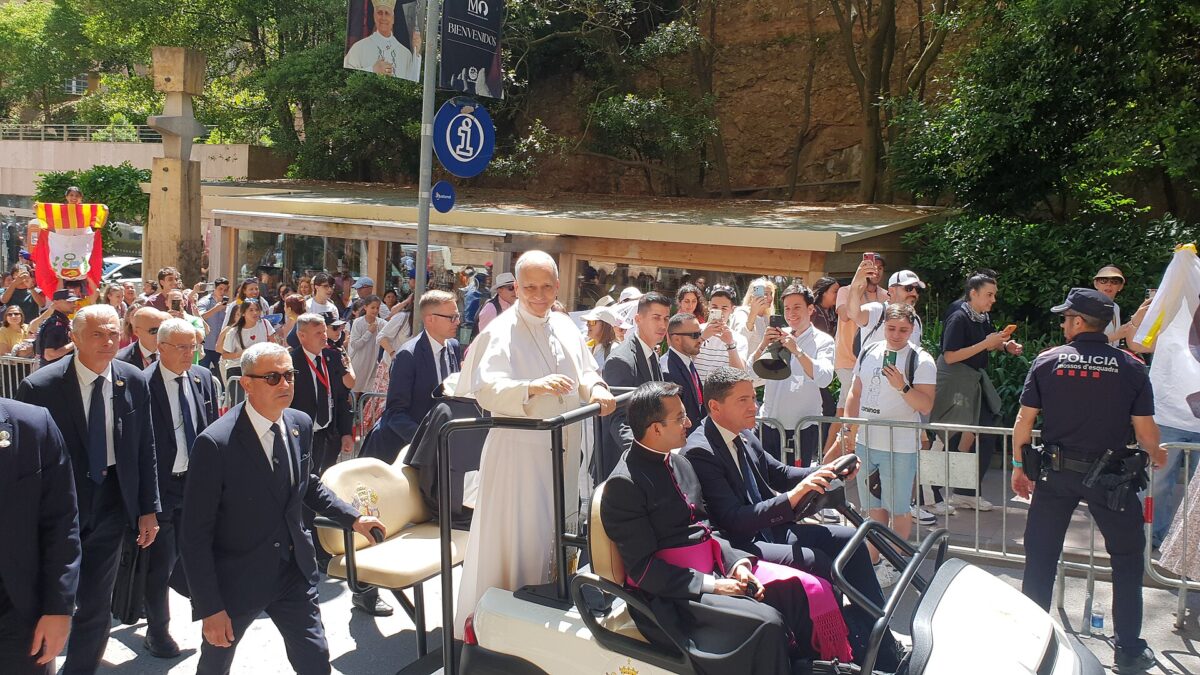
Greetings of olé olé olé as the Pope stepped down the boarding ramp set the tone for his Apostolic journey; time and time again, his ecclesiastical mission was met with secular gestures of approval. To many non-religious spectators, it was not immediately evident how to interpret this figure in a mozette and heavy golden cross. Since his predecessor, Pope Francis, set in motion a more liberal papal trend, the Vatican has come to play a vocal part in debates about climate change, artificial intelligence, and LGBTQ+ rights. Leo’s first encyclical (a document which outlines the Pope’s intellectual agenda) did not shy away from this legacy. His call for AI to be “disarmed” was accompanied by a reproof of private capital encroaching on the common good. Many read a revival of Christian socialism into his words and his left-leaning outlook was noted by the secular public too. Progressing slowly through the crowds in his Popemobile, he’s as much a political activist as the face of a 2000-year-old institution. Curiously, the closest analogy some found for his arrival was to sports. A retired teacher offered her hope for what this visit might achieve: “just like the World Cup unites us, hopefully the Pope will too”.
The election to the papacy of the Chicago-born Robert Prevost in 2025 provoked political comparisons almost immediately. A powerful American presence in Rome might,some thought, help to offset the persuasive power of Donald Trump among Catholic supporters. Whilst the Pope does not invite being cast in this role—he has repeatedly stressed that he is not a politician—his criticisms of the war in Iran have prompted several rancorous comments on X from the President of the United States. Direct confrontation might not be Pope Leo’s modus operandi, but many points on his journey through Latin America felt carefully targeted.
Pope Leo’s meeting with the Argentinian President Javier Milei, for example, was set to be tense. When Milei campaigned for the Presidency in 2023, a chainsaw became the notorious symbol for his agenda: cuts to social services and the scaling back of public sector jobs. Radical deregulation extended to technological advancement too. Earlier this year, Milei embraced Peter Thiel—the US tech billionaire who takes a skeptical view of advocates of AI regulation—at the Presidential Palace in Buenos Aires. Federico Sturzenegger, the Argentinian Minister of Deregulation and State Transformation, wasn’t shy about using AI to draft legislation either. As one might expect, Milei sat in sullen regard of the Pope’s speech on 8 November, with his occasional dutiful clap more censorious than commending amidst the heavy applause from his political adversaries. The Pope covered AI, austerity measures, political moderation—all topics which rang familiar to Milei, but Leo’s declaration that “technological development requires an ethical awareness commensurate with its power” was not quite how he would have worded it.
Whilst avoiding direct commentary on Milei’s policies, Leo let his agenda speak for itself. Following his speech before the President, his next stop was somewhat more humble: a Catholic-run care home for the disabled on the outskirts of Buenos Aires. Milei’s recent cuts to disability pensions and health care lent this visit a strong political bent, though the occasion was easily defendable as lying within the pastoral remit of the Church. A meeting with union leaders in Buenos Aires and outdoor Mass at a military aircraft factory in Córdoba (the site of recent protests against Milei’s cuts) are silent statements which save the Pope from voiced political provocation, while also ensuring that he can hardly be accused of complicity.
The Pope’s third leg took him through Peru, where city walls had been scrubbed of graffiti and freshly painted with murals of Leo gesturing benignly from green Peruvian landscapes. The recurring image was in no way fanciful; Leo has strong ties to the country and has described the final portion of the trip as a homecoming of sorts. The time he spent there prior to his papacy may even have helped to legitimise his eventual election to the post. Previously, the global hegemony of the US has made the Vatican hesitant about electing a US citizen as pontiff. Leo, with his strong ties to Peru, was able to bypass their misgivings by virtue of his commitment to a country outside the US.
Street vendors were selling everything from Pope-shaped loaves to Funko-style models of Leo. The pontiff himself, however, came with a serious message. A grave speech given to citizens and pilgrims in Pucallpa offset the Pope-mania with its appeal to regulating pollution and gold mining in the Amazon.
Right-wing populism in Peru is manifest in the figure of President Keiko Fujimori, who has gathered support through her strict commitment to fighting crime with increased military involvement. Cranking up surveillance in this way is understandably controversial, and Leo’s response was characteristically understated. Stopping by his erstwhile diocese of Chiclayo, the Pope paid special homage at the chapel of perhaps the most famous victim of extreme-right violence in Latin America: Saint Óscar Romero.
At the heart of the backlash against Latin American military dictatorships and poverty in the 1960s was the development of liberation theology, a movement which straddled faith and activism in its revival of Christian socialism. Archbishop Óscar Romero’s role in the spread of liberation of theology makes him, then as now, a markedly political symbol.
The President of the Argentinian Episcopal Conference had a firm vision of what Leo’s trip would entail. Speaking in October 2026, his objectives for the visit were clear: “[The Pope] comes as a pastor and as Peter’s successor, not as a political actor”. Leo’s journey has hardly borne this out. Journalist at the New Yorker John Lee Anderson points out the particular appeal that the Papacy might have to secular progressive countries such as Uruguay: the Pope is held in high regard by
“people in places which until a few decades ago were societies where traditional faith played a big role but have since transmogrified into modern secular communities.They now feel bereft of the idealistic, the otherworldly, the mystical.” Leo’s trip through South America brought to the fore a shift in how the secular world might interact with the Church today. Serving as a humanist rebuttal to concerns spanning from AI to climate change, the Pope has managed to appeal to followers of his faith and lay members of the public alike.