
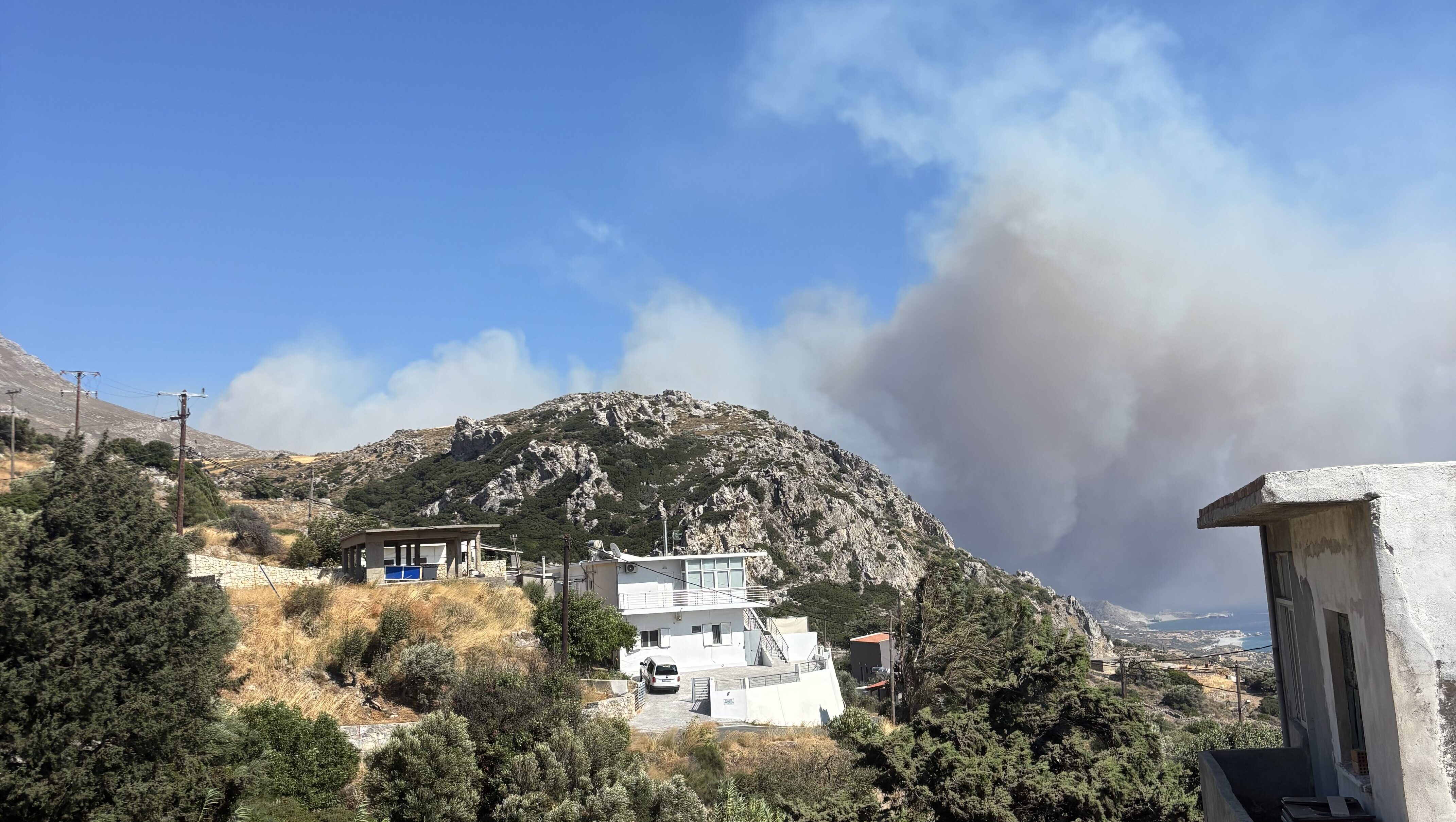
Every summer, for as long as I can remember, I’ve watched reports of wildfires. Southern Europe grapples with them every year, along with Canada, California and even Scotland. I never imagined I’d be affected myself. I live in the North East of England, a region that’s often smothered in rain, where conditions for wildfires tend to be less favourable. Yet in late July, I found myself in southern Crete for fieldwork, evacuating a rural village with three other students due to fires closing in on both sides.
I woke up from my nap at about 16:00 on 29 July 2026 to find emergency alerts on my phone. Around 6km away from us a wildfire had begun. The fire had started to our north-east, over a ridge, and the wind wasn’t blowing towards us, so we weren’t too concerned. Evacuation alerts appeared to be timely and prompt for villages nearby which further eased our worry. However, as the day progressed, it was clear this fire remained out of control. In fact, this particular fire made global news, as 2 firefighters died fighting it. It got to late evening, and as a group we decided we’d assess the situation the next morning, hoping the fires would be more under control. When I went up to the roof to relax, I was stunned by the sight in front of me. Looking east towards the coast, I saw what I initially thought to be the lights of a town, though they were far redder than I had seen before. My fellow student Sam looked through his binoculars, then turned to me: “They’re fires.” It was a breathtaking sight, though a concerning one. This was only 3km to the southeast of us, and the fact we could see it wasn’t a good sign.
We had to leave the town of Kerames the next morning. Later that day (30 July 2026), another fire started to the west of our village that came much closer to us, and into the area where we were supposed to be carrying out fieldwork. We left Crete around a week later, as the type of fieldwork we were performing wouldn’t be safe in an area that had been recently burnt by the fires. These two fires burnt over 4,500 hectares of land across the Rethymno region including close to, and partially inside, the area where we were planning on completing our fieldwork. A state of emergency was subsequently declared for the regional unit of Rethymno.
We were relieved to leave Crete without more serious consequences. The emergency alerts and evacuation warnings we received were reassuring, particularly for four young adults away from home. These warnings gave us time to leave before the fires reached us.
July 2026 broke the record for a single month for the most hectares burnt in the EU, almost four times the 2006-2025 average. Human-induced climate change likely made the heat and drought conditions that favoured fires more likely, potentially contributing to the 2026 fire season. A separate study by the World Weather Attribution found that ‘human-induced climate change made the extreme fire weather that fuelled the recent destructive wildfires at least twice as likely in France and at least 20 times more likely in Spain’. Although these findings relate to different countries, they illustrate how climate change can increase the likelihood of conditions conducive to severe wildfires. The European Commission estimates that wildfires account for an average of over €2.5 billion in direct damage to property and infrastructure across the EU every year. As global climates change and increasing temperatures combine with drier summers, wildfire conditions become more likely, which could increase the risk over the next 10 years. If this trajectory continues, how many more fires will burn?
Europe was not alone in experiencing extreme wildfires this summer. In Canada, fires in Western Ontario produced smoke that travelled across the eastern USA, drawing attention to the impacts of wildfire smoke beyond areas directly affected by the fires. Researchers have reported that annual deaths associated with wildfire smoke in Canada are up by 275% when comparing the years of 2003-2012 to 2021-2025. These figures show that consequences of wildfires can spread well beyond the burned landscapes. Smoke can travel across borders, affecting air quality and health thousands of kilometres away.
After watching the fires in Kerames and seeing the global shift in urgency relating to wildfires, I no longer see them as a distant problem, but rather an indicator for a need for change.