
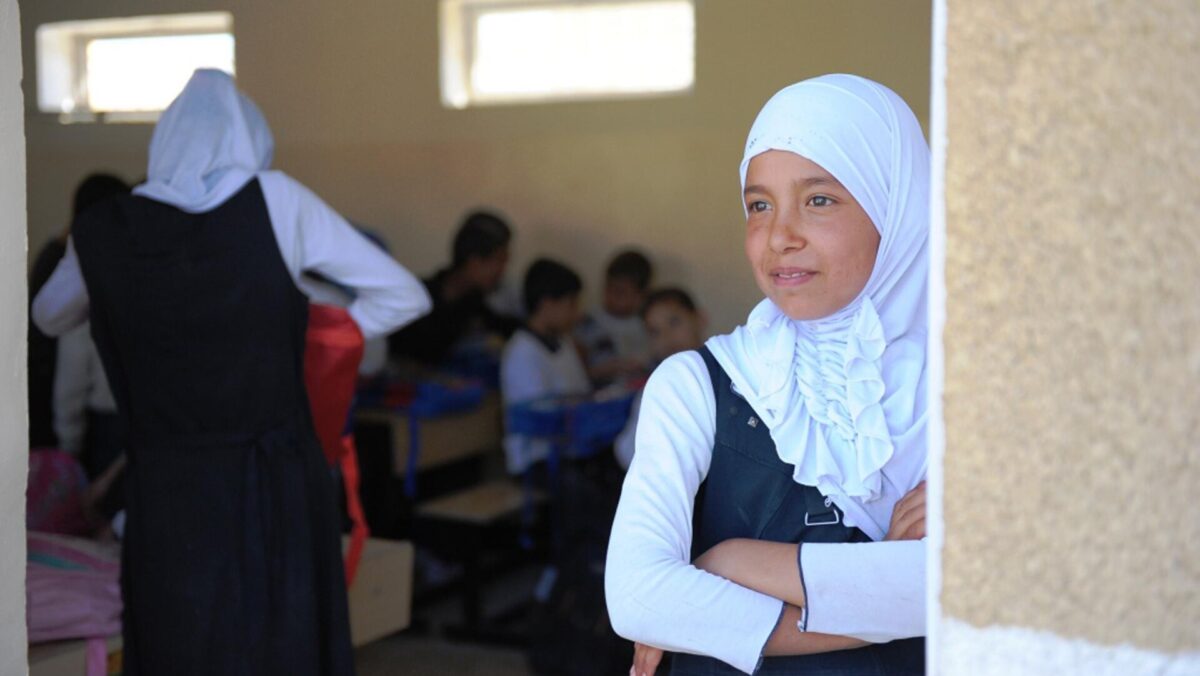
Azerbaijan is a country with a 96% Muslim population, where the hijab is both a religious attire and a cultural norm. However, on 12 October, students and teachers wearing the hijab in Azerbaijan were denied entry into schools, and teachers were subsequently dismissed from their jobs.
This follows the amendment to the Descriptions of Uniforms for Students of State General Education Institutions on 21 September which states that uniforms must be aligned with Azerbaijan’s “secular principle”.
This is not a nationwide ban on the hijab, but instead framed as an amendment to school uniform rules. By arguing that the change is merely a general uniform rule amendment that applies to all students, the government and schools are able to covertly target hijab wearing girls specifically, as it is in fact only these students whom the amendment is targeting. Other religious attire such as kippas are still being worn in schools.
Indeed, this is not the first time that Azerbaijan has targeted hijab wearing students in educational settings. Between 2010 to 2012, people also took to the streets to protest against the restrictions placed on girls wishing to to wear the hijab in educational institutions. Protesters were subsequently arrested.
The press also continues to target hijab wearing girls, most recently, Azerbaijani state television ran an AI generated clip which showed pupils wearing hijabs standing next to those who didn’t and asked viewers which school they would prefer to attend. Such clips are softpower tactics intended to humiliate, belittle and shame young hijab wearing girls for wearing the hijab in school.
While proponents of the enforcement have argued that school aged children are too young to make decisions about religious dress, videos shared on social media show hijab wearing girls crying as they are being ushered away, and having school gates closed on them. Many have defied the ban and instead chosen to sit on school steps, many again seen crying. Students are also seen explaining how important the hijab is to them and that they will choose their hijab over their education.
Despite girls crying and refusing to go to school unveiled, supporters of the ban continue to justify it under the guise of girls making their own choices, even though these girls clearly demonstrate that this is their choice. The ban also denies these girls’ right to choose away by discriminating against them and forcing them to decide between their religious beliefs and freedoms or the right to an education has only caused them distress and proven that they do in fact want to wear the hijabs, to the point that they will not enter their schools unveiled.
Students who do not wear hijab are seen crying as they hug their teachers, who were dismissed from their jobs, and classmates, who have been excluded or denied entry inside, goodbye. Hijab wearing girls have had no choice but to sit outside the school gates and attempt to study in isolation. Another video shared on social media shows school teachers wetting the school steps with hoses to deter them from sitting there.
Since then, reports have emerged that the Azerbaijani government has blocked the internet, specifically social media platforms like instagram and ticktock where most of these videos were shared. Human Rights Watch reported that a man had reportedly received a 25 day detention sentence for posting about the restrictions on TikTok.
Protests have quickly erupted across Azerbaijan. Thus far, 200 people have been detained and 37 arrested. While the authorities have accused the detainees of damaging property and attempting to obstruct school operations and traffic, they did not name the schools where this allegedly took place, nor did they provide any detail regarding the specific acts attributed to the detainees. Their names and ages have also remained undisclosed, and many suspect them to be minors.
Male students and those who do not wear the hijab have also joined protests in solidarity, with some boycotting lessons. Protests, especially of this scale, are rare in a country like Azerbaijan, where the police regularly disperse demonstrations.
Ilkin Huseynov, an artist and activist who launched an online project called “Let Leyli Go to School” which intended to link volunteer tutors with hijab wearing girls affected by the ban, went missing. Local media later reported that he had been given 30 days of administrative detention for allegedly disobeying police orders.
Polad Aslanov, an imprisoned Azerbaijani journalist who was convicted of high treason in 2020 and is serving a 113-year prison sentence, has also announced his hunger strike in protest of the ban. In a Facebook message posted by his wife Gulmira Aslanova, he wrote, “Despite being in prison, I am raising my voice against the trampling of our constitutional rights by employing the only means of struggle available to me – a hunger strike!”
Azerbaijan is not the only Muslim majority country to discriminate against the hijab or other aspects of Islamic identity. Kyrgyzstan, Tajikistan and a long list of European countries, most recent of them Austria and Kosovo, have also banned the hijab and/or niqab in educational spaces. For many Muslims, these bans also echo the past, such as Iran during the Kashfe hijab era, which my own great-grandmother lived under, and Türkiye during the so-called post-modern coup in 1997 when women wearing the hijab were banned from universities and dismissed from civil service jobs.
I spoke to Oxford student Elif Feyza Dinc, who is currently reading an MPhil in Development Studies, and whose mother could not enroll in university in Turkey due to wearing the hijab. Reflecting on that dark era, Feyza Dinc tells me “28 February 1997 is a date etched into the memory not only of Muslim women in Türkiye, but of anyone who has chosen to live their Muslim identity openly in public life”. She tells me that her mother “still speaks of those years as the time her rights were taken from her, and of her degree as a way of fulfilling the dreams she held at eighteen”.
Türkiye is a close ally of Azerbaijan, yet the decision sparked condemnation from Oktay Saral, a chief adviser to Türkiye’s President Recep Tayyip Erdoğan. In a post on X, he wrote: “How can it be morally or legally justified to turn away a student at the school gate because she covers her head for religious reasons? The hijab is not an obstacle; it is a requirement of faith! The right to education must not be sacrificed to ideological impositions!”.
He added: “We expect Azerbaijan to reverse this mistake as soon as possible. Rather than putting obstacles in the way of young people’s futures, we should help them move forward”.
As a result of this post, President Erdoğan dismissed Oktay Saral as his chief adviser.
As protests and detentions continue to take place in Azerbaijan, and as hijab wearing school girls are denied their right to an education, mothers and daughters across Azerbaijan are also protesting by posting videos of themselves wearing the hijab.
Despite this, the international community of women rights activists, including those who built their cause around girls’ access to school such as Malala, continue to look the other way. One social media user analysed a multitude of feminist focused Instagram pages and found only one speaking up for girls in Azerbaijan. Dishearteningly, comments under the post were disproportionately supportive of the ban.
Hijab wearing Azerbaijani school girls are enduring this battle alone, and it is yet another reminder that Feminist slogans like ‘my body, my choice’ have never applied to hijab wearing Muslim school girls who wish to cover their hair and bodies. Even when most have chosen to sacrifice their education in order to not be subjected to unveiling, hijab wearing Muslim girls are still being assumed to have not made their own choices.
For more discussion, read the Oxford Blue’s piece Kyrgyzstan’s Forced Unveiling: Echoes of Other Nations’ Restrictive Laws.