
“What’s authentic to me doesn’t mean it’s authentic to you, even if you grew up in Taiwan. Whatever I like, and whatever I want to serve, is authentic to me and authentic to us.” I first came across Eric Sze from his Eater Video a few years ago, and I found this line, as well as his view on cooking, so interesting.
We all want to be authentic: we want to be true to ourselves, and the same goes with food. We go searching on Google Maps or Beli for authentic food, and we want to try something that tastes as it is supposed to. But I think looking for something authentic is a bit more difficult and much more personal, and it feels less clear what we really are looking for.
It’s hard to define authenticity. The dictionary definition is that it is, “real, true, or what people say it is,” which isn’t very helpful (is there such a thing as fake food?). So, I’ve split it into two definitions. On one hand, what I’d imagine most people would define it as a culture-led definition: food that is representative of the land, people, and spirit that it originates from. On the other hand, an individual-driven definition, akin to Eric Sze’s, authenticity means what is original to, and expressed by the self. In fact, this is probably closer to the etymological root of the word, coming from the Greek authentēs, meaning “one acting on one’s own authority.” For now, let’s keep both on hand.
At this point, I think it would be fair to ask whether it should even matter if the food is authentic, as at the end of the day, most people just look for good food for a meal. It does matter, because our desire for authentic food comes from more than just a surface-level want for accuracy or technique, but rather an appeal to what food is best at – connecting people and places.
Back to our culture-led definition: for most people, food that tastes like home and carries the same flavors we grew up on, tastes better to us. You can chalk it up to nostalgia, neurons and memories, having developed a specific palate over time, or simply just that on a cold and grey Oxford day, a bowl of Taiwanese beef noodle soup sounds lovely. What is important here is that we crave authentic food because it brings us closer to home, and closer to the stories and memories that are dear to us. I’d like to believe that we all want to understand those same flavours and memories of the people around us, so we search for food that reminds them of their home.
Our individual-driven definition works the same way. A 2013 Study completed by the National University of Singapore found that food that ‘made with love’ tasted sweeter, and that emotions play a factor in our perceived tastes in food. Our want for authentic food in this sense comes from our desire to communicate our own stories, and to hear and understand other people too.
And so, here is my own authentic recipe, and the story behind it. The first meal I ever remember having was 叉烧饭 (caa1siu1 faan6): barbeque pork rice. It is honey-glazed, charred, juicy pork over rice (a Cantonese barbeque classic) and still my favorite dish ever. Growing up in Hong Kong, I had it often, sometimes more than once a week, at 新桂香燒臘, which I (and many many others) maintain does the best roast meat in the city. It is incredibly hard to make right, requiring a long marinating and roasting process, so restaurants start making it in the early hours of the morning. It is a labor of love that you can taste on the plate. Coming to Oxford and the UK, I realized how little Chinese cooking I had picked up. I grew up knowing that the best Chinese food was at most a 10-minute walk away, so I learnt Western cooking: making pasta, decorating cakes, and baking way too many cookies. And so, in the UK, I searched and searched for 叉烧 (caa1siu1) that tasted “right”, but whether it was a lack of the proper burners, or a different style and technique that had been passed on, it wasn’t the same.
Oddly enough, my inspiration for it came from a modern British restaurant. I watched the chef double-roast a duck, with the second roast being a honey-lacquer, which meant he poured a quarter of a bucket of honey over the duck before broiling it in the oven. And that is the technique that I adopted for my three-ingredient, British-restaurant-inspired, 叉烧. It is unconventional, cuts a lot of corners, and has come from a very different place from what I’d imagine my recipe would develop from, but it’s the closest I’ve gotten to 叉烧 that tastes like the best versions of it at home.
The recipe is as listed down below.
Recipe ingredients:
- Pork belly (skinless; either slices or an entire piece)
- Lee Kum Kee Char Siu Sauce (readily available at any Asian supermarket)
- Honey
Steps:
- (Optional) Using a fork or a meat tenderizer, pierce small holes in the pork belly to allow the marinade to seep in further.
- Place the pork belly in a Ziplock bag, and coat with the Char Siu Sauce, ensuring the entire pork belly is covered. Marinade for 24-48 hours.
- Pre-heat the oven to 140 degrees Celsius.
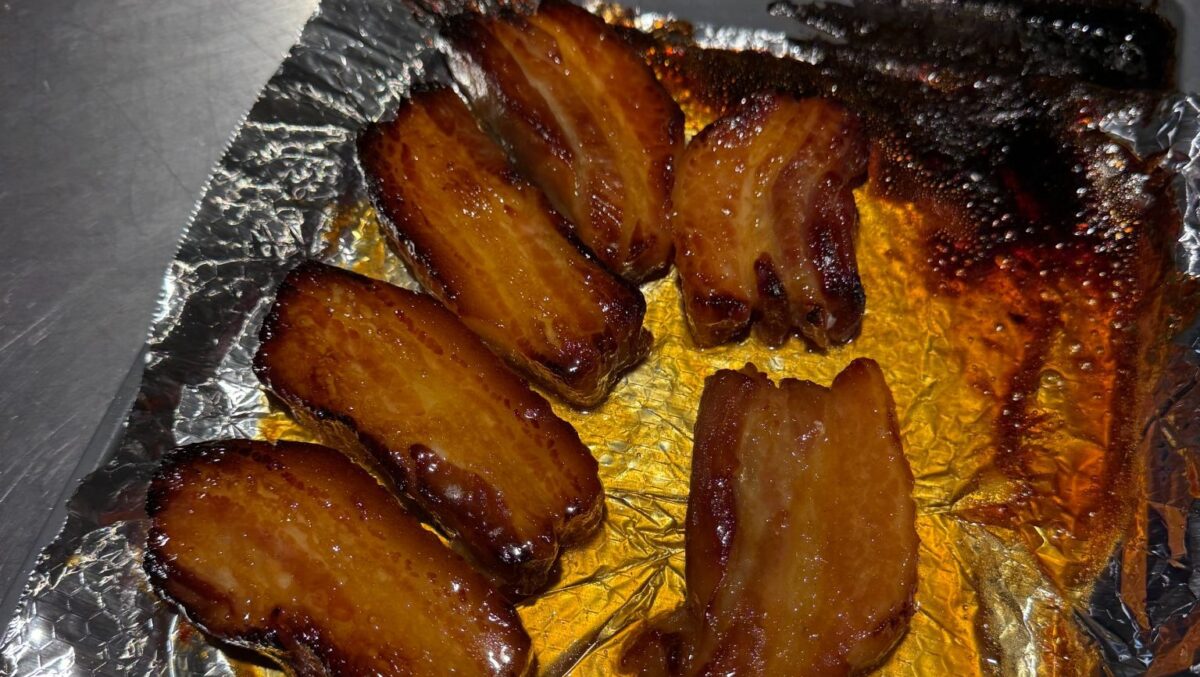
- Lightly wipe off the marinade and place on a baking tray with tin foil, preferably with four walls to prevent spillage later (see photo for what not to do).
- Roast first to 63 degrees Celsius/145 degrees Fahrenheit to ensure full cooking of the pork.
- Pull and rest for 5-10 minutes; Set oven to overhead/top heat only or broil mode, and change the temperature to 200 degrees Celsius
- Lacquer with a mix of 25% Char Siu Sauce to 75% honey (pour over the pork and ensure fully covered).
- Place the pork back into the oven, and broil till the honey has caramelized over the pork and is starting to char, flip the pork over and repeat.
I hope you try this recipe, and I get to share with you what is authentic to me. I am so grateful for our continued search for authentic food, and that it comes from a place of craving common connection, and to appreciate one another and where we’ve come from and been, and of course, a want for some delicious food. Eat well!
See more at @roysfoodaccount.