
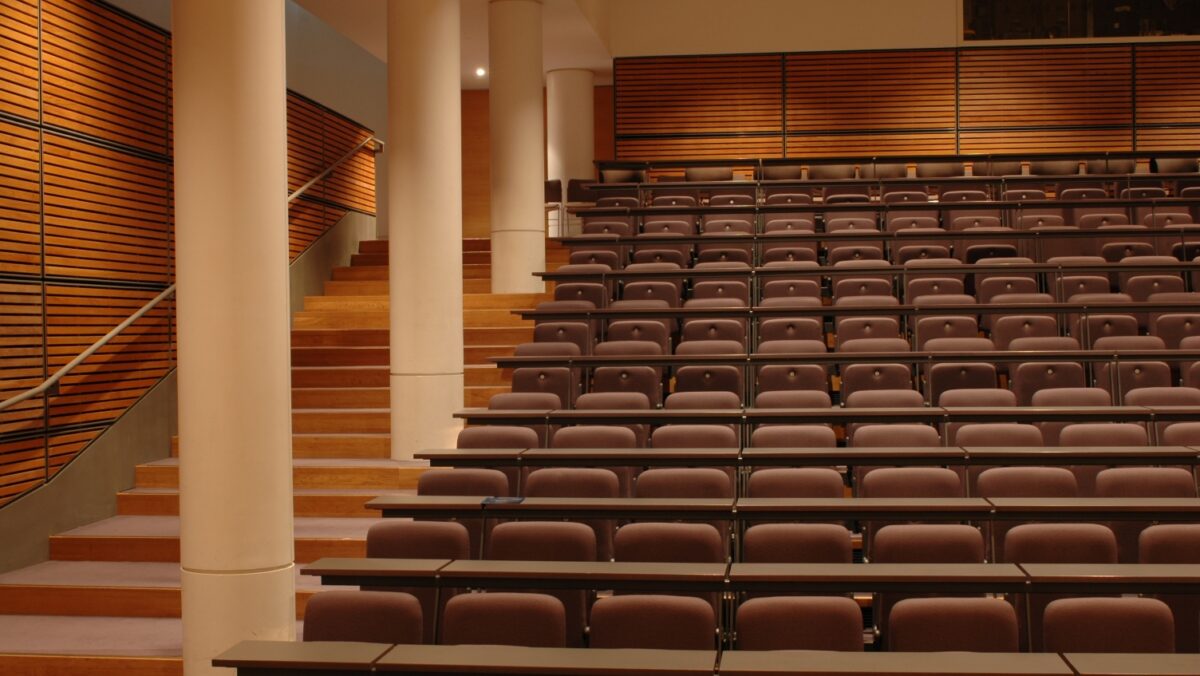
No other teaching style seems to divide opinion as much as the lecture. Whether you love them or hate them (or perhaps just tolerate them), everyone seems to have different preferences, habits, and ways of getting through them. There is no worse feeling than dragging yourself out of bed for a 9am, only for it to be time wasted on an unhelpful topic. Equally, sometimes you stumble upon gold and somehow even enjoy an hour spent in a room with no natural light. And, of course, there’s the question of whether you go at all. Depending on the subject, lectures take different levels of precedence: for many STEM subjects, they are a primary method of teaching, whereas for lots of the humanities, they focus on wider context or commentary. So my question is, what makes a good lecture? What qualities make for a good lecturer? And what does your lecture lifestyle say about you?
When you walk into the lecture theatre, you’re struck by the first dilemma: where to sit. You only have a couple of moments to loiter in the doorway and scan the room before it becomes awkward. Some colleges seem to come in groups and sit all together; some people branch off by themselves. Of course, there are those who will sit in the front row—either through keenness or shortsightedness, you can never quite be sure. Equally, some people head straight to the back, to whisper or nap for the duration. Speaking from experience, I’ve been in both groups (it was shortsightedness, for me), and now will settle for somewhere comfortably non-committal in the middle of the hall.
Once you’ve battled the half-tables that fold out (and usually get stuck) across your knees, the second decision must be made: paper or laptop? There are definitely arguments to be made for both options. The old-fashioned pen and paper may seem outdated with so much new, faster technology, but it’s been repeatedly proven that physically writing things out is actually much better for your memory. On the other hand, lecturers have a frustrating habit of talking much faster than you could ever hope to scribble down everything they say, and typing is a useful speedy alternative. Not to mention the ease of storing notes online, and the fact that you don’t have to decipher your own illegible scrawls later. That said, a friend was in a lecture once where the students were told to stop typing as the racket of frantic fingers on keyboards was too distracting—which is fine, until you later find you’ve forgotten everything they said. Having made your decision, you now have to balance your chosen writing method on the silly little arm-rest table, hoping they don’t have a handout which you’ll also somehow have to make room for. And pray you’re not left-handed, as 99% of the fold-out tables are attached to the right side of your seat, so good luck to you.
Additionally, it’s amazing how much difference the lecturer makes for the experience. And when it’s the start of term and you haven’t got to know who’s who yet, it really is a gamble. A bad lecturer can make even the most interesting topic an hour of unbearable boredom. Whereas an engaging speaker can somehow transform a lecture series on Old English grammar into the highlight of your week. This is, of course, all completely subjective—someone’s least favourite lecturer can be another’s hero. Some of my most memorable lectures have been those where the lecturer was entertaining—when they were reading dialogue in funny voices, or started singing. Or, my all-time favourite, in a seminar about language difference, when the lecturer pulled up his WhatsApp messages with his mum, together with messages on a groupchat for bald men, for comparative analysis. Needless to say, it was an excellent lecture.
And all lecturers have their own style. Most have slides up on the screen (once I was in a lecture where they used the fun PowerPoint transitions, and it genuinely made my day), but sometimes they’ll just read from their notes. Sometimes there are two lecturers, and the experience is so different when suddenly it’s a conversation, not a monologue; it’s a dynamic interaction, and you feel much more included in the debate than simply being spoken at for an hour. At times, to everyone’s horror, they ask for audience participation and address a question to the entire lecture theatre. You could hear a pin drop in the sudden silence of flashbacks to secondary school. And then everyone silently thanks the brave soul who speaks up to put us out of our misery.
Then, at the end of the lecture, there’s that awkward moment of do we clap or not? While it’s nowhere near as humiliating as clapping when a plane lands, it’s still pretty embarrassing to start clapping, only for the lecturer to stop you and tell you they’d rather you didn’t. But on the whole, it seems to be the accepted response to the lecture’s end, and I think it’s a nice way to show appreciation. In the aforementioned bald-men-groupchat lecture, the applause was so enthusiastic that it felt like a curtain call.
Everyone does lectures differently, both the students and the lecturers themselves, but I would say they’re worth going to. Of course, if you’re ill, or have a timetable clash, or just think you’d be more productive at home, they’re ultimately not mandatory (well, unless otherwise specified). But at the end of the day, you’re paying to be here, so you might as well get the most of it. Besides, going in person is so unlike watching it back online. Not only is it much easier to concentrate if you’re physically in the room, but you meet people too. You get to know your lecturers a bit, though this often ends up being a slightly parasocial relationship—I bumped into one of my lecturers in Tesco the other day and gave them a massive smile, before realising they naturally had no idea who I was. Friendships, even relationships, can form depending on who you end up sitting next to in the lecture hall. And even if you don’t get to know people properly, there’s a strange kind of camaraderie when you feel like you know someone, having recognised them from lectures, even though all you actually know about them is that they do the same degree as you and like sitting in the third row on the left.
Lectures are a quintessential part of university, and one day we’ll look back and wonder how we did them, how we concentrated for that long. And then we’ll remember that we didn’t always concentrate, and sometimes, actually, we wrote articles in them instead.