
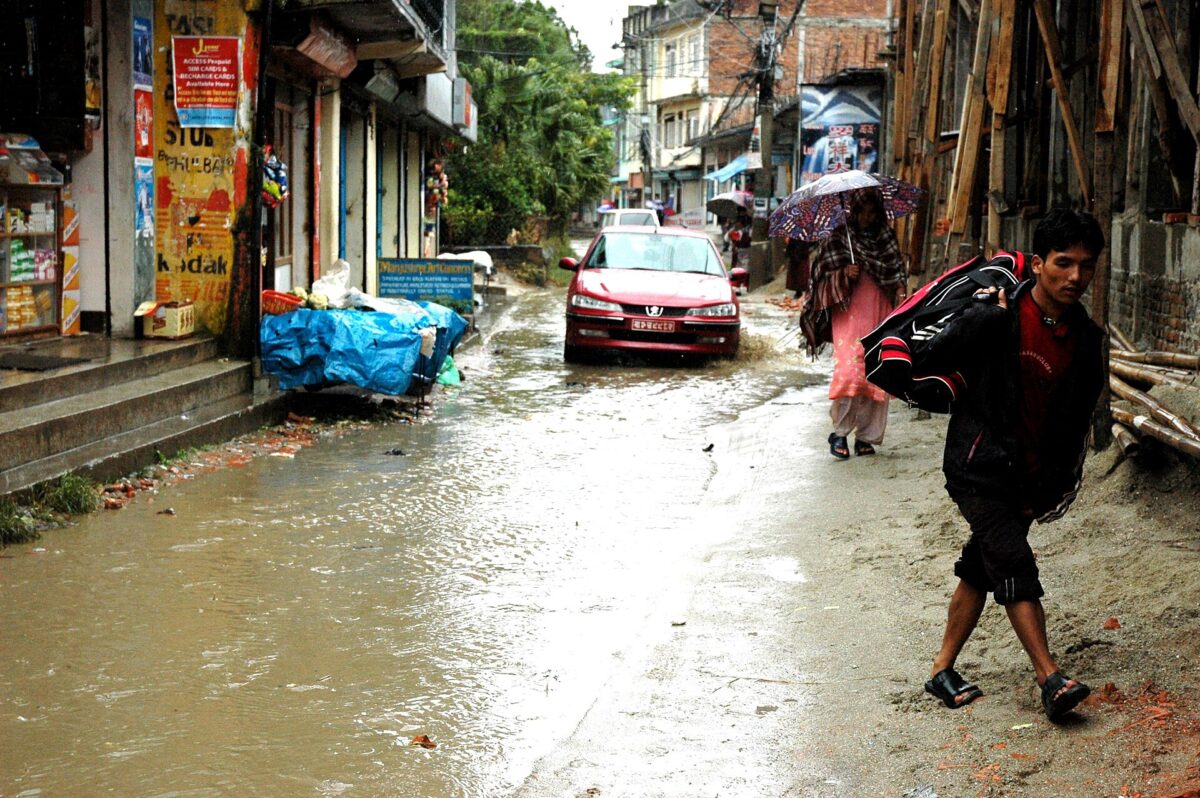
Less than two months after catastrophic flooding struck Nepal, another major flood hit the country. Although smaller in scale, the second disaster exposed an underlying problem: how can a country recover when another disaster strikes before it can rebuild?
Nepal is no stranger to flooding. Each year, Monsoon season brings intense rainfall, frequently triggering floods and landslides that threaten communities, damage infrastructure, and disrupt livelihoods. During my visit to Nepal in 2024, a monsoon-induced landslide forced us to take a diversion, offering a first-hand glimpse into the disruption such events can cause. Our guide explained that local communities often struggle to afford the repairs needed to restore access. With so many landslides happening during the monsoon season, repairing every damaged road is beyond the financial means of these small communities.
The two floods that struck in August and October 2026 differed from the typical monsoon flooding seen across Nepal. Floods caused by landslides are less common, but often a more catastrophic type of flooding, as seen by these two case studies.
I’m sure many of us saw the events of the 26 August 2026 unfold. Initially thought to be caused by an earthquake high in the Himalayas, the floodwaters travelled down a tributary of the Trisuli river. Videos of the event were later shared across social media, bringing the scale of the disaster into view. USGS geologists later established that the earthquake-like tremor was actually a seismic event caused by the collapse of a glacier that dropped around 1,200 metres into the valley below. The survivors told the UN Project Services chief that they witnessed a ‘wall of water more than 100 metres high, travelling at 180 kilometres per hour, which devastated 60 kilometres of valley in a matter of seconds’. The country later confirmed nearly 1500 deaths, and more than 5,000 people are still missing (as of 6 October 2026). The rural areas became unreachable and the fragile nature of such a landlocked, mountainous country was exposed on a global scale.
The flood that occurred on 11 October 2026 received considerably less media reporting, largely due to its much smaller scale. It is currently thought to have been caused by a landslide-dam breach, where a landslide occurred due to monsoon rainfall blocking part of the river. When this landslide was breached by the water levels, a wall of flood water was released along the Budhi Gandaki tributary of the Trisuli (part of the river that was flooded on 26 August). The river went from 2.5 metres to 8 metres in just a few hours, damaging over 200 homes and washing away many. Although smaller in scale, the flood still isolated communities and damaged homes, demonstrating how a disaster doesn’t need to reach the scale of the August floods to place significant pressure on local resources. The significance of the October event therefore was not simply the damage it caused, but rather that it struck a country still recovering from the August floods.
Despite their differences in size, there are some striking similarities between the two. Both floods washed away major bridges, making aid efforts much more difficult than they would’ve been otherwise. In addition, the August flood damaged parts of the major highway between Kathmandu and Pokhara, the two largest cities in Nepal. The two events also demonstrated the importance of early warning systems. During the October flood, warnings reportedly reached some downstream villages up to an hour before the waters arrived, allowing residents to evacuate. The August event presented a different challenge; systems designed to monitor conventional monsoon flooding may offer insufficient warning during sudden glacial collapses, where the speed of resultant flooding leaves downstream communities with little chance to react. Some only escaped due to community efforts rather than centralised warnings. Nepal’s challenge is therefore not simply to improve its response to flooding, but to prepare for a wider range of hazards, including those that the existing systems may fail to predict.
Climate change adds another dimension to Nepal’s vulnerability. Rising temperatures are changing Himalayan glacial environments and shifts in rainfall patterns might alter the frequency and intensity of rain-driven floods and landslides. The extent to which human-induced climate change has influenced these two events remains a separate question. Nevertheless, Nepal faces the challenges of adapting to a changing environment with extremely limited resources whilst trying to recover from these disasters. It was announced on 25 October that Nepal is expanding its early warning systems into six river basins, highlighting their willingness and efforts to adapt.
The question is not simply how Nepal can recover but who should bear the cost. If countries that have contributed relatively little to global emissions face disproportionate climate-related risks, what obligations do higher-emitting countries have to support their recovery and adaptation? Nepal emits 0.08% of global greenhouse gas emissions and, according to the UNFCCC, Nepal is facing losses due to landslides, floods, and glacial hazards, with the impacts going far beyond individual houses or small communities. Damaged roads can obstruct rescue efforts and repeated events can put pressure on the extremely limited resources that are left. The question is therefore one of climate justice. Should a nation that has contributed so little to the climate crisis be bearing the consequences of it?
International support has a role to play in both rebuilding and adaptation. The difficulty is trying to assist the country to become more resilient to the changing climate, rather than just leaving them in the same place they were pre-disaster. Following the August flood, international and domestic aid has totalled around $102 million. The UN Climate Fund donated $20 million to Nepal, the first donation they have ever made using this. However, this is thought to only foot around 1% of the damages, with current estimates putting the cost of reconstruction sitting at $4.7 billion.
The gap between international assistance and the estimated cost of reconstruction highlights the scale of the challenge ahead. Emergency aid can help a country recover, but rebuilding infrastructure and homes requires sustained investment, especially when potential hazards still remain high risk.
Nepal’s experience, however, raises a question that extends far past the Himalayas. If countries that have contributed relatively small amounts to global emissions face disproportionate risks and lack the resources to recover, international support can’t end at disaster relief. For Nepal, the task is not just rebuilding after two floods, but finding a way to prepare for the next, and that responsibility can’t solely fall on them.