
The Welkin is an extremely impressive expression of justice, womanhood, and moral dilemma, and this interpretation of Lucy Kirkwood’s play highlights these themes throughout, with excellent performances, set and sound design, and costumes. This production takes its audience into 1759 Britain, and more specifically, into the trial of Sally Poppy, as this cast constructs a thoroughly captivating performance. It is marked with secrets, struggles, and conflict, alongside a clear show of Oxford’s talented actresses.
The play begins in darkness, with the introduction of Sally, who stands in a white dress, splattered with blood. From here, we see the marvel that is Roselynn Gumbo (who plays Sally), as she portrays her character’s dark, but mysterious nature following the murder of Lady Wax’s child. She claims to be pregnant – which would give her a lesser sentence than hanging – and the audience witnesses her trial, in which twelve women must decide her fate: is she lying?
In the midst of their discussions, Sally proves to be an increasingly difficult prisoner, while the women’s uncertainty and struggles about gender politics within their situations generates dramatic tension. Alongside revelations of secrets, and subsequent shifts among character dynamics, fake identities, fantastic stories, and grey areas between truth and legend, this production of The Welkin is truly brilliant and engaging.
In the build-up to the trial enters Lizzie Luke (Rosie Sutton), who is persuaded to participate as part of the jury, in her (unique) pursuit to save Sally’s life. Sutton establishes herself as a dominant figure among the cast in the best possible way, mixing anger and empathy as they debate the task at hand. She commands the room with raw emotion, with eyes fixed on her in the midst of so many simultaneous conversations. Meanwhile, similar praise is owed to Jimena Herrero, who plays Charlotte Cary, the head of the group. She expresses a bold, authoritative demeanour, both as she speaks and as she silently watches. This makes her ulterior motives all the more shocking, since Herrero so greatly plays her character’s alluring confidence.
These two characters lead the early discussions amongst their fellow jurors, which combine vague theories about the case and tales of their daily lives and housework. Yet, this is brought to a halt on the entry of Sally herself, who enters chained, and with red hands. It is here that we see Gumbo’s talent at work, performing a somewhat unsettling mixture of humour, mystery, allure, and rage, all whilst seemingly on the verge of lunacy. Gumbo is remarkable in this way, not fitting any one description of her that her jurors provide. From humorous comments and fantastical tales to passionate fury, she toes the line between reality and fiction; she is the victim in the eyes of some, but the perpetrator in the eyes of others. This couldn’t have been performed more perfectly.
The contradictions within her character make the decision increasingly tough for the jurors, who, even on seeing Sally produce milk, doubt the truth behind her pregnancy. This doubt is only enhanced at the end of the first act, where the glass of milk that she produced is contaminated with soot – the aftermath of the explosion of a fireplace. This then begs the question as to whether it existed in the first place, even though it was seen by many. Subsequently, in Act 2, the jurors are brought back to the shared belief that Sally is, in fact, lying. This is further intensified by Sarah Hollis’ (played by Cait Kremenstein) monologue, claiming visions of demons and their association with Sally – and her stark defender, Lizzie. Despite her character’s two-decade vow of silence, this marks a turning point in the story, as Lizzie’s maternal relationship to Sally is revealed. Kremenstein, in this monologue, had me hanging on every word. It is worth her silence in the first act to hear this attention-grabbing show of pent-up emotion, with every member of the audience’s full immersion into her story.
Her story triggers the coming of the doctor in order to prove Sally’s guilt (or innocence). Much to Lizzie’s dismay, the women rely heavily on his skills and knowledge. Lizzie, as a midwife, does not garner the same respect as the male Dr Willis (played by Ezana Betru), despite reaching the same conclusion – that Sally is, indeed, pregnant. This is the clearest portrayal of these women’s role in the wider world beyond the courthouse, which proves a curious exception. While the women detail their housework, relationship to their husbands, and maternal role in their respective households, throughout the play, they go past any simplistic ideas of women as homemakers, as we often think of the period. Instead, each of the women has power within this room; they have someone’s life in their hands. This is nicely conveyed through the role of Mr Coombes (played by Rohan Joshi), who is repeatedly the butt of the younger women’s jokes, and whose rules are utterly ignored. The women were told not to eat, drink, or light the fire – naturally, they do all three. Within this space, he is the minority, and the women hold the power, so Joshi nicely shows this silent “authority” and disappointment at the younger women’s unruly humour.
Each of the twelve women have distinct backgrounds and personalities, made clear by each of these actresses even in their brief introduction in the first act, as well as in their individual relationships and how they behave across the set. They trade stories and gossip, and, in spite of their differences, come together under the banner of womanhood in many moments: Lizzie offers food to the rest, they pray together, they discuss their pregnancies, and, sometimes, show pity for Sally’s situation. Rosie Sutton, Jimena Herrero, Maisie Thorn, Tara Barker, Rose Martin, Laura Boyd, Caitlyn Fraser, Emily Polhill, Zee Obeng, Cait Kremenstein, Olivia Russell, and Coco Scanlon all come together on this stage and embody this play’s theme of womanhood and the complex network it forges, whilst also showing the range of talent that Oxford has to offer.
Boyd (who plays Emma Jenkins) plays well with Herrero’s Cary to reject sympathy for Sally, Martin (who plays Helen Ludlow) finally expresses jealousy at Sally’s pregnancy, meanwhile Thorn and Russell (who play Hannah Rusted and Kitty Givens, respectively) offer wild, outlandish theories as comic relief. Again though, no matter how distinctly they approach Sally’s case, we cannot ignore the key unifying factor of this play: womanhood. Following their final decision, one of the women says how nice it was to be out of the house. They all relate to this, highlighted by the references to the work that is yet to be done – i.e., Mary Middleton’s (Barker) insistence on leaving before sunset.
Still, this theme of womanhood is further expressed through Lizzie and Sally’s complex relationship, with both a lifetime of distance and an innate connection. Sutton so greatly interprets Lizzie’s disinterest in Sally, which Gumbo’s Sally makes humour out of. And yet, this strained and distant relationship enjoys further complexities, not least of the fact that, despite insisting she has no maternal instincts, Sutton gives such passion as Lizzie in saving Sally’s life. This is especially seen in the play’s final scenes, where Mr Coombes regains his male power (due to the trial’s end), pushing Lizzie and Sally to come together.
When Mr Coombes – on the order of the wealthy Lady Wax – regains power, there is a clear shift in Joshi’s attitude, as he portrays the male-dominant power dynamic that had previously been central in the women’s discussion. Joshi’s newfound authority goes hand in hand with a stark transition in Gumbo’s performance; it is a transition from anger and humour to sheer distress upon Coombes’ abuse, which causes a miscarriage. Gumbo’s screams echo the theatre, and, like in the rest of her performance, I simply could not take my eyes off her.
It is after this that Boyd, as Emma Jenkins, truly comes into her own. Like Kremenstein, her character goes into a gripping monologue, so compelling that it changes subsequent decisions; this results in Sally’s death. We see a cycle here, as Jenkins repeats her earlier actions, of covering her ears, like she had earlier in the play, but now with a much deeper, darker meaning. Boyd puts across a subtle, but raw emotional reaction, in line with her character’s strict adherence to societal rules. In the meantime, Sutton and Gumbo bring tears to their audience, with a merciful death for Sally, so she might avoid a public hanging. These final performances are genuinely heartbreaking; looking back on how these characters have developed and how these actresses portray them, all for it to come to such a bitter end.
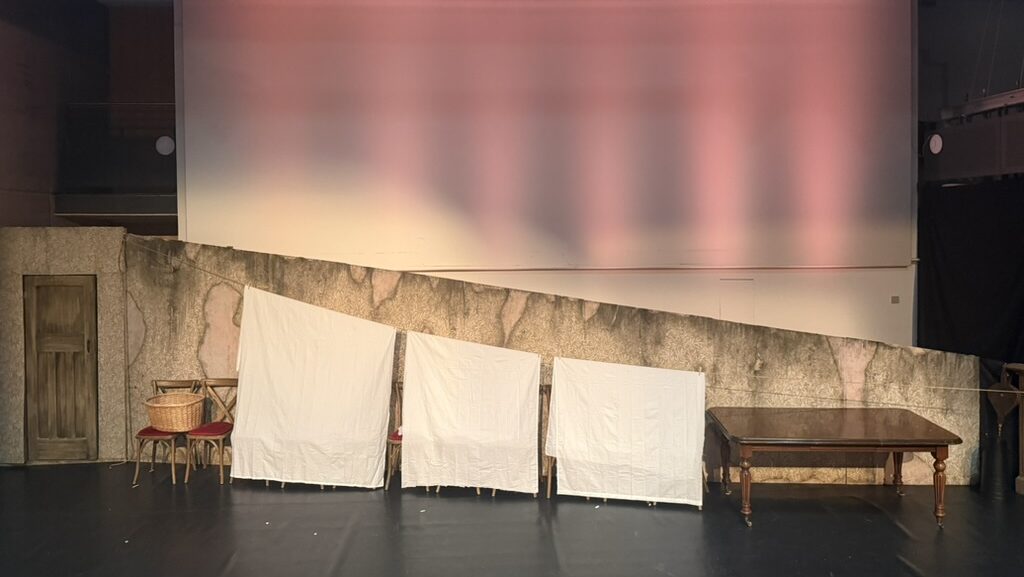
In addition to this, I would be remiss not to mention the role of the set and sound. From the beginning, the set is kept in the dark, when Sally enters beside her husband, Frederick (played by Betru), bathed only in candlelight. This, even at the outset, immerses the audience into Sally’s fantasies, attracting focus onto her and her alone. I greatly enjoyed this production choice, being an immediate form of immersion into the powerful stories that The Welkin tells. Similarly, the line-up of chairs represents the women on the jury, like the lights behind, and the use of these chairs in introducing them, presenting them powerfully as they look towards the audience. This scene also presents the judge (voiced by Rufus Shutter), which I believe is an excellent stylistic choice – emphasising the role of women in this production, while still proving the male judge powerful through both his booming voice and his invisibility.
Moreover, the most surprising part of this play is the a cappella rendition of Kate Bush’s “Running Up That Hill”. After the initial shock, and my friends and I exchanging a confused look or two, I saw how this song represented this community of women. It represents the women’s shared female experience in the face of these societal views, underlining how society’s attitudes still turn against womanhood, from 1759 to this song’s release in 1985 and beyond.
These aspects of production aligned with this exceedingly talented cast to create a captivating and striking interpretation of Lucy Kirkwood’s play. I was thoroughly entertained by this production, between its humour, outrage, wild stories, and portrayal of womanhood, and recommend it strongly. So, to its cast and crew, I wish you the best of luck in the remainder of your run!