
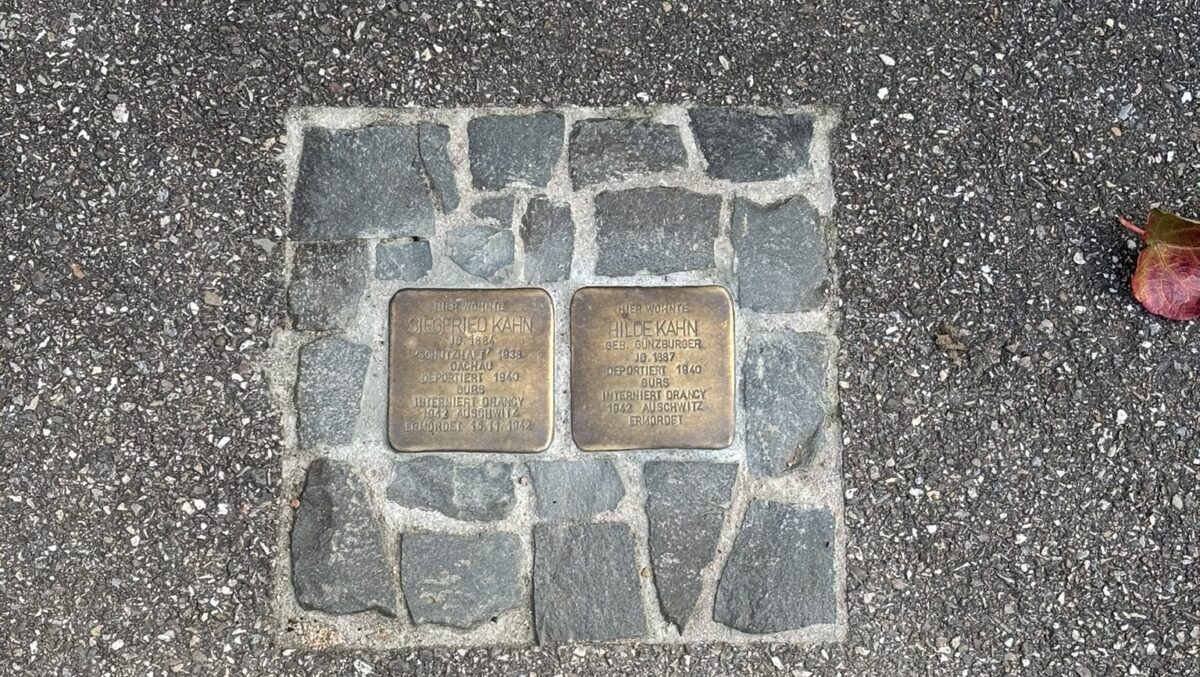
The first time I noticed a Stolperstein in the small town of Müllheim in Germany, where I am currently working on my year abroad, it was pouring down with rain. I was running down the street, my head bent down, watching my feet to avoid the puddles forming on the pavement. Amongst the puddles, I noticed it. Stolpersteine look fairly inconspicuous at first: small brass plates in the middle of a pavement, nestled amongst similarly sized paving stones. The literal translation of Stolpersteine is ‘stumbling stones’, a physical obstacle in your way. Despite the name, they are easy to miss and you aren’t at risk of stumbling over them as they sit flush with the pavement.
Despite the weather, I was stopped in my tracks. Stolpersteine are not merely brass plates: they contain the information of persecuted individuals, recorded to have lived or worked in a nearby building during the Nazi period. The memorialising plaques note these individuals’ birth year, and their fate under Nazism.
On this day, I did not physically stumble over the stone as their name denotes, but I did stumble upon the story of Jeanette Schwab. She was born in 1875, and in 1942 at the age of sixty-seven, she was deported to Riga Concentration Camp, where she was later murdered. I contemplatively looked up at her house for a second before continuing down the road. Barely five seconds later, I came across two more stones: Josef and Helene Zivi, brother and sister, who were both murdered in January 1943 in Theresienstadt Concentration Camp.
I could not get the thought of the fates that Jeanette, Josef, and Helen faced out of my mind as I continued down the road. How many people had been forced to flee, were deported, or murdered, who had once called Müllheim home? Who were these people beyond the preliminary information given on the stones? How must it have felt for their neighbours to turn against them, hand them over to the authorities, or stand by as these atrocities were committed? My uneasiness, my questions, and my attempt to understand their situations are the goal of the Stolpersteine project.
The project was initiated by the artist Gunter Demnig in 1993, and in 1995 the first twenty-five stones were laid in Cologne, where Demnig lived and worked. As of 2026, one hundred and sixteen thousand Stolpersteine have been laid across the whole of Europe, according to the project’s own figures. Demmig’s project is tied closely to the Jewish proverb that a person is only forgotten, if their name is forgotten. His idea was that by being confronted with even just a few details of the personal background of the persecuted individuals, people would be provoked to think about the realities of the horror of the Holocaust. Approximately six million Jewish people were killed by Nazi Germany during the Second World War, and the Nazis also carried out the mass murder of millions of others, including members of the Romani community, disabled people, LGBTQ+ people. The enormity of the destruction, terror, and murder is impossible to fathom, and, when spoken about in such unconceivable numbers or terms, the horror is at risk of becoming an abstract idea. The stones Demmig and the Stolpersteine team have laid therefore bring the reality of what the mass murder of millions of people means to the streets of Europe.
In a 2014 article, Demmig stated that the most pleasing thing about the project is the engagement of young people. For example, in Müllheim the Stolpersteine were installed in 2004 as the result of a project run by students from a local school. Demnig says that students are able to grasp, with their involvement in such projects, the stories behind people from their local area, maybe thinking to themselves
‘Der war ja so alt, wie ich jetzt bin, als der ermordet wurde. Oder: So alt sind ja jetzt meine Großeltern.‘
[He was as old as I am now, when he was murdered. Or that is how old my grandparents are now. (my trans.)
I have now, since that first encounter in the rain, visited all the Stolpersteine in Müllheim. There are twenty-five in total. One marks the site of the former synagogue, which was destroyed during a pogrom in November 1938, and another marks the site of the ‘ghetto house’ where many of the town’s Jews were forced to move before they were deported. The other twenty-three tell the fates of persecuted Jews who lived in the town. There were, however, eighty Jews in total living in the town in 1933 when the Nazis took power, but increasingly racist treatment and disenfranchisement forced many to leave. In total, forty-six Jews from Müllheim and the nearby village, Badenweiler, were murdered in the Holocaust.
My stumbling on Müllheim’s Stolpersteine made me reflect on how people view the Holocaust in Britain. A 2016 UCL Centre for Holocaust Education report titled “What Do Students Know and Understand About the Holocaust?” found that more than half (56.1%) of younger students from years seven to nine believed that the Holocaust was solely attributable to Adolf Hitler. Furthermore, only a small number of students considered the German people to be complicit in, or responsible for, the persecution and mass murder of Jews and other victim groups. In modern British society, community tensions are rising, which conservative politicians could manipulate to evoke strong feelings in Britain about political history. It seems more important than ever to think about the realities of what happened in Germany between 1933 (when Hitler was appointed Chancellor of Germany) and the end of World War II in 1945.
Antisemitism, racial hatred, and the dehumanisation of people deemed ‘other’ were government policy in Nazi Germany, and the systematic murder of eleven million people was largely carried out in concentration camps outside of Germany. However, in towns like Müllheim, all across Germany and Europe, neighbours turned against neighbours. Political hatred seeped into communities and drove out people who had roots there for generations. Pogroms were carried out by local people, ‘normal’ people. Houses next door to those marked by Stolpersteine were likely lived in by the very people who committed such acts of violence. Jeanette Schwab, whose Stolperstein was the first I came across, was reported to the German SA, likely by neighbours.
To me, it seems increasingly pertinent for people in Britain at this time of Remembrance to remember the horrors of the Holocaust in the face of attempts from some politicians to sow divisions or classify ‘otherness’. While we are not physically confronted with the realities of Nazism in Britain, this does not make its lessons any less relevant to us. We must remember what Nazism did to Europe, and how it started. We must recognise how quickly prejudice can become normalised, how readily communities can turn against one another, and we must be vigilant against the hatred and division that made such atrocities possible.
Therefore, I end my article with a reminder of the premise of Stolpersteine:
‘A person is only forgotten, if their name is forgotten.’
Below listed are the names on the Stolpersteine of Müllheim, taken from Müllheim Tourist Board and Markgräfler Museum information.
Ida Meier, born 1887: a ladies’ tailor, died by suicide in 1938 after her home, which she shared with her sister Rosa, was destroyed during a pogrom.
Rosa (Meier) Wolff, born 1890: suffered a severe depression after her sister’s death and was deported from a Jewish old people’s home to Auschwitz where she was murdered in 1942.
Siegfried Kahn, born 1884: deported to Auschwitz with his wife in 1942 and was murdered there on the 15th of November 1942.
Hilde (Günzburger) Kahn, born 1887: despite the efforts of her son from her first marriage to facilitate their moving to Switzerland, Hilde was deported with her husband and died in Auschwitz.
Leo Bernheim – died in 1931
Frieda Bernheim- died in 1936
Sophie Bernheim, born 1903: deported in 1940 to Gurs Concentration Camp, and was murdered at Auschwitz.
Max Bernheim, born 1919: brother of Sophie, fled Müllheim for Denmark and later Sweden and survived. His descendants ensured that the entire Bernheim family was commemorated in the Stolpersteine.
Isaak Günzburger, born 1886: deported in 1942 to Izbica concentration camp, where he was murdered.
Jacob Alperowitz, born 1883: detained in 1938 in Dachau concentration camp, before managing to flee to Palestine in 1939, where he died in 1944.
Samuel Moses, born 1888: fled to France in 1936, but was later detained and murdered in 1942 at Auschwitz.
Rebekka Moses, born 1881: detained at Drancy and later murdered at Auschwitz in 1944.
Mina Moses, born 1890: fled to France in 1935, but was detained and murdered at Auschwitz in 1942.
Julius Moses, born 1892: fled to France, separated from his non-Jewish wife in order to protect her, was murdered at Majdanek in 1943.
Carry (Heimann) Zivi, born 1885: attempted to flee to the US in 1942 with her family but she was taken off the soon departing ship alone, deported to Auschwitz and was murdered there.
Mathilde Zivi, born 1884: after the forced purchase of her house, she was deported to Gurs and then to Auschwitz where she, her brother and her sister-in-law were all murdered.
Fritz Schaller, born 1880: expelled from Müllheim, was handed over to the Polish police with his son Heinrich in 1934, and taken to Ukraine. He was arrested by the Gestapo in 1941 and murdered.
Irmgard Schaller, born 1923: expelled from Müllheim, died of heart failure in 1938, contributed to by malnutrition and poor living conditions while her family prepared for their flight to Palestine.
Leopold Alfred Meier, born 1905: fled to Switzerland in 1937, but went to France where he joined the resistance. He was detained in 1942 and deported to Auschwitz where he was murdered.
Jeannette Schwab, born 1895: seamstress, who was reported to the SA. She was attacked and forced to sell her home. She moved to an old peoples home in Berlin but was deported from there to Riga Concentration Camp where she was murdered.
Helene Zivi, born 1878: forced to move to the ‘ghetto house’ after the pogrom in November 1938, later deported from a Jewish old people’s home to Theresienstadt where she was murdered on the 21st January 1943.
Josef Zivi, born 1868: brother of Helene. forced to move to the ‘ghetto house’ after the pogrom in November 1938, later deported from a Jewish old people’s home to Theresienstadt where he was murdered on the 10th January 1943.
Arthur Meier, born 1912: choirmaster and religious leader of the Müllheim Jewish community, was deported after the pogrom in 1938, and murdered at Auschwitz in 1942.