

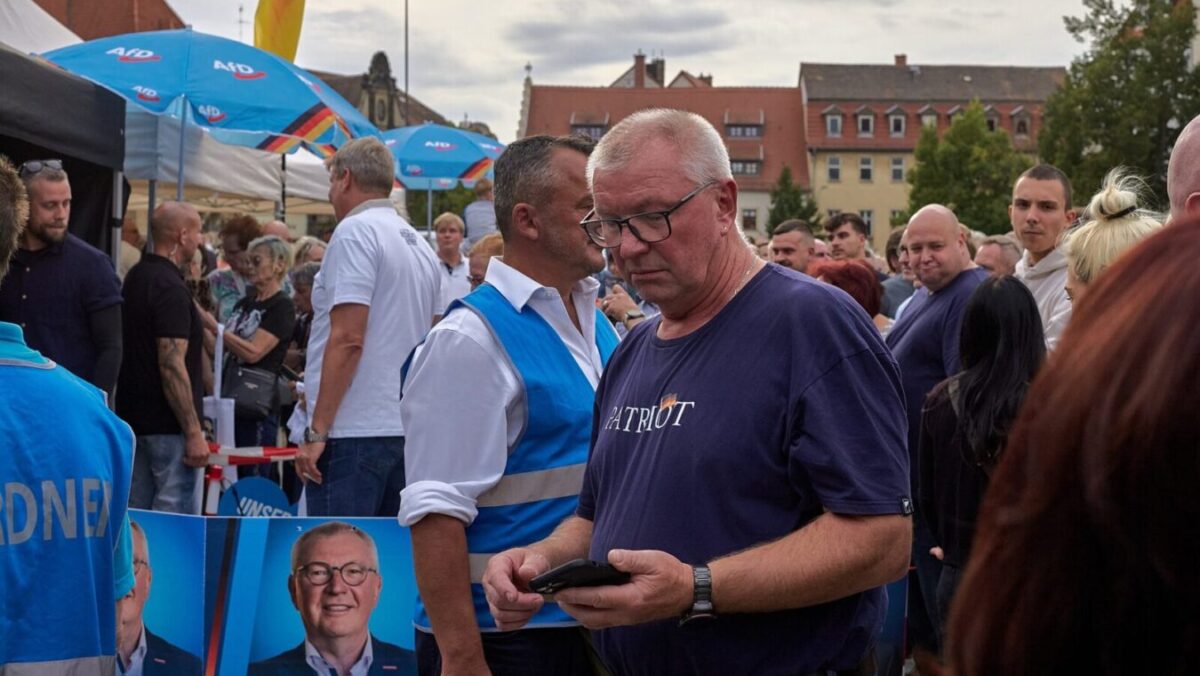
The three most recent state elections in Germany all reflected something different about Germany’s current political climate. The far-right Alternative für Deutschland (AfD) won in Sachsen-Anhalt, their second ever win in a state election. In Berlin, The Left Party (Die Linken) prevailed. For the first time, the established Christian Democratic Union of Germany (CDU) will not sit in a government. What does this mean for Germany’s future? What does it mean for Chancellor Freidrich Merz? And can the AfD really come to power in Sachsen-Anhalt?
On 6 September 2026 German state elections (Landtagswahlen) were held in Sachsen-Anhalt, with a record turnout of 77.8%. The far-right AfD came out with 43.8% of the votes, nearly doubling their previous share. By stark contrast the conservative CDU’s share, current chancellor Friedrich Merz’s party, more than halved.
For one single party to form a majority government within a state they need a clear cut majority, winning 50% of the seats. In Sachsen-Anhalt the AfD secured 39 seats of a possible 83, falling short of that majority by just three seats.
The same month, on 20 September, elections took place in Mecklenburg-Vorpommern and in Berlin. In the former there was a similar result, with the AfD overtaking the SPD as the most popular party. The party acquired 32 of a possible 71 seats, again falling short of a majority. The SPD were left with 29 seats, whilst The Left Party and the Greens (Die Grünen) took just five seats each, just barely surpassing the 5% minimum to secure representation in the regional government. The most shocking result out of Mecklenburg-Vorpommern was that the CDU fell out of a regional parliament for the first time since the party’s formation in 1945, reaching just shy of the minimum at 4.9%.
On the same day in Berlin, Die Linken were victorious. They claimed 47 of 158 seats, followed by the CDU, the AfD, Die Grünen and the SPD. It was largely younger voters, in the groups 16-24 and 25-34 years, who voted for the left wing party, with a sharp drop thereafter.
So, without a single party able to form a majority alone in any of the three states, how might each government actually look?
Mecklenburg-Vorpommern and Berlin are fairly straightforward. Whilst the AfD took the most votes, the other parties have refused to cooperate with them: a problem they also face in Sachsen-Anhalt. Therefore, in Mecklenburg-Vorpommern the SPD will need to form a coalition government with Die Linken and Die Grünen. This is not difficult to imagine, the parties are similarly politically oriented, and it is reported that the previous coalition between SPD and Die Linken went rather smoothly. Together the three would exceed the 36 seat majority by three seats, leaving the AfD as the only other party to form the entire opposition.
In Berlin the most likely constellations are either the same as in Mecklernburg-Vorpommern, but with Die Linken holding the bulk of seats around which Die Grünen and SPD would coalesce; another less likely possibility is the latter two parties forming around the CDU, with Die Linken and the AfD acting as a sharply divided opposition.
In Sachsen-Anhalt the options become slightly more complicated. This is largely due to this so-called “firewall” which most other parties have presented against the AfD; an attempt to deplatform their extreme right-wing policies through noncooperation. In theory, this meant that no majority government could be formed by the AfD. This excludes any instance where the AfD were to meet that majority alone.
Simultaneously, a majority government is highly unlikely to be formed around any other parties. In fact, all five other parties represented in the Sachsen-Anhalt Landtag (State Parliament) would need to form a coalition in order to gain a majority: CDU, Die Linken, Die Grünen, SPD and Sahra Wagenknecht Alliance (BSW). Not only is this extremely unlikely, but trying to run a government whilst stretched so thinly among so many parties, spanning the political spectrum, could lead to policy gridlock.
A government will be formed in Sachsen-Anhalt based on a vote to elect a Minister President amongst the representatives who hold seats in the government. For this vote to be successful, the representatives must try to organise a coalition, which would give them enough votes for a majority. The remaining parties will then form the opposition.
So, what are the possibilities? The first is a minority government in which the AfD runs the government, but without any absolute majority they would be relying on the votes of other parties to help them push through policy on a vote-by-vote basis.
Another option would be for a CDU-centred minority government, made up of a coalition with SPD and Die Grünen. The CDU has explicitly refused to form a coalition with Die Linken. Without The Left Party as part of their coalition, CDU candidate Sven Schulze would be left with 31 votes to the AfD’s 39. This means the 8 representatives of The Left Party would need to support the coalition, for it to have a chance at competing with the AfD.
In this situation, both an AfD government and a CDU/SPD/Grünen government, supported by The Left Party, would have 39 votes. This leaves the BSW with the deciding 5 votes. Made up largely of former members of Die Linken, the BSW do align with the AfD on a number of policies, namely their opposition to immigration and criticism of support for Ukraine in their war against Russia.
The AfD are now looking for other parties to enter coalition talks. The BSW are the only party which did not explicitly agree to the firewall against the right-wing party, so a coalition between the two seems to be potentially on the cards.
It remains to be seen whether the BSW would align itself with the AfD or with the CDU coalition: their candidate in Sachsen-Anhalt originally claimed that in such a situation, they would side neither with the AfD’s candidate Ulrich Siegmund, nor the CDU’s Schulze.
However, with the 6 October election of AfD politician Tobias Rausch as speaker of the state government, the possibility of BSW support for the AfD seems ever more likely.
Rausch received 48 of the 82 votes for this position. Whilst the vote remains anonymous, it is possible that of the nine non-AfD votes five came from the BSW, with the remaining four from other parties. With the vote for Minister President looming in December, this result is a huge win for the far-right party.
The other pressing implication of the three elections is the fragility of current chancellor Friedrich Merz. The blows in Sachsen-Anhalt and Berlin, places in which they were previously part of the leading government, demonstrate not only a lack of satisfaction with Merz’s party, but also represent a larger trend towards the more extreme ends of the political spectrum in Germany.
In Mecklenburg-Vorpommern, the complete expulsion of the CDU from both leading government and opposition was also of great historical significance, representing the first time the party has failed to meet the 5% minimum threshold for representation in a government.
Mecklenburg-Vorpommern was also where former CDU chancellor, and Merz’s political rival, Angela Merkel held her constituency. Now, with Merz suffering from the worst approval ratings of a chancellor ever in Germany (only 1 in 10 Germans approve of his performance), the comparison reflects rather poorly on him.
It is easy to attribute this shift away from the centre and towards the extremes to political unpopularity, perhaps in the same way that Keir Starmer was eventually forced to step down as Prime Minister in the UK. However, the idea that politics is decided only by popularity whitewashes what is really happening all over Europe.
According to Politico, in France 34% of voters intend to vote for the far-right National Rally in the upcoming national parliament election. In the Austrian parliament, the far-right FPÖ won more seats than any other party in 2024. Recent opinion polls show Reform UK as comfortably the second most-popular party in the United Kingdom, polls from earlier this year took them for the most popular. Far-right parties are also part of ruling coalitions in Finland, Italy, Czechia and Croatia.
The trend towards the extreme right end of the political spectrum in Europe, and the rest of the world, is not something new; in many European countries these parties follow the same patterns.
Noticeably the AfD uses similar political rhetoric as President Donald Trump does in the US. The slogan ‘America First’ is rooted in a history of non-interventionism, but Trump now uses it to support his nationalist ideologies, whilst simultaneously justifying US intervention in other countries, such as Iran.
The AfD’s slogan ‘Unser Land zuerst’ (‘Our country First’) makes use of the same rhetoric: one of their main policies being to end all aid to Ukraine and to begin to reform ties with Russia. However, the end result of such non-interventionist, inward policy-making is actually often the exact opposite of what it promises, leading to further dissatisfaction amongst the domestic population.
For example, Trump has had to turn to blaming President Volodymyr Zelenskyy for rising diesel prices in the US, despite experts confirming that increased prices were triggered by the US’s bombing of Iran, rather than Ukraine’s attacks on Russian infrastructure.
10 years on from Brexit, a referendum grounded in isolationist rhetoric which claimed that being a part of the EU was harming the UK economy, 50% of the UK want to rejoin. Only 28% wish to remain independent from the union. The majority of economists believe that Brexit harmed the UK economy in the long term.
These examples demonstrate the danger behind this far-right rhetoric, which attempts to garner popularity through inward-looking foreign policy. With the rise of the eurosceptic AfD in Germany, it seems ever more likely that they could be the next country to follow this pattern.
Nevertheless, far-right rhetoric continues to garner support by making such false promises. Perhaps the most obvious example of this in the last few years being Trump’s grand plan to improve the cost of living in the US by placing tariffs on a long list of countries: a policy which increased the prices of goods for US companies and consumers.
This is also crucially important in consideration of the AfD’s immigration policy. Just like the American and British far-right, the AfD’s scapegoat is immigration. Their isolationist rhetoric is only functional in tandem with the unjustified fear they themselves have whipped up around immigration.
This rhetoric is used despite the fact that Germany, alongside the US and UK, is a country built on immigration. During the 1950s and 60s, referred to as the “economic miracle”, the country signed bilateral agreements with Italy, Spain, Greece, Turkey and many other countries to fix its shortage of labourers. Turks particularly form an integral part of German culture to this day. Whilst a plethora of studies contend that immigration has had and continues to have a positive effect on the German economy, the AfD continues to oppose immigration.
According to economists, opposing immigration could hinder economic growth in Germany. The takeaway being that opposing immigration hinders a domestic population in the long run.
Granted the AfD are still far away from coming to power centrally in Germany, but these elections demonstrate their huge voter base. They have shown the world that the possibility of the AfD running a regional government is not as impossible as was once thought. The firewall that once stood in their way is beginning to falter, and it is becoming gravely important to consider the possibility of their future election, and the implications thereof.