
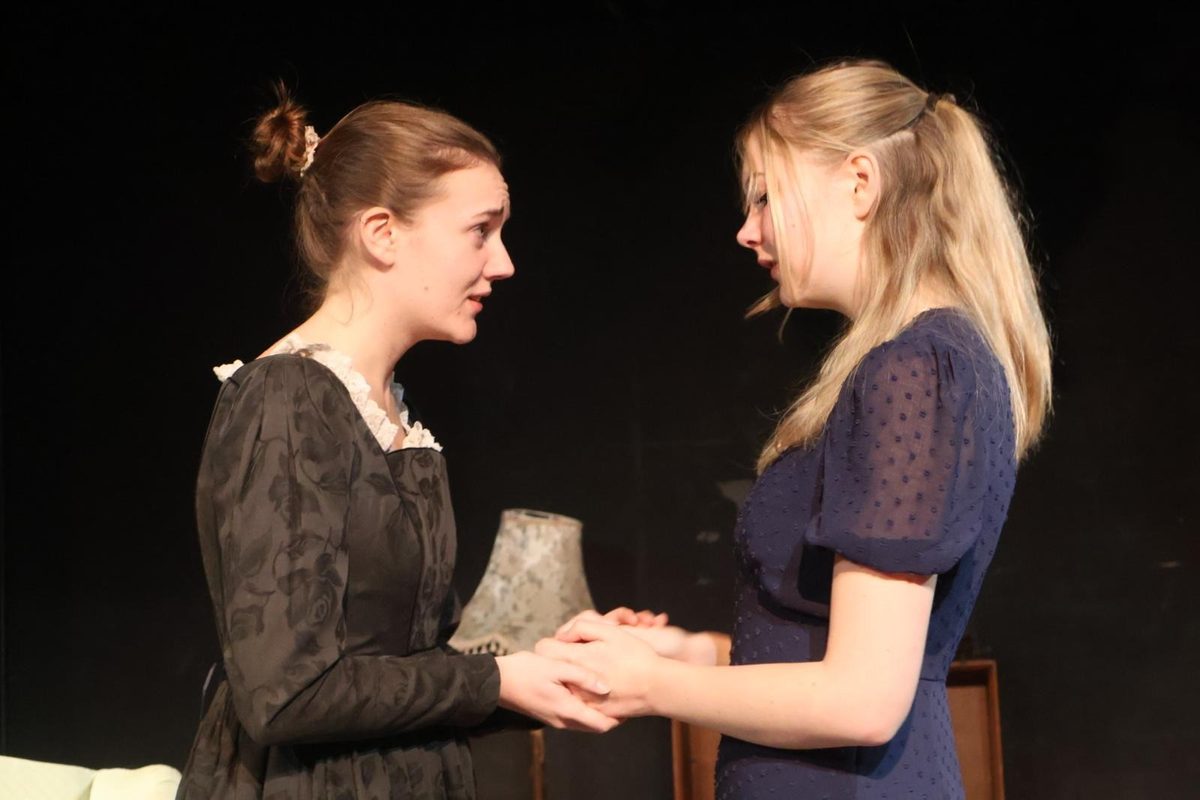
Earlier this term, I was lucky enough to watch Burning Down the House, an adaptation of A Doll’s House, in the Schwarzman Centre. It was a lovely production, yet the image that struck me the most was a young girl accompanied by her mother in the seat in front of me, holding her colourfully annotated Methuen Student Edition of the play. I truly wish I had my copy with me for this production, simply to further steep the pages with the ink of eager analysis. Although I had no paper to hand, this production of the play by St Giles’ Productions had my mind scribbling excited thoughts at every second.
A Doll’s House was written by Norwegian playwright Henrik Ibsen in 1879, and, in the 150 years since, has been an incredibly popular play – renowned for its loud door slam at the end which signals the beginning of doll-wife Nora’s independence. The play encompasses the conflict between Nora’s performance as the sweet, doting ‘spend-thrift’ wife, and the reality of a financial secret. Having illegally obtained a loan with the forged signature of her father, a loan that both saved her husband Torvald’s life without his knowledge, she risks the complete obliteration of their social and moral good-standing if found out. A lie keeps this marriage together, and the play will not let you forget it.
Central to this anticipation was Tristan Hood’s Krogstad: a lawyer, moneylender, and the source of Nora’s loan. His interpretation of the character retained the powerful feeling of bitterness that Krogstad holds towards the Helmers’ picture-perfect life with smug, terse delivery that sometimes exploded into frustration at his own situation; it is early revealed that he, too, lost his good-standing over forgery. Regardless of the fact of his literal height difference against Nora, his slow, wide, swinging gestures perfectly encapsulated the looming presence both Krogstad and her secret hold over the play. The contrast between him sitting smugly in the family’s living room armchair, mocking Nora, and his almost child-like excitement at the prospect of a rekindled relationship with Mrs Linde (played by Emily Polhill) was delightful to watch.
Indeed, particular attention was given to the body language in this production especially. Mia Pitt’s Nora embodied the fast-paced, flighty jitteriness that best befits both her performance as a childish wife, and a woman living with the knowledge of the incoming implosion of the current state of her marriage. By contrast, Emily Polhill’s Mrs Linde, as a more experienced woman of work, and a widow who feels ‘unspeakably empty’ (though not by her husband’s death!) was much more withdrawn and precise. Her movement is constrained, with arms tucked by her sides. Will Hamp’s Torvald embraces the almost-mechanical precision of a man attempting to play the perfect husband in a way that never lets you forget his unsettling control over Nora, even in his more playful moments. Cameron Spruce’s Dr Rank showed a smooth, measured performance that gradually devolved into a show of his physical weakness – a hereditary punishment for the moral sickness of his promiscuous father (a very Ibsenite concept). This crumbled into awkward flusteredness as his character professes his love for Nora, a break in his disposition that I do not often catch in other productions of this play. Nevertheless, he was able to successfully disappear into the background of the set when playing the non-diagetic piano.
The piano itself was a new addition for this production, and not something I have seen before. I admit I had my fears with this, worrying that it would remove the weight of the frenzied Tarantella performance that occurs right before the end of Act 2. However, with pieces written by the supremely talented James Pearson and performed on-stage by Spruce, it only further communicated the tacit breakdown of a marriage based on ‘playtime’ rather than any serious talk. It almost felt meta-theatrical, which was certainly aided by a Penguin copy of Ibsen’s A Doll’s House in the back shelf of the set (see below). Superficial performance is the linchpin of this marriage, and I was glad the production placed a special emphasis on this. The wooden chair, mainly used by Spruce to play piano throughout the play, finds itself by its match at the dining table at the end of the play when Torvald and Nora finally sit down to talk, a nice movement from the theatrical use to real, domestic usage. The pillows that Nora attempts to fluff in Act One sink sadly into the sofa, the beginning of this theatrical breakdown. For this, credit goes to set designers Maya Flint and Alexandra Russell.
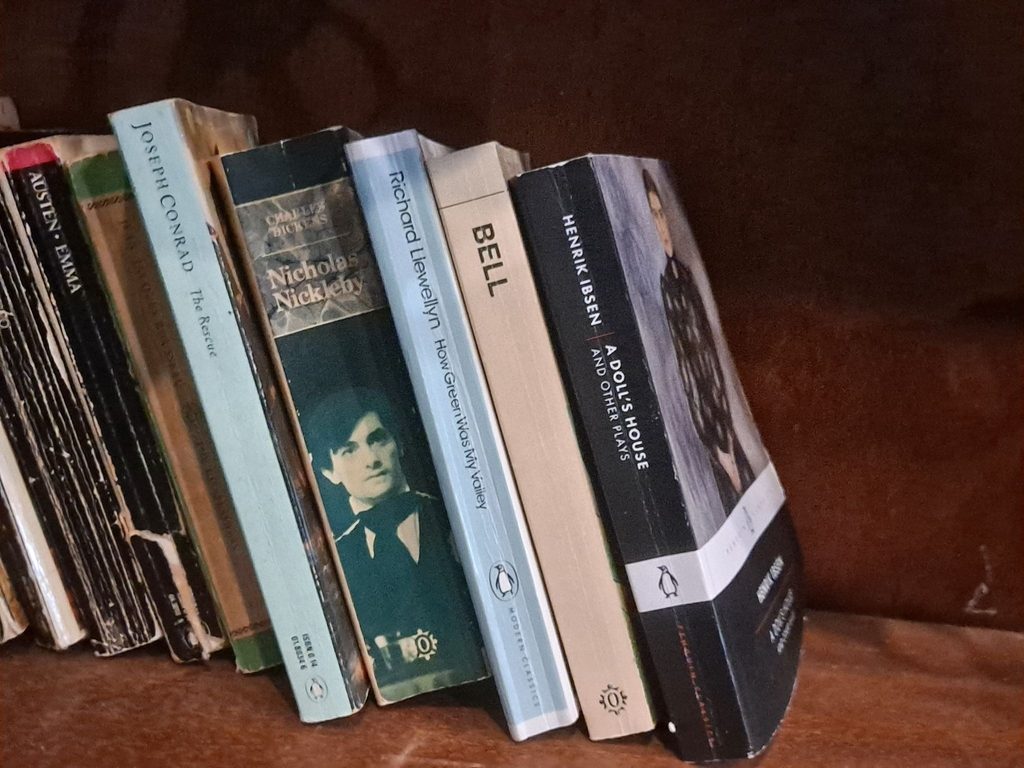
Image credit: Mya Sidhu, used with permission.
I’m very well acquainted with Henrik Ibsen’s A Doll’s House. So much so that I caught myself mouthing the lines at some points, but this couldn’t take away from the anticipation as to how they would be delivered. This was an incredibly tight performance for an opening night, and even small trip-ups in cues were nicely saved and integrated into performance. In a play that so often shows a cynical ‘switch’ in Nora’s character after she realises Torvald’s chivalric conception of himself is nothing but a self-soothing pretense, I was glad to see a more subtle performance here from Mia Pitts. Nora retains her soft register. She doesn’t shout or scream, at least in ways that depart drastically from her previous performance. Instead, we watch a more subtle recognition of a shallow marriage, and the grip of an identity as ‘mother’, ‘wife’ and even ‘Christian’ that slips completely. Nora loses this security of her sense of self, but Pitt’s performance acknowledges that she really has nothing else to perform. Not until she leaves and is inaccessible to both Torvald and the stage, that is.
Although it picked up in the final act of the play, courtesy of Hamp’s drunken Torvald, I do wish some of the comedy had been played more obviously. Dr Rank’s unintentionally misogynistic jab towards Nora where he implies pregnancy-induced madness (‘is she… expecting?’) was delivered a little too quietly for my taste. On omissions: some of Torvald’s excessive reference to Nora as a little girl was (justifiably) removed, although I did miss the moment where Nora and Torvald remove their wedding bands, marking the official and mutual ending of their marriage. Nonetheless, this was an amazingly tight cast and script, and St Giles should be thoroughly impressed with the depth they were able to give characters who have had so many reiterations.
I cannot ignore the set though – and this production was a masterful use of the space of the Michael Pilch studio. A Doll’s House, as the name suggests, feels slightly claustrophobic and artificial. St Giles’ production sees his artifice falling apart, whether it’s the meagre Christmas tree on a table in the corner, the box of forbidden confectionery hidden under the sofa, or the slightly dreary-looking shelf at the back. With the two doors of the Michael Pilch, I eagerly awaited the final door slam to my immediate left. I am happy to report that it truly did live up to the classic line from James Huneker in 1905 I humbly recall from A-level: ‘that slammed door reverberated across the roof of the world’ (or in this case, OX1.)
Really, I could go on forever with this review. In fact, I was tempted to do so with director Maya Flint, and some members of the audience once the performance was over, which I hope is a testament to its outstanding continuation of Ibsen’s legacy – shoes that are rather large to fill! Ostensibly, this production was a work of immense passion from all involved: so, from an Ibsen fanatic, give the play a watch before Saturday is over!
A Doll’s House is showing at the Michael Pilch Studio from 24-28 November.