
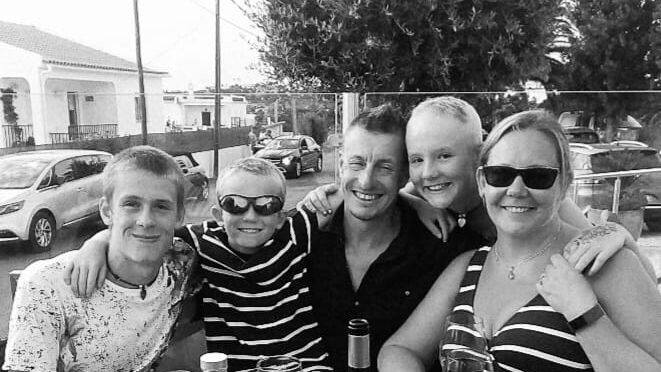
Something I struggle with very often is the homophone as highlighted in the title. Or rather, I struggle with both aspects of this title because being bold and confident is scary but being bald is even scarier when you are an eleven-year-old girl looking at secondary schools.
The first time that I noticed my hair falling out, I was getting ready to visit a school for an open day, a change I was not looking forward to as a shy personality, anxious and scared to move away from the idylls of a primary school setting. Talk about a bad moment to have a crisis. You would think you would notice immediately if your hair suddenly starts falling out, but it is a creeping transition. Looking in the mirror at a face distraught with the sudden realisation that I could see part of my scalp way more than I should have been able to—that moment was formative. A specialist later informed me that I had Alopecia Areata, a term I have had to define for many people over the years.
Alopecia Areata is a condition in which a person experiences partial hair loss whilst Alopecia Totalis or Univeralis is complete hair loss. Alopecia UK, in 2021, approximated that 400,000 people in the UK either have Alopecia Areata or have had it in the past, and I guess that includes me. Whilst I have never lost all the hair on my body, my eyebrows threatened to go on one occasion. But, they never made it more than halfway gone, so I just looked consistently surprised for a bit. The hair on my head has fallen out completely before. When people around me ask ‘I wonder what it would look like if I was bald?’, or use a social media filter that removes your hair, I find it funny to watch the look on their faces when I assert the fact that I have been—twice.
People are weird towards you when you have no hair. You don’t think much of it until it happens to you. On vacation in the pool, when I finally worked up the courage to remove the headscarf I had been wearing to get some sun on my beautifully pale scalp, an older couple clearly stared at me and my mum later admitted that they were discussing whether I had cancer or not. It feels awful that, contrary to pitying glances, I did not have cancer. I have an auto-immune disease that rejects my hair, so I am not dying. But, it is hard in a different way entirely to lose control of your appearance like this.
The lack of femininity I have felt at different points in my life has shown me the incredible amount of socio-cultural attachment to hair. A student at Exeter University conducted research into ‘what should a woman look like?’ and received the response of long hair as the most common factor into femininity. The cultural signification of long hair as synonymous with femininity has no basis in concrete scientific fact. Both a man and a woman can have short hair or long hair. What is more, having short hair as a woman also does not make you automatically lesbian or old, as people have implied to me on several occasions. Sexuality is a different aspect to bodily representation as is the fashion for different ages and does not necessarily fit into a stereotypical view. Those around you who are not culturally sensitive to this fact though, especially in my experience those who are older, can make comments that try to place femininity into an intrinsic link with long hair. To go into this further, Raewyn W. Connell discusses this cultural attachment to the value of long hair in her book Gender and Power: Society, The Person, and Sexual Politics in 1987 in the first seminal text that deals with this topic. Connell goes into how masculinity and femininity are divided into binary terms that are defined through ‘block differences’ such as characteristics of long hair vs short hair. In fact, the system of gender definition in relation to external appearance is far more fluid than societal strictures permit.
At around the age of fifteen, I finally worked up the courage to wear a wig for the first time, after the second time of my hair falling out and realising something had to change. Over Covid-19, I had become increasingly insular and shy, developing an Eating Disorder that stemmed from the lack of self-confidence I felt, which has had long-lasting effects that I still deal with today. A wig, although I detested that word as much as I detested the word ‘bald’ which springs to mind pictures of male pattern baldness, gave me part of my confidence back.
The Little Princess Trust is a foundation that supports children to those aged 24 who have lost their hair due to cancer treatment or other conditions like mine. Guess how much it costs to buy a human hair wig (donated hair that lasts longer than synthetic versions)? There are different quotations about how much this costs on the internet, but I found prices between £300-2000. At the time, I remember the hair stylist telling me it cost £700-£800 for them to make a wig, which was shocking to me, especially considering they were giving me one for free. My family, supportive to the utmost, later held a charity event to raise money for the trust and we donated enough money for at least one of these wigs, which felt like a small way to give back to something that had aided me immensely. Not only does the organisation give you the wig, they style it to your preference as best as they can. This was not a proper replacement for my real hair. It is uncomfortable to wear and degrades in quality over use, but it provided a temporary relief for me. Anyone who would like to contribute – their own hair or to donate money – can visit their website.
Despite suddenly turning up to school one day with an abundance of hair that I certainly didn’t have before and didn’t grow overnight, I count myself lucky that my schoolmates were mostly respectful of my situation in a way I recognise that in other, less healthy, friendly environments, would not have happened. Inevitably, there were the odd few comments. People assumed I was Muslim because I was wearing a headscarf to cover my head, which I am not. Obviously, being Muslim is a positive part of identity for many and there is no offence to be taken with this, but to be identified as something you are not is a confusing aspect of existence when your interior is not recognised in your exterior appearance. Once I was asked the question: ‘How hard would I have to pull to take your wig off?’ In retrospect, this question was rather disrespectful, but for some reason the audacity of it still makes me laugh to this day. I was too shocked to be offended by it, instead answering ‘Not that hard to be honest’.
However, when my friends finally worked up the courage to ask me what my condition was, something I had not realised they were too scared to ask me, as very sensitive souls, I was more than happy to answer. I have Alopecia Areatas as described above, which, for me, is part of an auto-immune condition. Auto-immune conditions are chronic, and I inherited it from my dad, whose condition has manifested in his gut health rather than hair. Your immune system mistakenly attacks healthy cells (like my hair cells) instead of doing what it should by defending against harmful cells. When my hair is flaring up, I get very tired which I fight against to do my academic work to my perfectionist standard. When I am stressed, though this does not cause the condition as many people mistakenly assume, it makes the hair loss worse than it would be otherwise. When people tell me my hair loss would stop if I just stop stressing, I internally groan and want to ask them where they found the switch to turn off stress in the body. Because that would be very useful.
At seventeen, I was looking for a boyfriend. But, part of the consideration of becoming interested in boys at the time was that no one would find me beautiful enough, or feminine enough, to date me. I have been proven wrong consistently. The right sort of person does not quantify their affection for you by the way your hair looks. Now my hair has grown back, but becomes patchy here and there. My partner reminds me that the tufts of hair growing back are something he loves about me. More importantly, it is becoming something I love about myself. I have been through every hairstyle under the sun and have a bag of wigs in my cupboard that would be very useful for a Halloween costume.
You would be surprised by the difficulty that comes with having no hair though. Rain becomes a problem because it makes your hair look thinner; swimming is a whole other issue. I hate my prom photos because my wig does not look natural as my hair was growing back and pushing it up underneath. However, that was the summer I could stop wearing wigs, and let it grow.
This is not a pity party for myself—although I feel like I would be rather entitled to that at this point, everyone needs one now and then. In fact, this is partially a selfish way to avoid explaining again and again what Alopecia is, though I do not mind when someone is genuinely curious about it. I have lacked the boldness to show photos of myself when I had really short, to no hair. But now, I consider the fact that cutting my hair short would be fun and a positive aspect of my identity. In the picture at the top of the article, of me surrounded by my loved ones, I am going to change my apprehension towards my identity as someone with Alopecia. I am choosing to grasp hold of my boldness and baldness by showing myself with my short hair.