
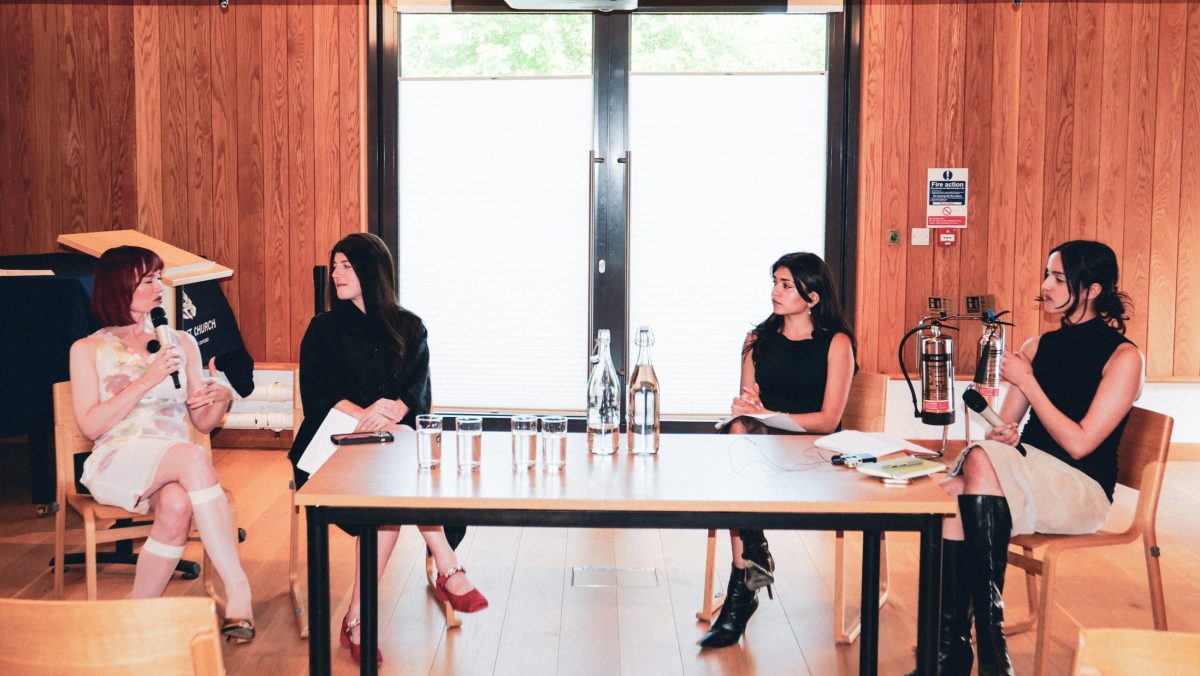
On the 8th of May, Oxford Fashion Society held their ‘Women in Fashion’ panel. This consisted of an inspirational discussion by the two renowned industry experts – Julia Hobbs and Daisy Hoppen – who each shared their experience and insights in the world of fashion, whilst demystifying its stereotypes.
Hobbs is British Vogue’s Senior Contributing Fashion Editor. Having studied Law, and later European Law in the Netherlands, her career is characterised by her dedication to the industry, which she detailed in remarkable stories of her path to her current position. During her time spent at the Financial Times, she showed commitment to Vogue, and she currently writes across a range of topics that concern fashion. Meanwhile, Hoppen studied History and worked for a jeweller in Tooting, before breaking into the PR industry by working for Purple PR. In this position, she worked with brands such as DKY and Roberto Cavani, before deciding to freelance (after time at another agency), and starting her own PR team, DH-PR, in 2013. Currently, they have an excellent roster, working with brands such as Stone Island, Belmond, Dover Street Market (London and Paris), Mulberry, Tekla, Ganni, and Birkenstock. This is a testament to both of their hard work, and their commitment to their respective careers, despite neither initially studying for a fashion-related career.
Both panellists also gave an interesting account of what a career in fashion genuinely consists of, from the extensive hours to the never-ending social affairs (to which The Devil Wears Prada provides a surprising accuracy). They described having many late-night WhatsApp discussions about something that seemed urgent at the time, with much time spent at many different events. Hobbs joked: “Enjoy making your friends mad by missing birthdays and cancelling on dinners and things like that because you’re always working”. Still, this was by no means presented in a wholly negative light, as both panellists agreed that this dedication is how they manage to grow. This means being as involved as possible in their careers, attending social outings at four times a week, and, in different fashion seasons, attending events for up to six weekends in a row. Hoppen explained that attendance is a client expectation. Indeed, despite being heavily pregnant at the time of the panel, Hoppen is set to work up to three days prior to her due date. That said, she is going to be back for the following Fashion Week, since, once again, this is a client expectation.
It is for this reason that both panellists emphasised the necessity of balance. Life in a fashion-oriented career consists of close relationships with clients that can lead to a blur in the lines between personal and professional life. However, both experts find time away from their careers; Hobbs illustrated her average weekend is spent decked out in Crocs, spot cream, and prescription sunglasses, whilst walking her sister’s “very badly behaved” dog. Hoppen similarly spends her average weekend in a playground, saying “it’s something quite humbling to have a toddler throwing pasta in your face” despite the stereotypical glamour of their world. For this reason, they say, it is important to retain a true self, distinct from the industry.
The PR side of fashion is often thought to be “ab fab”, as described by Hoppen, but she also explains that it is far more than this image of drinking champagne before the next glittery, glossy runway. Instead, much more goes into this: there’s the features, the profiles, the organisation of runway shows, sounding boards, and even acting as a therapist for clients. Good PR is, in many ways, invisible, so Hoppen’s work in crisis management and the complex organisation of such events has only proved to be, from what her and Hobbs described, far more impressive than generally thought.
Similarly, Hobbs sheds light on her work with writers in shaping their stories, in nurturing those relationships with them, and in watching their ideas grow and evolve. Yet both panellists’ careers are dependent on this social side, as bringing stories from the night before to work the next morning is how the industry functions, and is how people are discovered. The fashion industry is powered by gossip – “Who did you meet?”, “What story have you got?”– and so on. Hobbs explains that, particularly in the age of the internet, the Vogue readership wants to hear about what cannot be discovered by a simple line typed into a search engine.
As a result, The Devil Wears Prada, and its enjoyable 2026 sequel, provide an insight into the world of fashion in the same way the industry itself provides an insight into the world of celebrities and cultural figures. Hobbs expressed the complete shock and surprise from herself and her Vogue co-workers at the premiere of the new film, which she says had many aspects that could have easily been a documentary. Watching it, they were caught in mixed whispers and mutters of “Oh, my God”, “How did they know that?”, and “That was exactly like that!” The protagonist Andy Sachs and her fear of making mistakes (in both the original and the sequel), is said by Hobbs to be entirely accurate. Many fear their boss’ reaction to something so simple as forgetting to cancel a hotel room. Likewise, the chic and powerful Miranda Priestly is presented in both films as the so-called ‘villain’— but both panellists agree that in the fashion industry, this is just business.
This circles back to the panellists’ emphasis on community within the industry, particularly as it is female-dominated – as Hoppen says, her own company consists 90% of women, but welcomes men who wish to join the industry. The social side of the industry, they explain, does not solely link to nights-out and gossip; female friendships and networks are essential, particularly across different generations, to both get and, later, give help. So, this community and social aspect are indispensable. Especially given the female dominance within the industry, the panellists emphasised the importance of mutual understanding and support throughout their careers – as many women, like Hoppen, deal with the demands of the fashion world in combination with pregnancy. To prove this further, Hobbs and Hoppen expressed that their own friendship has, as of now, lasted around fifteen years. This, in itself, is a testament to the benefits and support networks that can be forged within the industry.
Hobbs and Hoppen presented an engaging insight into the fashion industry, derailing many stereotypes, whilst providing Oxford Fashion Society’s audience with their advice and expertise. This made for an excellent discussion, with revelations into the industry that were to be thoroughly enjoyed by its audience.