
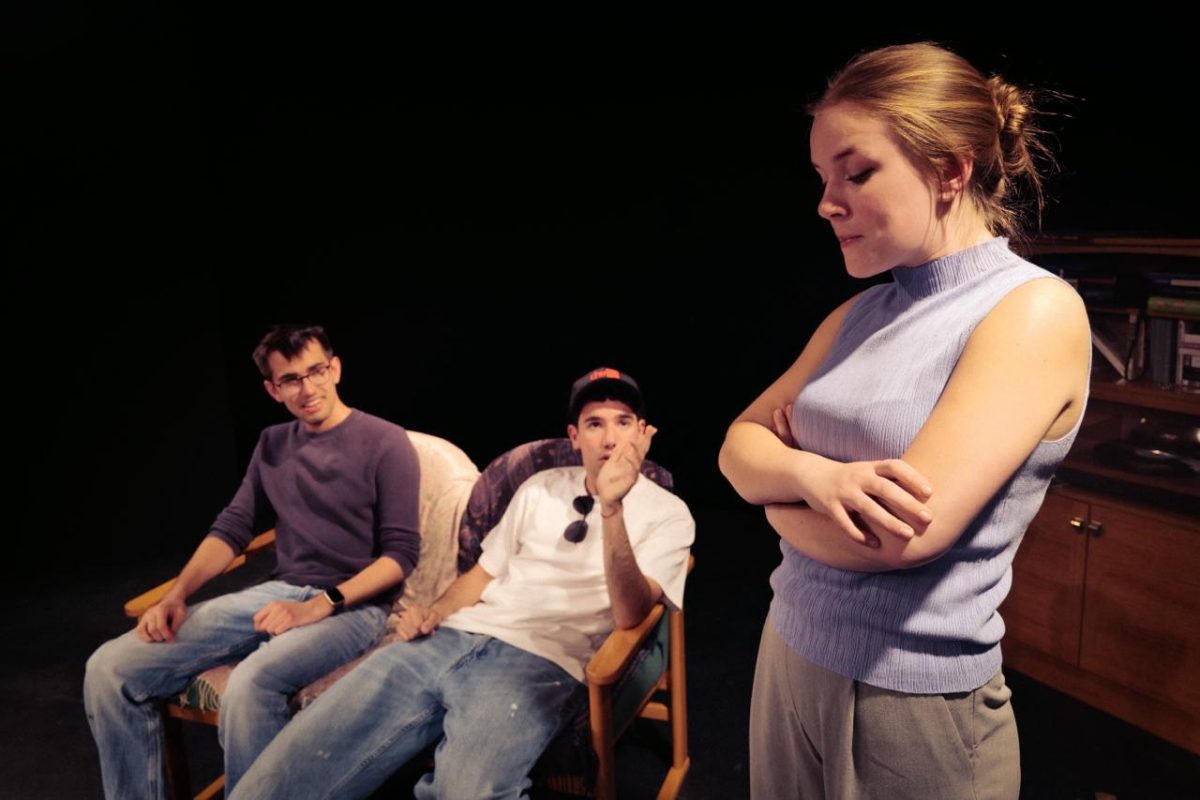
This is a conversation you don’t want to miss.
The premise of Ulster American is exactly what the tagline reads. It is a play that consists almost entirely of a conversation between an actor, a writer, and a director. Unlike many plays, there are no scene changes or time skips: instead, you are presented with one continuous point in time for the entire performance. And yet, directors Kate Burke and Robyn Hayward have staged this conversation in such a way that you cannot tear your eyes away from the stage.
Before the play even began, I found that there was much information that I could glean from the set, designed by Naomi Flexman. The books and records on the desk and on the bookshelf in the back made me feel like I truly was catching a glimpse of the flat in which the play took place. All-in-all, Flexman did a wonderful job of making the BT look like a lived-in space. On Grá Productions’ Instagram page, I found that they had specifically put out a prop call asking for materials invoking a “performative male” vibe to use for their set. Evidently, this was a very successful call.
This meant that when the characters actually walked on stage, I had an understanding of what they would be like before they even said a word—but probably what impressed me most about this production was how quickly this “performative male” characterization solidified when characters actually began speaking.
Jay Conway (Aaron Gelkoff) is an actor with an incredibly high impression of himself, and Gelkoff embodies him perfectly from the very beginning. Not only did the cadence of his dialogue ring obnoxiously natural, but every expression and mannerism that Gelkoff added to this character only emphasized his nature. For example, Gelkoff has mastered the exaggerated look of contemplation, which he used multiple times—this was an especially effective juxtaposition when his dialogue didn’t warrant the expression, which was often. I found it incredibly impressive how much his performance reminded me of Chace Crawford’s The Deep from The Boys, who is a similarly infuriating and obtuse character.
Leigh Carver (Rohan Joshi) is a director who also has an incredibly high impression of himself, although he would probably be less likely to admit that out loud. Leigh is initially presented to us as a more rational counterpart to Jay; however, this illusion quickly falls apart a few minutes into their first conversation. This conversation is a push and pull with each character testing to what extent the other is willing to reveal their true opinions on topics such as racism, sexism, homophobia, and most consequentially for the play, rape. The first half of this play is a performative male-off, and they’re both losing.
Joshi flawlessly toes the line between how the character wants to present himself—morally superior than Jay—and how he actually is—morally about equal with Jay—in this performance. My only critique would be with the staging of the first half—from my seat directly facing the stage, I was unable to see Joshi’s expressions, as he was sitting in a chair facing away from me, while those in side-facing seats likely could see those same expressions. However, I do have to give credit to Joshi for being incredibly expressive tonally—although I couldn’t see his expression from where I sat, I could imagine it very well from his often incredulous tone.
The flow of dialogue is impressive throughout this play, but especially in the beginning: the switch from generally discussing racism in the film industry to outright asking each other if they’ve said the N-word would seem abrupt, but Gelkoff and Joshi handle the switch seamlessly—there was never a point in the show that I thought I was watching anything but an actual unfiltered conversation. Although this was the only interaction between Jay and Leigh that we saw, it was incredibly easy to infer what previous interactions between these characters looked like from Leigh’s constant exasperation. Another aspect that both actors handled impressively were the contradictions within their own character dialogues—Jay had this most frequently, proudly proclaiming at one point that he was a “fucking feminist,” only to immediately follow this by saying he would “rape Princess Diana… if [he] had to… at gunpoint.” These contradictions happen so frequently and so rapidly that it can leave the audience a bit shellshocked, but Gelkoff and Joshi are masters at making it seem natural, and —most importantly—making it seem human.
Ruth Davenport (Caeli Colgan) is a writer who enters the stage around the halfway point, and it is immediately obvious that the dynamic shifts when she steps foot into the scene: from two guys throwing out whatever thought they have in their head to a professional meeting where they have to watch their words. Gelkoff and Joshi handle this shift in character perfectly, and Colgan, like her co-actors, brings an energy that immediately characterizes Ruth. As the second half continues, Ruth is faced with a situation that impossibly grows worse with every passing moment, and it is fascinating to see how Colgan demonstrates this change in Ruth’s energy. Her initial mannerisms make the audience resonate with Ruth’s effusiveness and joy to work on this project with Leigh and Jay, but as the situation continues to degrade and tension continues to rise, Colgan has Ruth’s mannerisms degrade in the same way. Ruth ultimately becomes the character we most empathize with throughout the play.
While the flow of dialogue is unerringly impressive in this production, what I found almost equally striking was the use of silences—whether those were shocked, tense, or uncomfortable silences, or even a combination of the three. Ulster American presents itself as a play about an unobserved conversation, and it is these silences that periodically remind the audience that we’re not supposed to be here. It is only this effective because of how brilliantly the actors embody the tense space they’re in.
Ulster American is not a play that lies about what it is. There is no sudden reveal where characters who appear to be talking about one thing are actually talking about another: it does not shy away from the fact that these characters are discussing rape, homophobia, racism, and sexism. However, the first half of this production has Leigh and Jay discussing these themes with almost a light-hearted levity, and it is only in the second half that they are treated with the gravity it deserves. Each actor on stage handled this tonal shift brilliantly. When the tension finally explodes, it does so magnificently, with every character embodying a manic and frantic energy in their own way, with the lights (designed by Gabriela Panova) perfectly adding to the chaos unfurling on stage, with an end so abrupt and so visceral that you find yourself still on the edge of your seat when the lights fade to black.
Of course, it would be amiss to end this review without talking about one of the core aspects of the production: its humour. The audience was in splits for most of the play, and I found it genuinely impressive how none of the actors cracked a smile at any point in the play. Ulster American’s irreverent humor may not be for everyone, but it’s hard not to laugh at moments like Jay so earnestly trying to put on an Irish accent. Each actor brings their own brand of humour to the play aligned with their character, and the killer delivery and the way these lines interact with each other makes for an unstoppable combo.
But at the end of the day, Ulster American is a play that’s meant to make you feel uncomfortable. This is a conversation you don’t want to miss. This is a play you don’t want to miss.
[Ulster American, staged by Grá Productions, is running at the Burton Taylor Studio, May 19th-23rd, 2026.]