
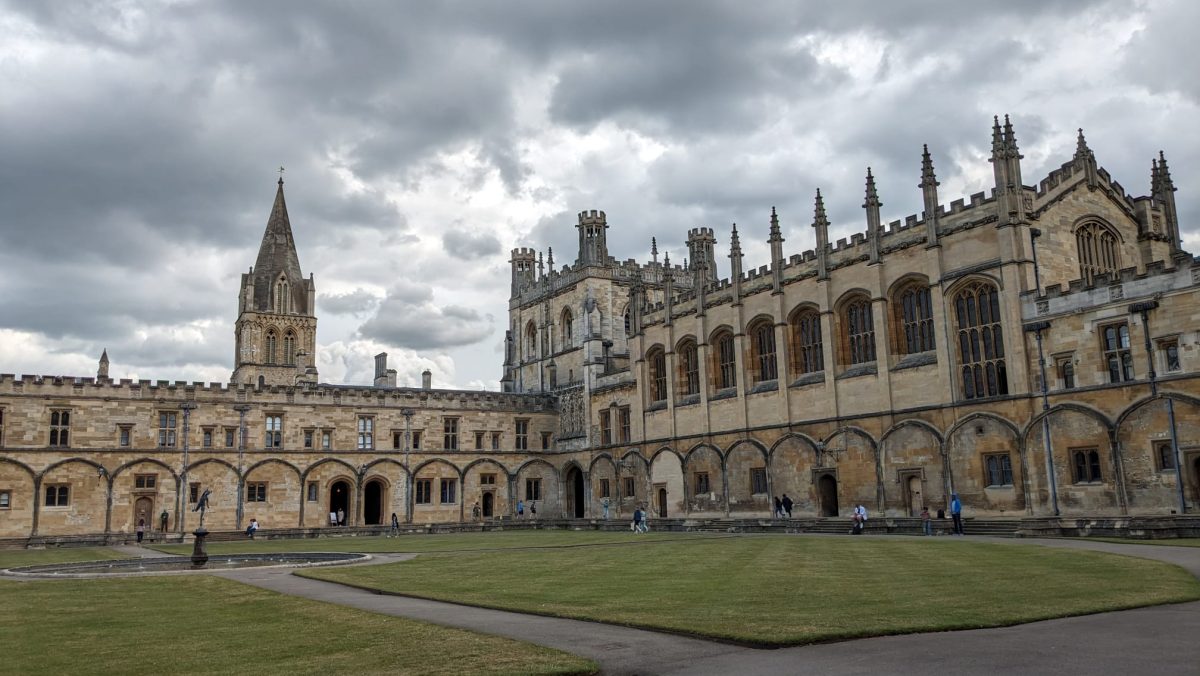
Grass Oxford college quads were established in the 17th century after lawns became popular in the Middle Ages in northern Europe as a status symbol among the aristocracy. Grass lawns required lots of water and intensive scything whilst not being productive in comparison to grazed meadows, which supported livestock and produced agricultural products like hay and silage. Before the 17th century quads were often paved or cobbled for functional domestic work: the idea of the college quad as untouchable grass is a relatively new one.
Lawns became more accessible after the invention of the lawnmower. As a status symbol they quickly spread across Europe and North America, creating a tradition of green monocultures. Monocultures such as grass lawns are low in biodiversity and do not support many organisms unlike traditional meadows or natural grasslands. Lawns are also often maintained with artificial nitrogen fertilisers, which further decrease biodiversity and contribute to chemical pollution. College quads’ lack of biodiversity and contribution to a loss of natural habitats in a several nature-depleted Britain is a problem, especially in the face of ongoing threats to wildlife.
There is an argument for the maintenance of quads as historical landscapes (although some quads weren’t grassed until the early 20th century), and the way that they frame college architecture around them, which is often listed also preventing changes. Quads that you can walk and sit on also provide areas for relaxation and community: a third space away from the world of work, especially important in an environment like Oxford, and slowly disappearing in wider society. However, they represent a status symbol indicative of Oxford’s institutional power and lack of warmth. They create hierarchy and instil weird harshly regimented rules that promote exclusivity, during a time when Oxford should ever be reaching outwards.
To me, the ideal Oxford quad would be a rewilded grassland periodically grazed by a variety of livestock (different livestock feed in different ways, promoting a diversity of plants) made of a mosaic of areas, with clearings available for people and larger plants like trees and shrubs, which would create shade both for people and different microhabitats for a range of plants and animals. This way, they could provide habitat for both the exhausted student and crucial pollinator and plant species that contribute to biodiversity in Britain.
Of course, this isn’t necessarily possible, as it would take lots of funding and effort. More acceptable options might be patchwork lawns, where the lawn is ‘let go’ and different species of grass and small flowering plants are allowed to thrive in different patches, promoting biodiversity and pollination whilst requiring less mowing, reducing the amount of energy and effort required for upkeep.
Other plants could also act as the major species in a lawn: moss requires a lot less water than most plants and is shade-tolerant. Camomile is fragrant and not very trample resistant, so could be used on low access quads. Whilst these are monocultures, they would be different monocultures, and so provide patches of different habitats for animals across the university.
Christchurch recently published an article on their website about unobtrusively planting low-growing, pollinator-supporting plants around their historic Tom Quad. This is good but the attitude of ensuring “that the lawn and the historic proportions of the space remain unchanged” by planting unobtrusively does not promote a positive attitude towards increases in biodiversity.
One reason to change the structures of quads that would appeal to colleges would be the government requirement of biodiversity net gain. All new construction is required by law to be accompanied by a 10% increase in biodiversity over a specific area. Lots of colleges and businesses export these gains by buying biodiversity units elsewhere, not increasing biodiversity locally, whereas quads could contribute to mandated biodiversity net gain. There’s also problems associated with increasing the biodiversity in a small area where it is already relatively biodiverse, instead of increasing it in dense urban areas where people and wildlife need it the most.
Quads are a historical institute of power and in the current climate (literally) there should be serious consideration of their place and need. Contributions to biodiversity are both needed and mandated, and therefore the tradition of grass college quads should be ended.