
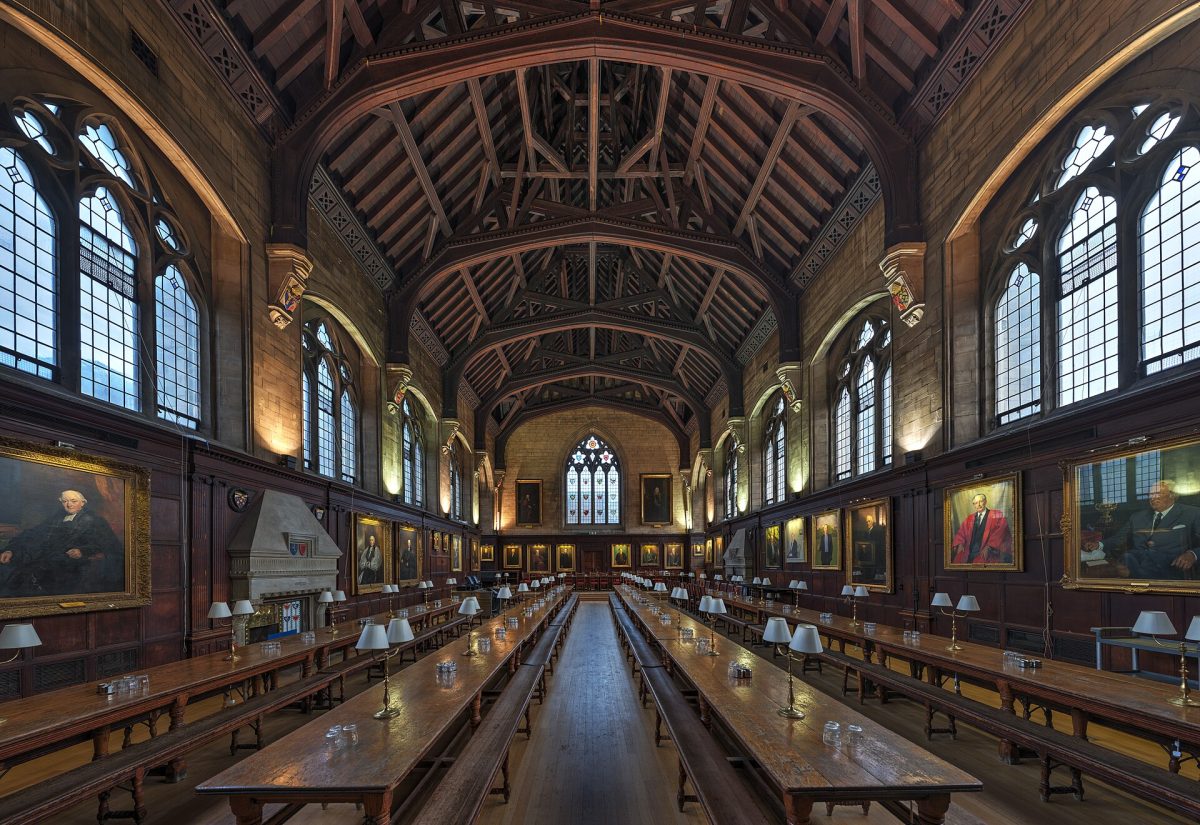
In 2024, state school admissions to Oxford stood at 66.2 percent, down from a higher 68.6 percent in 2021. These pupils are among the 93 percent of the school age population in England. In the same light, the University’s own admissions page describes Oxford as committed to attracting students with the highest academic potential, from all backgrounds.
I came to Oxford after a career inside large American companies, which is to say I had already watched several elite institutions describe their own selection processes before I arrived here.
The pattern is always the same. Each institution insists it admits on talent and potential, and yet those admitted on talent and potential turn out to look, sound, and network remarkably like the people who used to be admitted on background and connections. It is presented as a coincidence, though it rarely is.
In the second week of Michaelmas, I conversed with a a first year, whose father, she mentioned, was an electrician. The conversation did not stop.
A few minutes later the same group was discussing scholarships, internship pipelines, and a research opportunity in their department that none of them had heard about from a tutor. The first year listened without asking, because she had understood, faster than I did, that the information was not being withheld from us; it was simply not being directed at us. This is the part of Oxford the access numbers do not measure.
The students who arrive already fluent in the unwritten syllabus, which tutors to email, which societies confer leverage, which internships count, which fellowships appear on the right CVs in the right order, are not randomly distributed across the intake.
They are the same students who were always going to be fine. The barrier to success does not disappear after students from all backgrounds are able to fight for a place at Oxford. Instead, the barrier remains and has only moved inward.
The British access conversation tends to stop at British students, which is itself revealing. Roughly a third of Oxford’s student body is international, drawn from more than 170 countries, with international undergraduates paying tens of thousands of pounds more in tuition than home students. The University publishes the home fee as a single capped figure of £9,535, while overseas fees are described only as “significantly higher” and routed to individual course pages, where the headline numbers run from the mid-thirties into the high-fifty-thousands a year, and considerably more again on programmes like the MBA. The asymmetry in how the two fees are presented is its own small piece of evidence. This cohort is rarely included in the access debate, because its instead structured around domestic class rather than global wealth. International students arrive having already cleared a financial filter most British applicants never face. Therefore, the international cohort is, on average, more privileged in absolute terms than the domestic intake the access reports measure.
Sam Friedman and Aaron Reeves, authors of Born to Rule, tracked the British elite from 1897 to the present. Their finding brutally summarised that the people who comprise the elite class have changed, while the mechanisms by which the elite reproduces itself have not.
The same handful of private schools, the same Oxbridge colleges, the same Westminster, City, and broadsheet circuit recur decade after decade, regardless of who was technically allowed in.
In their earlier book, The Class Ceiling, Friedman and Daniel Laurison found that working class candidates who broke through into elite professions earned around 16 per cent less than their privileged colleagues doing the same job, because the institutions kept reading accent and comportment as merit.
Popular culture has noticed. Saltburn turned the dynamic into horror, with a state school boy learning the code in real time and weaponising it, while My Oxford Year, on Netflix this year, turned it into fantasy: an American Cornell graduate with a Goldman Sachs offer defers her career to read poetry at Magdalen and falls in love with a charming local.
The film works because it assumes Oxford is an embellishment rather than a turning point, and the students for whom it is a turning point do not appear, because the story does not need them to.
The vocabulary that holds this together is “potential.” It is the most useful word in the new lexicon precisely because it sounds neutral, and because no one can prove they have it or that they do not. In practice, potential tends to be measured by how easily a candidate appears to belong in the room, which means it tends to be measured as confidence. And confidence, at eighteen, is largely a function of whether you have spent your life being told that places like this were built for you.
The state school candidate who pauses before answering an interview question penalised for appearing unfamiliar with concepts talked about, how she articulates her ideas, and how confident she is in her opinions expressed.
The old elitism believed certain people were better and ought to rule, and in the loathsome way of things which do not lie about themselves, it was at least honest. The new elitism claims everyone competes on merit, and then defines merit as familiarity in a certain class and culture.
Davos does not call itself an elite gathering; it calls itself a convening of leaders working on the future of capitalism.
You can be an Oxonian and object to these clubs, in the same way you can be a banker and object to tax evasion.
What would it take to fix this? Not more outreach videos, and not another rise in the headline percentage, because the headline number is the easiest thing to move and the least useful thing to celebrate.
The harder work lies elsewhere. It means making the unwritten rules of Oxford explicit, asking which opportunities are formally advertised and which travel by word of mouth, and asking whether the qualities being rewarded actually measure ability or simply familiarity with how the institution works.
Oxford has opened the door, but the students walking through it are now expected to navigate, on their own. It remains a building that still rewards those who already knew the floor plan.
That is not access. It is a new kind of exclusivity, no less effective for being polite about itself.