
Brian Friel writes of, “dancing as if language had surrendered to movement”; indeed, if I could dance this review of Friel’s Dancing at Lughnasa, I certainly would, for Gra Productions’ adaptation of this beautiful story was completely and utterly moving.
Rooted in the complexities and heartwarming unity of sisterhood, Friel depicts the Mundy sisters and their home in the fictional town of Ballybeg, Country Donegal, Ireland. Their brother, Michael, narrates this tale retrospectively as an adult. This group of young women dance, sing, and love, and yet their peaceful lives are continually affected by economic strains, religious tensions, and the variability and instability of work and people. Talk of the pagan people and their festival Lughnasa encroaches on this Catholic household, and the stern Kate Mundy (played by Thalia Kermisch) vehemently condemns the Mundy sisters’ engagement with it.
Simultaneously, Father Jack Mundy (played by Tristan Morse) slowly recovers from malaria after living in Uganda as a Catholic missionary. As he regains strength, we see him enamoured with Ugandan rituals and their beauty. With a nuanced exploration of ceremony, both in a spiritual and domestic context, Friel highlights the importance of divergent cultures and lifestyles. The director, Kate Burke, offers us an imitate and magical portrait of the family, as she beautifully illustrates the idiosyncrasies of these women.
The characters in Dancing at Lughnasa felt so unified and close-knit, a testament to the remarkably brilliant cast that imbued every single character with passion and sensitivity. The often static and difficult role of the narrator was adopted by Nathan A. Harris incredibly fluidly and captivatingly – he worked brilliantly to render Friel’s narration as a story, specifically through his subtle foreshadowing of their bleak endings.
The Mundy sisters had an incredible dynamic. Their ensemble moments were notably seamless – interrupting, dancing, laughing – it felt like we, the audience, were sitting around their dinner table, too. Thalia Kermisch’s portrayal of Kate Mundy was entrancing; she was the backbone and the beating heart of the family, and, in true older sister fashion, tries to maintain the home seamlessly. Kermisch balances her joviality, her seriousness, and Catholic sentiments incredibly – revealing a character who, despite her complexities, is truly caring. This play is full of laughter, yet, for me, Cait Kremenstein, who plays Maggie Mundy, is particularly hilarious. Her wonderful wit permeated every single line she delivered, and her reactions were equally amusing; all together her portrayal was fantastically uplifting.
Imogen Bowden, meanwhile, emblazoned her character, Rose Mundy, with an innocent naivety – although she is off frolicking in the second act, Bowden left a notable impression of a merry and impassioned young woman. Nicole Palka, as Agnes Mundy, particularly shone in the second act – I especially liked her dancing scene with Gerry Evans (played by Rohan Joshi). Finally, Caeli Colgan played her sensitive character, Chris Mundy, beautifully, and her adoration of Gerry was incredibly bittersweet. Their interwoven lives, as they butt in and out, spontaneously dancing and shouting, created an effortless sibling camaraderie.
Joshi’s portrayal of Gerry was very charismatic; his sustained use of his cane was comical, and his assured confident portrayal was engaging, but not overbearing. Joshi played Gerry consistently charmingly. Similarly, Father Jack Mundy was very compelling; Tristan Morse handled his recovery and transformation with such grace. Even though Father Jack Mundy is challenged by forgetting language, Morse portrayed this struggle sympathetically and, as the play went on, the brilliance of Morse as an orator only grew, especially in Jack’s recollections of Uganda.
Alongside Harris, Morse illustrated nostalgia and the importance of memory, which is at the core of this play. Perhaps, my only pernickety observation was the slight inconsistency of accents; I really appreciated the choice to preserve the accents of the actors, as it instilled a greater integrity to these characters. However, at moments, I felt that some actors reached for Irish phonology which, although a commendable attempt to emulate Irish culture, occasionally distracted the audience.
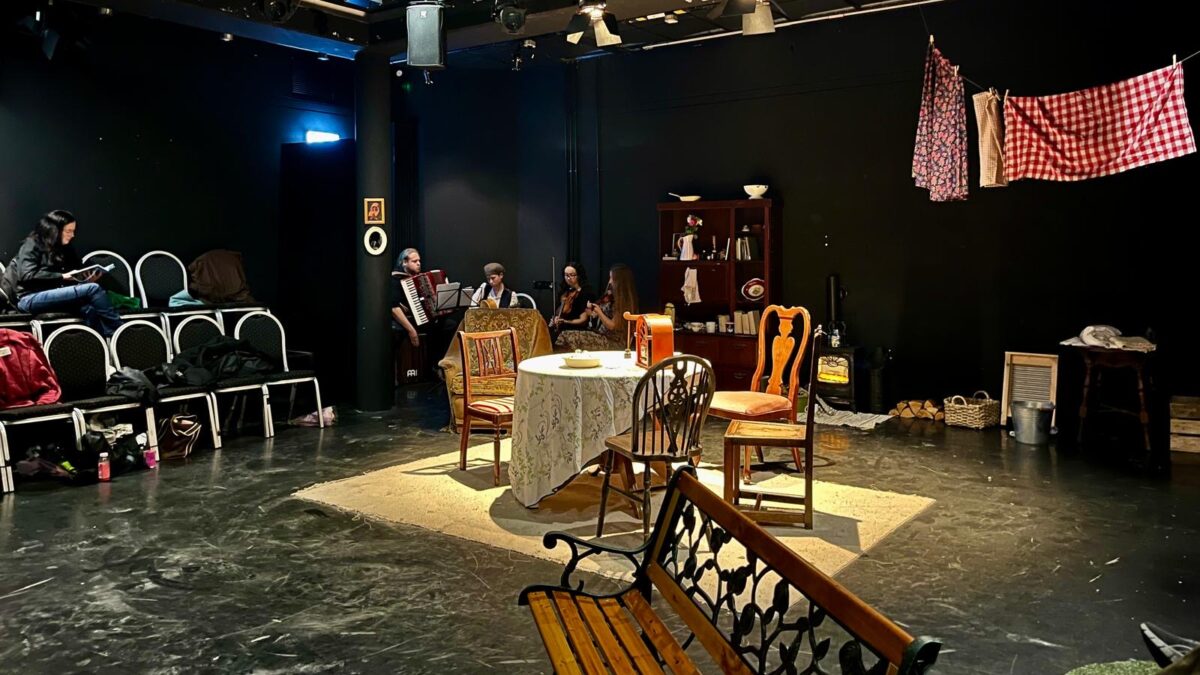
Gra Productions created a truly magnetic atmosphere in their set, costume, sound, and lightning. The traditional Irish music, co-directed by Tamara Brunert and Tom Constantinou, was particularly absorbing. It created such a joyous ambiance, whilst complimenting the integral themes of dancing, and pulled us into the immense culture of Ireland. Not only did the music entrance us upon entering the Michael Pilch Theatre, but, for the Mundy girls and their temperamental radio, these moments of live music became even more kinetic. The set (designed by Holly Rust) was incredibly homely and comforting – the soft furnishings, including a wood burner and large rug, worked incredibly well. Similarly, this was enhanced by the warm lighting and rustic costumes (designed by Frankie Forbes).
There truly was an audience of smiles as the Mundy girls moved and pranced in the natural, but lively, dancing sequences, choreographed by Miranda Forbes. In these special and free moments, I not only got goosebumps but also had a strong urge to put on an embroidered apron, hop into Ballybeg, and join them!
It is difficult to do justice to the brilliance and beauty of Gra Productions’ remarkable adaptation, as it is so thoughtful and truly a triumph, so I must insist you go watch it!