
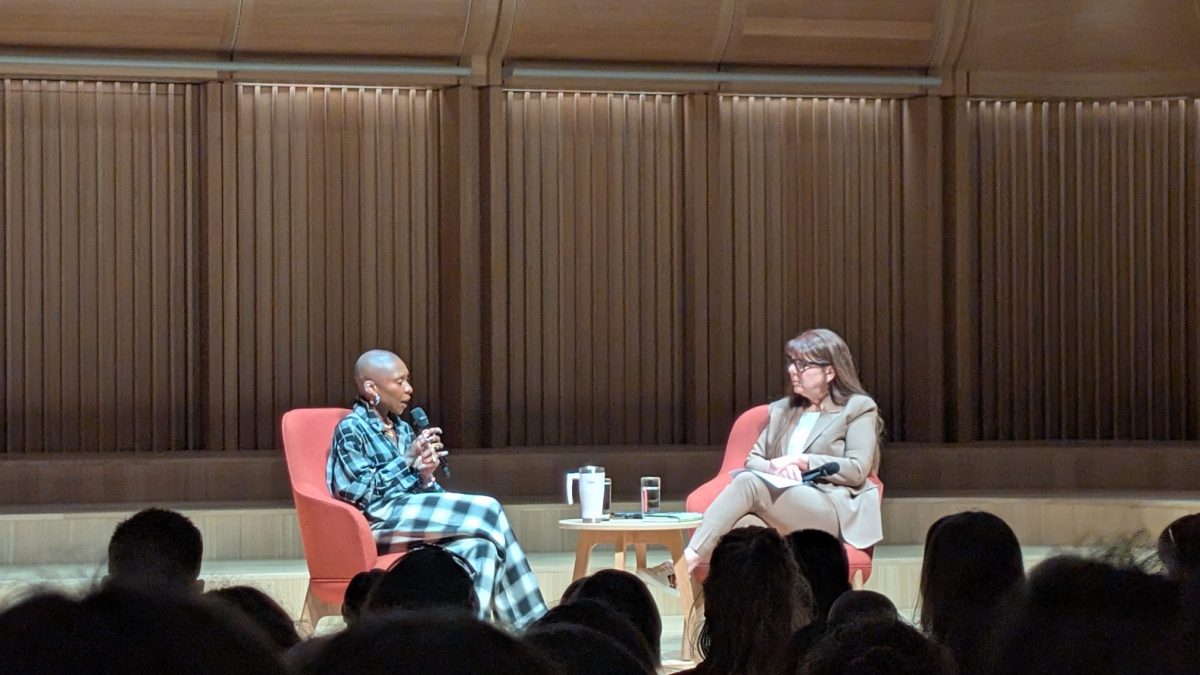
When news broke that Cynthia Erivo would be making an appearance as the inaugural speaker in the Schwarzman Centre for the Humanities’ new cultural programme, I knew I had to be there. Erivo is a two time Grammy winner, an Emmy and a Tony winner, and three time Oscar nominee, making her one of few people to be just one award away from “EGOT” status. To be able to see Erivo speak about her career away from cameras and in person was an absolute privilege, and she certainly did not disappoint.
Erivo’s address can neatly be summarised into three parts: her past, her present, and her future. She addressed all of these in her hour-long talk to the sold out 460-seat Sohmen Concert Hall, moderated by Dr. Stacy L. Smith. Smith, as introduced by Sue Black, Baroness of Strome and the current Principal of St. John’s College, is the founder of the USC Annenberg Inclusion Initiative, the “leading think tank in the world studying diversity and inclusion in entertainment”. Black’s introduction of Smith at the start of the event truly set the tone for the discussion, remarking that “representation matters because it changes perception”.
After a short video introducing Erivo, showing clips from her catalogue of filmography to ‘Defying Gravity’, ‘For Good’, and ‘Stand Up’, she arrived on stage to a standing ovation. The conversation began with Erivo’s past, discussing her start in acting at the Young Victoria Theatre, being encouraged by her teacher to apply for the Royal Academy of Dramatic Art (RADA). At the time, Erivo was already a student at the University of East London, but after much back and forth, she eventually decided to apply because she “love(s) a challenge”. Erivo commented on the surprise of getting through round after round of admissions before finally succeeding, and how this was undoubtedly the first stepping stone for her career.
Yet, despite RADA being such a turning point in Erivo’s life, the watershed moment that she returned to multiple times throughout the conversation was ‘The Color Purple’. After starting out in the London production playing the leading role of Celie in 2013, The Color Purple returned to Broadway in 2015, revived after seven years, an opportunity that Erivo “never expected”, but which “changed [her] life”. The revival received critical acclaim, with Erivo specifically being singled out as an “incandescent new star” by the New York Times. Erivo would go on to win the 2016 Tony Award for Best Actress in a Musical, her first major award and first letter in EGOT secured.
What Erivo truly highlighted was the emotional reactions that people had to The Color Purple. Real emotional reactions were her emphasis, in that people would burst out into tears in the audience. The Color Purple’s themes are intense, but it was this intensity that Erivo believed could allow her to connect with the audience. It sparked an already existing desire to learn more about the human condition, a quiet observational role that she enjoys carrying out. She commented that, contrary to popular belief, she is an introvert, and is “quite happy to sit in a room by herself with a book”, but that when she is in a crowded room she picks someone and focuses on them.
This nicely brings us to Erivo’s present. Smith remarked about the first time she met Erivo (which she did not remember), at the 2025 Sundance Film Festival. On the first day of the festival, 23 January 2025, the nominations for the 2025 Academy Awards were released: Erivo was nominated for Best Actress in a Leading Role for her performance as Elphaba in ‘Wicked’. Erivo was part of a workshop in a small room, at which Smith was an attendee, and said she “burst into tears” on seeing Erivo after this nomination. It was Erivo’s kindness and empathy to stop the room from discussion and turn to those in need that truly made Smith admire Erivo, to which she remarked that it was simply a reflection of her observant nature.
Observation seemed to form a large part of Erivo’s present. She explained that her philosophy is that observation is how we garner information and how we learn, that it is our way to learn how to communicate, and that observation is often present in many of the roles that she takes on. The aforementioned Elphaba is an observer in order to understand how to fit in, whereas a role like Harriet (which also resulted in Erivo receiving a nomination for Best Actress at the 2020 Academy Awards) is an observer in order to understand how to take action. When asked which of her roles she believed to be most like her, however, Erivo said that all of her roles had some form of connection to her. If she had to single one out however? “The Blue Fairy in Pinocchio. She’s very pragmatic, very matter of fact.” I personally see that Erivo identifies most with a character in one of her most negatively received productions as a testament to her own character: a critic’s rating or a film’s success bears no part in her enjoyment of, or relationship with, a role.
Perhaps a surprise of the conversation between Smith and Erivo, was the lack of focus given to her recent starring roles in ‘Wicked’ and ‘Wicked: For Good’. What was mentioned however was a quote John M. Chu, director of both Wicked films, gave to Smith for the conversation: “She is a force of nature, put on this planet by God to change us all.” Smith also highlighted research by USC Annenberg Inclusion Initiative showing that 2.7% of the top films since 2007 are centred on black women. This represents about 50 films total: Erivo played the leading role in two of those 50. After this, Erivo accepted the inaugural USC Annenberg Icon Award to her second standing ovation of the event.
The final section of the conversation was looking at Erivo’s future. Erivo’s name is now attached to the “Cynthia Erivo Film Bursary”, a bursary awarded collaboratively by the Schwarzman Centre and the Oxford University Film Foundation. The inaugural round of applications for this bursary will begin in Michaelmas Term, with short films that progress through the rounds for receiving the bursary being showcased in the Schwarzman Centre’s in-house cinema. This bursary will undoubtedly secure Erivo’s legacy within Oxford far past a singular conversation at the Schwarzman Centre.
On her own career, when asked who she would most like to work with in the future, Erivo had no shortage of answers: Guillermo Del Toro, Jessica Chastain, Renée Zellweger, Viola Davis (again), and Angela Bassett, just to name a few. Erivo had particular praise for Zellweger, commenting that her transformation from her day to day accent to Bridget Jones is incredible, and that flexibility with voice and characterisation is something she truly admires and enjoys.
Further to this was a link back to her past. In 2024, Erivo was appointed as Honorary Vice President of her alma mater, RADA, a role she said that she accepted only if she could be actively involved in the school. She refused to simply be a figurehead, a marketing tool, and wanted to actually give back to current students with workshops, which she is returning next month to deliver. She said this was shaped by her own experience at the school, which had its own challenges, but that this only fueled her desire to return in a meaningful way: “I always found myself returning there” she remarked.
This evolution of her involvement at RADA, from her initial scepticism around applying to becoming a vice president, and her giving back to the youth of today, was a truly inspiring story to hear. Erivo clearly deeply cares about young adults in the industry, from her role at RADA to her sponsorship of the bursary in her name. Her final address on life advice to young people, those of us in the audience at times in our lives with uncertain paths, was simple but effective. “We are told to be ready for the ‘Nos’ but rarely told to be ready for the ‘Yeses’. Be ready for the ‘Yeses’”. Her past, her present, and her future have all been shaped by being prepared for the best rather than focussing on bracing for the worst. This optimism, this belief in following your gut, was truly refreshing to hear.
Erivo’s closing statement was a cliché by her own admission, but in an increasingly volatile world, it rings true more than ever: “It sounds blasé, it sounds cliché, but be yourself. That’s what I would tell you all.” The Sohmen Concert Hall rose in applause for Erivo for a third and final time.
In Conversation with Cynthia Erivo showed a side of Erivo rarely seen. Away from the typical press tour of a production, Erivo was free to talk her mind and share her life. Not a single note was sung, but her words were stronger than any belt her vocal range reaches. I was truly inspired by Erivo, and with Stacy Smith, she defied far more than just gravity: she defied any and all expectations I had.