
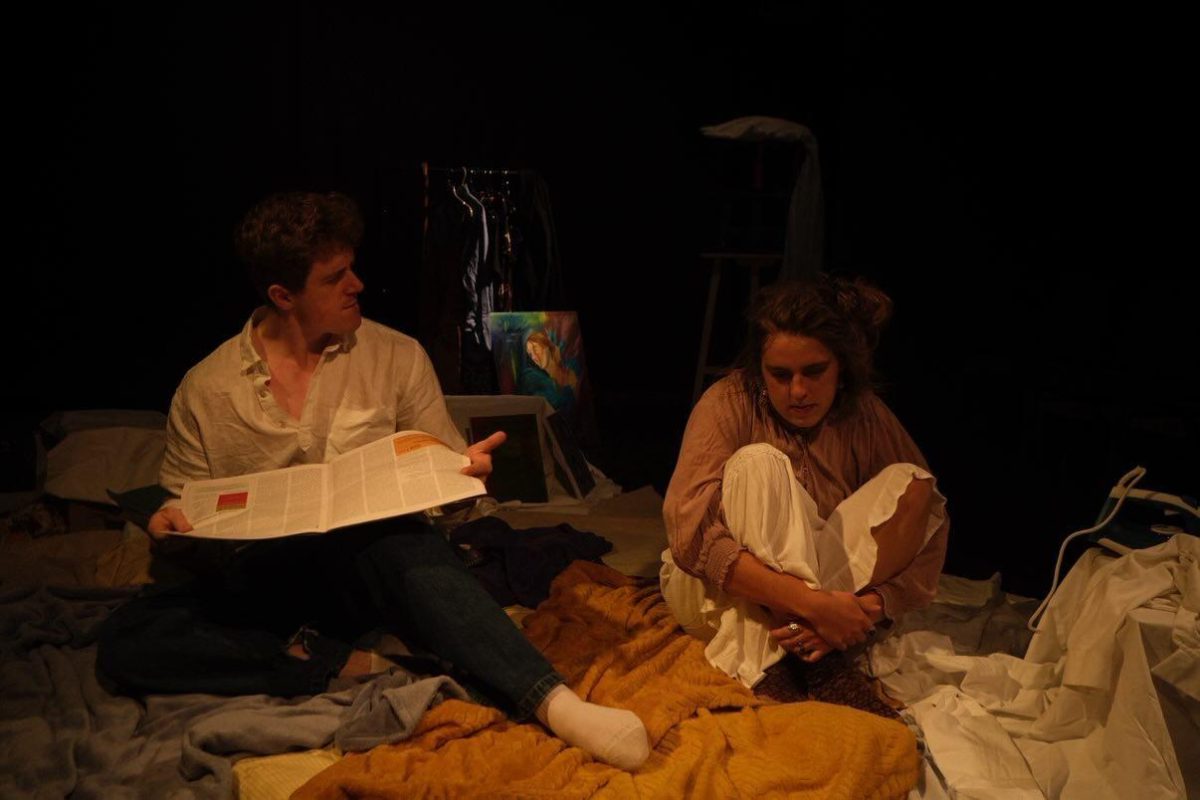
As the lights come on, the audience is greeted by the married couple of Jim (Henry Cane) laying centre-stage on a mattress, and Linda (Rowan Brown), who is ironing off-centre. The atmosphere is vivid, with the soft pattering of rain in the distance (soundscapes managed by assistant producer Ruby Wallace). Around them there are a few pieces of furniture; three mismatched, colourful pillows litter the mattress, Jim’s paintings and a modest clothes rack are cluttered in the Burton Taylor Studio. A truly bohemian living space, a sentiment which Linda’s friend Babe (Grace Greaves) agrees with later on, as the latter is used to a life of more luxury. It is a misleading beginning, as the initial positioning suggests that Jim will be the focal point of the play, yet it is Linda that becomes the driver of the story.
Costume designer Clara Woodhead has placed Linda in a white boho skirt adorned with a pink frilly blouse and a jumper vest of granny squares along with a pair of silver ballet flats. This contrasts with Jim’s white linen shirt, blue jeans and socked feet. The clothing makes Linda’s anxiety and layers of emotions immediately visible, while Jim is undeniably nonchalant.
The audience is privy to a rather vivacious Jim, who even during serious conversations about the couple’s dire financial situation is making jokes. Still, he becomes even livelier at the prospect of his paintings being scouted by a talent hunter. Here, it is fitting to praise the set designer, Amelia Panayiotides, as the paintings enhanced the bohemian atmosphere with the explosions of colour and shape which were dotted around Jim and Linda’s living quarters.
On the other hand, Linda is more volatile, with constant changes in voice and facial expression. Rowan Brown’s Linda is anxiety personified. Unlike Jim, she has shoes on for the duration of the play – a very noticeable feature in the moments when Linda is alone in the flat, and circling it like the thoughts in her mind. The stomping of Linda’s feet against the rain accompanied by Linda’s silence really creates a tense and unpredictable atmosphere.
This really drives home the feelings of uncertainty she cannot escape, insecurity regarding the couple’s living situation and, more importantly, the relationship itself. The latter is very clearly visible to the audience through the constant, fleeting touches and looks directed to Jim, who appears somewhat oblivious to the extent of the turmoil brewing within Linda’s body and mind.
In Jim’s absence, Linda stomps around the flat and sheds her jumper – her first physical and metaphorical layer. Upon Mrs. O’Fallon’s (Avani Rao) entry, the landlady to whom the couple owes rent, the lights, in the hands of Rafi Soccorso, become almost clinically white, as if the landlady was the reality check that Linda was dreading. The landlady’s harsh words and physical presence stalk Linda around her living quarters. Remy Billington and Rio Moore’s The Magic Tower truly used space well, as there were no clusters in a particular area, and all sides of the audience were equally immersed in the ongoing action.
Her exit brings Molly. Although she has a short presence on stage, the costume choices of pigtails and patterned dungarees combined with Kelly Yeung’s childlike voice highlight the character’s naive nature. She serves as a momentary tension defuser, before the emotionally straining conversation between Linda and her friends, Babe and Mitch.
The climax is upon us in the form of Mitch (Harriet Turnbull) and Babe. The ghosts from Linda’s past as an actress who, with their clothes of a higher calibre, haunt her to try and persuade her to leave Jim and return to the show. The back and forth between Babe and Mitch left no doubts regarding their chemistry in playing the shoulder devils.
Jim returns depleted both by the rain and the rejection from the talent hunter. He is met with a Linda who has shed her clothing to reveal a polka top with short dungarees, yet he does not bat an eye. Instead, he dwells on his situation, no longer vivaciously taking up space but curled up on the mattress. Linda begins to pack her belongings, but she struggles to open her suitcase and leaves the flat laden with clothes, as if her anxieties and insecurities were physically represented.
Linda and Jim dream up their magic tower as a form of escapism from their very real poverty and issues. But the set teleports us into a real magic tower through the bohemian elements of the flat, the colourful paintings, and Rafi Soccorso’s lighting. During Jim and Linda’s first conversation about the magic tower, the lights change into a colour ensemble which make the setting even more magical. Moreover, Linda and Jim’s British accents stand in stark contrast to the rest of the characters’ American twang. This choice makes the married couple and their magic tower stand in further contrast to the real world, transforming the real tower into a physical, rather than imaginary, concept. Adding to this is the fact that the audience can see the play happening from three different angles, creating the feeling that we should not be privy to what is happening. It is as if we, the audience, are intruders to the magic tower.
The ending of the play took me by surprise, the exit of the characters left me hanging and deeply disturbed. The Corpus Christi Owlets production of The Magic Tower by Tennesse Williams, co-directed by Remy Billington and Rio Moore, is a production that entices the audience to seek more from this group.
[The Magic Tower, staged by Corpus Christi Owlets, is playing at the Burton Taylor Studio, 26th-30th May, 2026]