
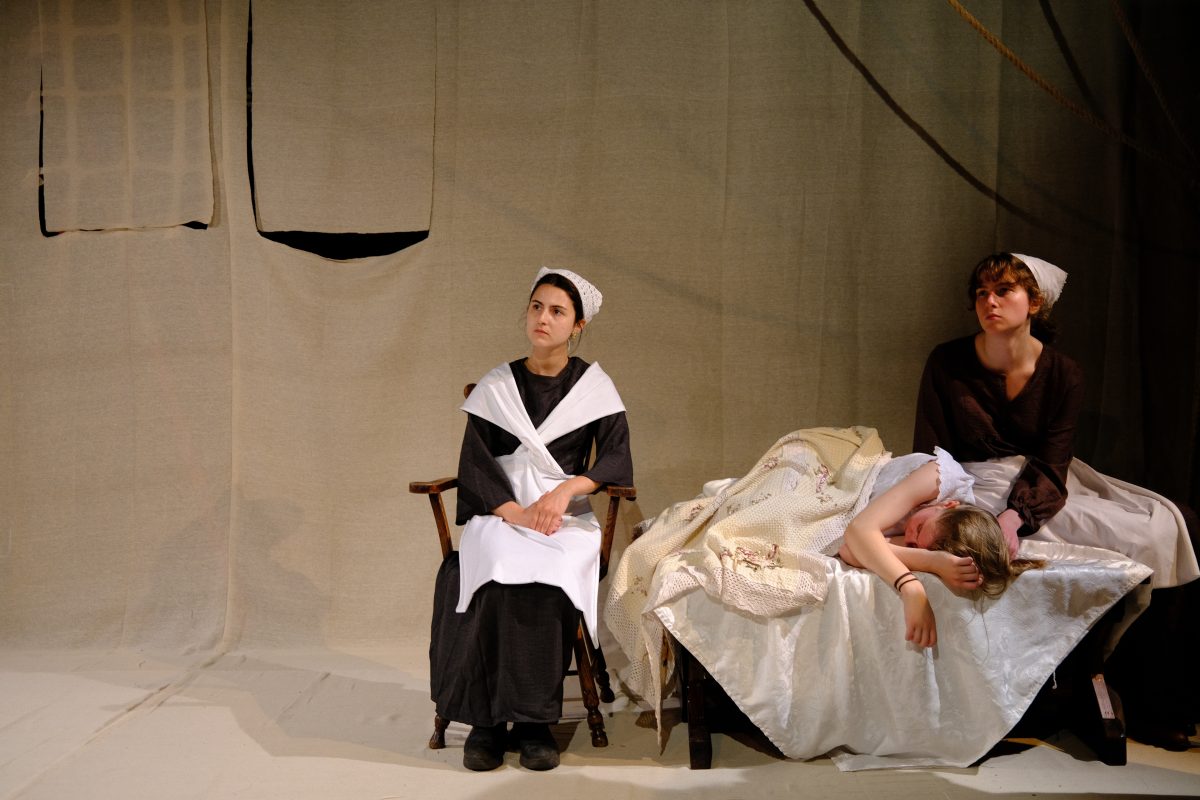
Arthur Miller’s The Crucible has always been far more than the anti-Red Scare parable it played as when it was first written in 1953. Its retelling of the Salem Witch Trials of 1692-93 brings out perennial themes of justice, integrity, and truth, while never taking its eye off the personal animosities and prejudices which shape the town’s responses to every accusation of witchcraft. But enough of my English Literature GCSE. Charlie Lewis and assistant director Zachary Serban’s take for Boulevard Productions brings plenty enough of its own to the table.
We begin in darkness. The girls, whose accusations will form the play’s heart, sway on-stage, and embark on a flowing, ritualistic dance (choreographed by Mimi Nanud, with foreboding musical accompaniment by composer Luke Lee), which we later learn to be an attempt at blood magic. Staging this moment, so often alluded to in the play’s first act, highlights one of its most extraordinary ironies: that the ‘innocent’ children, led by a masterfully manipulative Georgina Cotes as Abigail Williams, are the only ones to do anything even resembling ‘witchcraft’.
The first scene sees Salem’s leading citizens attempt to grapple with the fallout from that ritual, as many of the girls have fallen ‘ill’ after their discovery by Reverend Parris (Rufus Shutter). Its frequent exits and entrances are challenging from a theatrical perspective, but well-managed, especially considering the smaller scale of the Michael Pilch Studio’s stage. The interactions start off somewhat flatly, but that is in large part due to the fact that Parris and Thomas Putnam (Xander Lewis), some of the first characters on stage, are decidedly this production’s villains, and they work best when bouncing off the play’s more righteous characters. Shutter expertly plays a slightly pathetic Parris, an unpleasant mixture of entitlement, pettiness, and snivelling fear, while Lewis’s aloof Putnam is every inch the kind of man who sees his neighbours only for the value of their land. Maya Luthi brings commendable emotion to the role of Ann Putnam, mother of seven dead children. But the play is clearly waiting here, biding its time before the arrival of its undoubted protagonist John Proctor (Nathan Harris).
Arthur Miller writes big protagonists, tragic protagonists, and Harris rises to that challenge fantastically. If his body language is sometimes static, he more than makes up for it with the range he expresses in his delivery. His John is weary, pained, conflicted, yet earnest and truthful to the core. The revisionist charge of abusing his positions of power present in the play’s modern reception is there in moments – his outburst of violence against servant girl Mary Warren (Ros Gumbo) when he finds out she has testified in court without his approval – but Harris’s John largely stays true to the script’s vision of an honest man working on the flaws he knows himself to have. This is especially evident in his relationship with his wife Elisabeth Proctor (Lucia Mayorga), which carries real tenderness even at its lowest points.
Mayorga and Gumbo put in excellent performances of their own. Mayorga gives Elisabeth’s distance, but ultimately still-decisive loyalty to her husband perfect expression – this has the unfortunate but welcome side effect that her character is far more interesting and sympathetic than her self-blaming speech at the play’s end would have you believe. Gumbo, meanwhile, is standout, bringing a brilliantly fragile fierceness to Mary’s character and giving us a moving insight into the extraordinary mental pressure the girls are under in every confrontation with their male superiors. The dynamics between the trio are a joy to watch.
The play’s central tension however, is that between John Proctor and Abigail Williams, with whom he had an affair while she still worked as a servant for the Proctors. Boulevard Productions’s previous show Oleanna, which I reviewed earlier this term, suggests itself as an intriguing parallel text to this relationship: here, the show’s closeness to Miller’s script leaves Abigail a far more morally messy character than her possible counterpart Carol, the clear victim of a male abuse of power. Cotes plays with the conflict in Abigail’s character excellently: her manipulative side is fully brought to the fore in the dramatic courtroom scene where she draws Mary Warren back to her, but she plays equally well the moments when that facade drops and we see a little of the damaged young woman beneath. Cotes and Harris play well together, although I thought the dynamic perhaps a little too direct in their first scene.
I can only apologise to the rest of the cast that I don’t have the space here to give them the plaudits they deserve. Ali Khan gives us a Governor Danforth of incredible conviction and authority even as we lament his utter refusal to listen to dissenting voices; Ezana Betru’s charisma as Reverend Hale morphs into nihilistic despair with terrifying plausibility; Ademide Obagun’s Tituba, the first to be accused and the first to crumble under the pressure to confess, is a heart-wrenching figure. This is a big play: a 17-strong cast is I think bigger than even the Playhouse productions I’ve seen. That it works at all in such a small space is entirely to the credit of set designer Ben Adams and assistants Tara Nimmoneser and Yusuf Naeem. An enormous sheet of fabric is draped across the back wall and the entire floor of the Pilch. That, and the front-on audience seating, extends the playing space, cuts out the Pilch’s awkward pillars, and allows the furniture to be kept within view, but out of mind, through its placement beyond the fabric’s bounds. The part covering the back wall, meanwhile, has flaps cut into it which are raised and lowered to move us from the rectory, to the Proctors’ house, to the jail cells with ease. Covering the black box studio in white cloth plays deliciously with the play’s themes of concealed darkness too. All in all a simple design with incredible potency.
The holes in the back allow for some powerful lighting effects as well (designed by Alexandra Russell and assisted by Maeesha Naeem and Ben Watson) – spotlights appear with unusual but confident frequency at key intervals, while the sunrise at the play’s end was simply jaw-dropping in its beauty. It is an excellent staging: the costuming (designer Madeleine Halsey and assistant Isabel Bentley) is meticulous (including amusingly repurposed sub fusc for the judges), sound effects (designer Marnie Frankel and assistant Joelle Lee) unobtrusive but perfectly fitting. The only slight misfire was the green armchair among the period furniture in the courtroom – otherwise we are immersed entirely into this world of deceit and tangled truth, into the question of what doing right looks like when an entire system is turned against you. The Crucible is the first play I’d previously studied, or even encountered at all, to come up for review in my time at Oxford. Undoubtedly that demonstrates the lack of exposure I had to theatre before coming here; but on this evidence, I would thoroughly enjoy Boulevard Productions trying their hand at any and all of the others.
[The Crucible, staged by Boulevard Productions, is running at the Michael Pilch Studio, 27-30th May 2026]