
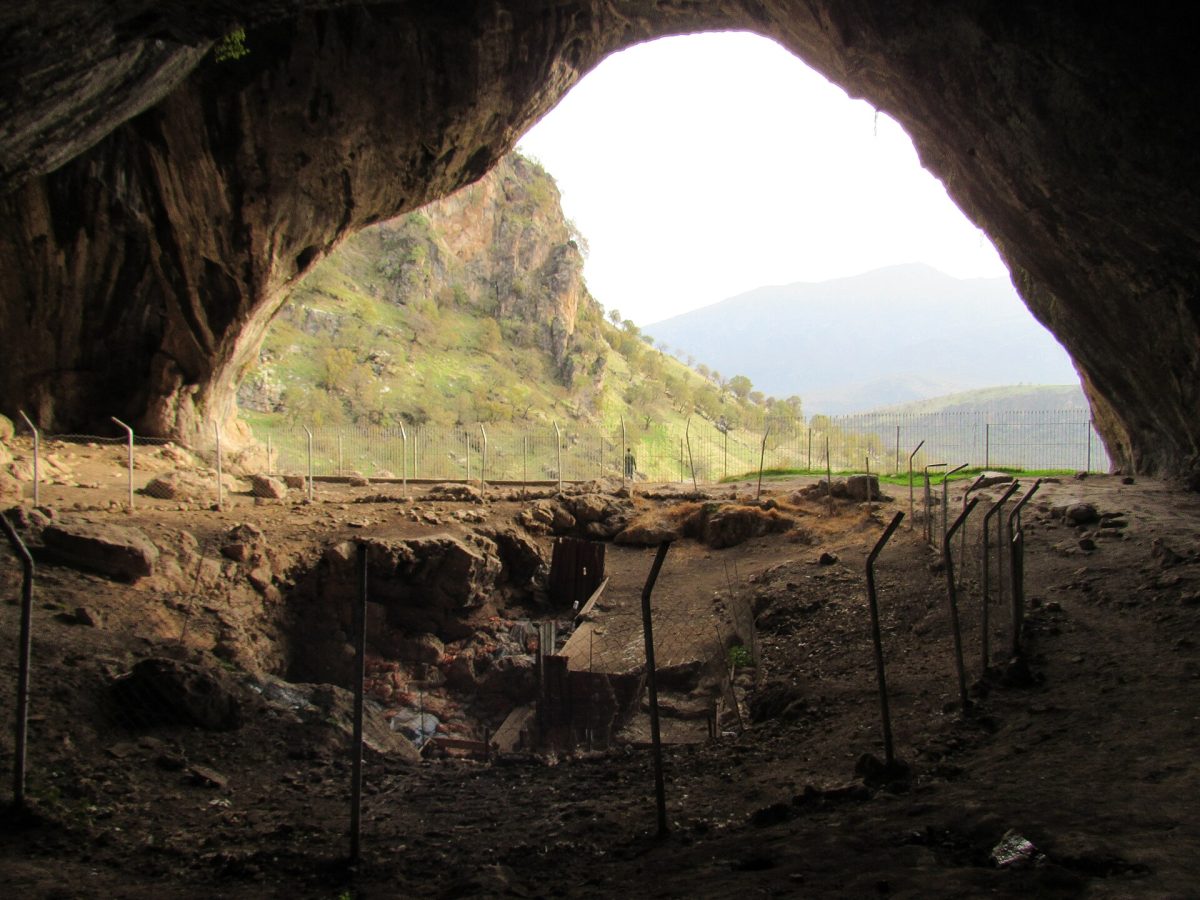
On 2 May 2024 Netflix released a documentary, Secrets of the Neanderthals. The film follows a group of British and Kurdish archeologists undertaking an excavation in Shanidar Cave.
The discovery of this cave in the 1950s unveiled an archeological treasure trove. Buried deep beneath the sandy surface of the cave’s interior, ten Neanderthal skeletons have lain untouched for over forty thousand years. This remarkable discovery has given the archeological field an entirely new understanding of the Neanderthal community, knowledge and way of life.
However, today, sadly, I will not be diving into the wonders of Neanderthal life, fascinating though they may be. Instead, I will be doing my own kind of metaphorical digging, exploring the geopolitics surrounding this seemingly apolitical archeological site.
This is because the Shanidar Cave is located in the Kurdistan Region of Iraq. The history of the cave, and its archeological journey, is therefore intimately interwoven with the political history of the region. A region steeped in seemingly unending violence and political conflict.
This dig, therefore, is monumentally important for the officials of the Kurdistan Regional Government in Iraq. The discoveries made on this site offer numerous political opportunities to Kurdish officials. The publicity around the archeologists’ discovery have enabled Kurdish officials to send their own messages about this land that they inhabit, and its people.
The History of the Excavation Project
The first excavations of Shanidar cave, between 1951 and 1960, were led by the celebrated American archeologist Ralph Solecki. It was during Solecki’s time at the site that the first nine Neanderthal skeletons were uncovered. This discovery rocked the world of archeology, and marked Shanidar out as a site of unique importance for the study of our prehistoric cousins. However, in 1960, the volatile history of the region came into conflict with the archeologists’ progress. The site was abandoned and for over fifty years Shanidar cave remained untouched.
In 2011, the Kurdish Regional Government approached Professor Graeme Barker. Barker was, at that time, the head of the Department of Archeology at the University of Cambridge. They wanted to know if he would consider returning to Shanidar and picking up work where Solecki had left off. From this moment, the collaboration between the University of Cambridge and the Kurdistan General Directorate of Antiquities was born.
However, the project has not been smooth going. Although officials first reached out in 2011, digging only began in 2014 and after just two days the project had to be brought to a halt. During this time, ISIS was at its most powerful and was highly active in the region. The team at Shanidar received reports that ISIS forces were nearing the cave. Fearing for the archeologist’s safety, the dig was aborted.
Work in Shanidar was also complicated by the region’s extreme changes in temperature and humidity. This made the project not only expensive, but painstakingly slow. Although the team returned in 2015, the excavation’s main discovery was made three years later. This discovery, however, was worth the wait. A new near complete Neanderthal skeleton was uncovered. The quality of the skull has enabled facial reconstruction, and the way in which the body was found has fuelled debates on Neanderthal burial practices and spiritual beliefs.
Nevertheless, to truly understand the importance of the discovery to officials in the Kurdistan region Government in Iraq, it is necessary to dip into the Kurdish history of the region.
The History of the Kurdistan Region of Iraq
The Kurds have faced a long and brutal history in Iraq. Their fight for independence first began in the 1920s. Following the end of the First World War, the dissolution of the Ottoman Empire ignited hopes of an independent Kurdish state: “Kurdistan”. The initial Treaty of Sèvres mentioned a parcel of land being provided for a Kurdish homeland. However, hopes were dashed when, three years later, it was not the Treaty of Sèvres, but the Treaty of Lausanne which was agreed upon in 1923. Under this treaty, Kurdish territory was split between Turkey, Syria, and Iraq. Nevertheless, many Kurds have continued to strive for a homeland through a variety of resistance and protest methods.
In Iraq there were several Kurdish rebellions, in 1931, 1944, and throughout the 1960s. The insurgency of the 1960s was led by Mustafa al-Barzani, the leader of the Iraqi Kurdish Democratic Party. Barzani’s resistance was maintained until 1975. However, in 1975, Iran chose to withdraw its support for Kurdish resistance. Without aid from a foreign power, the movement collapsed.
Anti-Kurdish policies continued in Iraq throughout the 1970s. Iraq’s Ba’ath Party had a policy of settling Iraqi Arabs in areas with Kurdish majorities, displacing Kurdish residents from those regions. In the 1980s, they intensified this resettlement policy. Many Kurds were forcibly relocated. Despite this governmental oppression, Kurdish resistance continued throughout the period.
Finally, in 1988, Iraq put its foot down, wanting to quash the resistors once and for all. In a series of operations between March and August 1988, Iraq sought to suppress these Kurdish forces. The attack was carried out through the use of chemical weapons on civilians. One of the worst attacks was in the village of Halabja, where as many as 5,000 Kurds were killed by mustard gas and nerve agents. The Gulf War of 1990-91 led to another brutal suppression of Kurds and a mass exodus of Kurds from the region.
However, after the war ended, the United States stepped in, establishing a “safe haven” for Kurds in the North of the country. This region was governed by an autonomous civil authority, relatively free from Iraqi interference. Following the fall of Saddam Hussein and the Ba’ath Party, the Kurdish parliament convened its first session in the region’s capital of Erbil in 2005.
However, in the 2010s the Kurds faced a new threat. The rise of ISIS proved almost fatal to the independent region. ISIS began to capture territory adjacent to Kurdish areas in Iraq and Syria. Kurdish fighters in northern Syria then engaged in heavy fighting with ISIS, proving to be extremely effective combatants. A multinational effort at long last led to ISIS’ expulsion from its strongholds.
In September 2017, Iraqi Kurdistan held a referendum for independence. It passed with more than 93% support. Despite this, the Iraqi government pushed back against Kurdish forces moving to assert full control over areas within the new independent Kurdistan region. Iraq’s forces quickly put the bid for independence down.
Investment in Culture and Heritage in the Kurdistan Region of Iraq since 2017
The discovery of the full Neanderthal skeleton in 2018 was particularly significant, therefore, for asserting Kurdistan autonomy and unity. Soran Amir, head of the Mergasor Archaeological Department, stated, “The reconstruction of Shanidar Z’s face is more than a scientific triumph.” He continued. “It’s a moment of pride for the people of Kurdistan. We are not only guardians of modern history but of humanity’s deep past.”
On 21 May 2024, Kurdistan Chronicle, the Kurdistan Regional Government, and the Kurdistan Film commission organised an event to honour the archeologists, government officials, and Kurdish excavators that had enabled the discovery of the remains in the Shanidar Cave. The event was attended by many high ranking individuals, such as the KRG Minister of Interior Rebar Ahmen Khalid, Mullah Mustafa Barzani (Babo), supervisor of the Soran Independent Administration Halgurd Sheikh Najob, and KRP Minister of Municipalities and Tourism Sasan Awni. It is clear the people of the Kurdistan Region of Iraq wish to honour and emphasise the Kurdish connection to, and identity of, this project.
This discovery, which has attracted international attention, has provided a real opportunity for Kurdistan to boast its long cultural history and heritage. “While Shanidar will remain as one of the most important archeology sites, we must bear in mind that Kurdistan boasts thousands of other locations that connect us to our ancient past”, Sheikh Najib said.
Kurdistan certainly intends to capitalise on the international pull Shanidar has generated. “We are building a museum near Shanidar Cave to preserve all the archaeological pieces found there. If the museum is completed by year’s end, Shanidar Z will be placed there“, Soran Amir stated. Sheikh Najib has added that, “We at the Soran Independent Administration proudly announce that our doors are open to the academic community from around the world. The KRG is committed to providing every possible facilitation.”
Kurdistan’s investment in the Shanidar Cave perhaps reveals an attempt by the KRG to project Kurdistan’s voice onto the international stage. People living in the region see an opportunity, perhaps now more than ever, to assert the KRG as an independent region, filled with a culture and heritage unique to its lands. Its desire to attract visitors from around the globe, tourists and academics alike, also suggests an ambition to establish a financial and intellectual economy independent of Iraq. Partnerships between the Kurdistan Regional Government and the University of Cambridge are already demonstrating its autonomy and agency in investing in its land’s history, whilst simultaneously promoting advantageous global relationships in the present. Now, with the attention that Shanidar Cave has generated, international collaboration with this Kurdish region of Iraq will only grow. Does all this hint towards a greater emphasis on Kurdish independence and autonomy for the future?