


Hong Kong is in collective mourning.
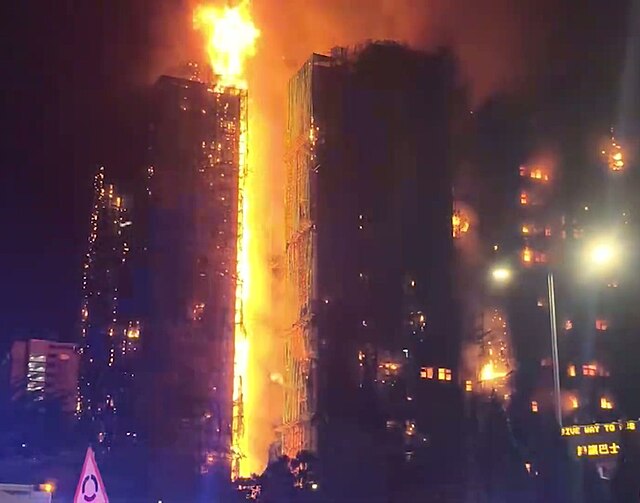
On 26 November, a catastrophic fire tore through the Wang Fuk Court housing estate in the Tai Po district. At least 128 people have died and hundreds are still missing. This is one of Hong Kong’s deadliest residential disasters in decades. Within hours, the blaze tore through bamboo scaffolding and exterior materials covering the buildings, now suspected to have fuelled the inferno.
Families, neighbours and strangers from the city and overseas are flooded with grief, loss, and fundamental questions about safety, responsibility and justice. For those of us from Hong Kong, the footage of the burning towers looks nothing like the city we know, yet everything about it feels heartbreakingly familiar.
A Blaze Turns into Flammable Tragedy
The fire began around 2:50 p.m. at Wang Fuk Court, a public housing complex built in the 1980s, which was undergoing renovation. What ignited on external scaffoldings wrapped in bamboo and green renovation netting, quickly turned into an inferno. Within hours, flames spread from building to building, engulfing seven of the eight towers in the complex, all more than 30 storeys high. As darkness fell, rescue workers and firefighters battled intense heat, thick smoke, and collapsing scaffolding.
A Firefighter Lost, and Many Lives Upended
A 37-year-old firefighter, Ho Wai‑ho, lost his life while attempting to reach trapped residents in a final act of courage that now hangs heavily over the city. His death stands as a sombre symbol of the disaster, a quiet testament to how ordinary lives often carry the burdens created far above them in Hong Kong.
Entire families have rarely been heard from. Elderly residents who were unable to flee down smoke-filled stairwells were found unconscious in lift lobbies. Parents carried children down scorched corridors. Many never made it out. Officials have confirmed that at least 128 people are dead. At the same time, around 150 people remain unaccounted for, and authorities warn that some bodies may still lie buried under debris. Rescue work has ended, yet the recovery continues: a slow and methodical task that may stretch on for weeks.
A Renovation Meant for Safety Turned Deadly
The renovation contract for Wang Fuk Court was estimated at HK$330 million (equivalent to around £29.1 million GBP), a scale that had already unsettled many residents when plans were first announced last year. Some had questioned the unusually high cost, the prolonged disruption caused by the works, and the months-long shroud of scaffolding and coverings that wrapped the towers from top to bottom
In the wake of the blaze, that renovation now carries a devastating irony. A project meant to strengthen and renew the buildings instead introduced layers of flammable coverings and insulation that helped the fire spread with terrifying speed. It became, in effect, a Trojan horse that trapped residents and caused their deaths, a costly upgrade that hid dangers no one imagined would one day turn fatal.
Suspected Negligence — Renovation Under Scrutiny
Investigators now believe that the blaze spread with such terrifying speed because the towers were wrapped in layers of renovation netting and foam insulation that are suspected to be non-compliant with fire-safety standards. Several of the coverings appear to have lacked proper fire-resistance certification. The green mesh netting that was meant to catch falling debris thus acted like a vast sail for the flames. Beneath it, sheets of plastic and foam cladding ignited almost instantly, sending the fire racing up the bamboo scaffoldings and across entire facades in minutes.
Fire experts have long warned that renovation netting and the plastic mesh used on Hong Kong high-rises are highly flammable, despite being technically legal. They have also urged stricter rules for scaffolding on tall buildings for years. In Tai Po, those concerns became reality as the coverings caught fire almost instantly and carried the blaze upward in minutes.
The Arrests
Police have arrested three individuals connected to the renovation contractor, including a project manager and two site supervisors, on suspicion of manslaughter. According to investigators, the renovation team may have installed low-grade and non-certified exterior coverings. Officers are reviewing purchase records, safety certificates, internal emails, and inspection logs to determine whether corners were cut, standards ignored, or warnings suppressed.
It is also said that investigators are assessing whether parts of the façade were left in an incomplete or unsafe state, creating channels through which the fire climbed at extreme speed. Several workers from the site have already been questioned about procurement decisions, subcontracting arrangements, and whether pressure to meet deadlines influenced material choices. More arrests remain possible as the inquiry expands.
If these suspicions are confirmed, the disaster would represent one of the most serious failures of regulatory oversight in Hong Kong in decades. It would also reflect a painful truth that many residents have voiced: the tragedy was not caused by nature or chance, but by systems that prioritised convenience and cost above the safety of the people who lived inside the towers.
Several residents had already raised concerns about the renovation long before the fire. Local authorities inspected the site after receiving safety complaints in 2024, including worries about the flammable construction netting, renovation debris stored along the scaffolding, repeated blockages of escape routes and the prolonged external works that left towers wrapped for months. In response, officials visited the estate multiple times in response to earlier reports, yet no significant corrective action was taken before the blaze, even as complaints continued to accumulate. Survivors interviewed by reporters said they had flagged malfunctioning alarms and other safety hazards more than a year earlier, but their warnings went unanswered and left them feeling that the risks were being ignored until it was far too late.
In the aftermath, what haunts many residents is the realization that this was not a natural disaster but a human neglect built from overlooked warnings and failures that should never have converged. The fire was sudden, but in many ways it was foreseen, and that painful truth carries a weight that is difficult to bear. It hangs over the city like smoke long after the flames have died, forcing Hong Kong to confront what it means when lives are lost not to fate, but to the very systems meant to protect them.
Pain, Solidarity and the Quiet Resilience of Hong Kongers
Even amid devastation, Hong Kong’s instinctive solidarity has become one of the clearest lights in the smoke. Across Tai Po and far beyond it, thousands of volunteers mobilised within hours. Community groups, churches, schools, and NGOs set up makeshift aid stations that distributed water, blankets, phone chargers, hot meals, masks, medicine and bedding to displaced families.
Small businesses also stepped forward. Restaurants across Tai Po offered free meals to survivors and firefighters. Cha chaan teng owners left handwritten signs on their doors saying, “If you are affected, come in and eat — no charge.” Local shops set out boxes for donations, and some pledged an entire day’s earnings to relief funds. A few eateries stayed open until dawn, delivering congee and hot drinks to families waiting in community halls. One volunteer told Le Monde, “We cannot rebuild their homes, but we can make sure they are not alone.”
Mutual-aid networks sprang into life with extraordinary speed. Volunteers sorted stacks of sanitary products, towels, shoes, baby formula, and bedding into crates. Social workers coordinated counselling for traumatised families. Youth groups offered to look after children whose parents were missing or injured. Hong Kong’s diaspora joined in: people abroad arranged fundraisers, delivered online grocery vouchers, and helped coordinate missing-person information channels.
Around the world, Hong Kongers abroad echoed that spirit, organising vigils, raising funds, and offering support from afar. The grief travelled widely, but so did the solidarity.
All of this – the speed, the compassion, the refusal to look away – reflects the best of Hong Kong. This is the Lion Rock spirit people speak of: the deep, unspoken belief that when disaster strikes, strangers become neighbours, and neighbours become family. It is a resilience forged from decades of hardship, migration, struggle, and community care — a spirit that persists even when confidence in institutions falters.
Debate Over Bamboo: Safety and Tradition
In the days after the fire, some authorities moved quickly to link the disaster to Hong Kong’s long-standing use of bamboo scaffolding and signalled an accelerated shift toward metal, fire-resistant frameworks. Officials announced plans for public works to begin phasing out bamboo in favour of steel, with a target for 50 percent of government construction projects to use metal scaffolding due to its fire resistance and greater durability in Hong Kong’s humid weather.
Yet videos of the blaze seemingly show that the bamboo poles did not burn as intensely as the green synthetic mesh surrounding them. Investigators believe the mesh netting — a plastic material stretched over the scaffolding — alongside foam insulation and exterior plastic coverings, acted as far more potent accelerants than the bamboo itself.
For many Hong Kongers, bamboo scaffolding is more than a building material — it is part of their heritage, a symbol of toughness, agility and ingenuity that shaped the city’s skyline. Critics of a full ban warn that abandoning bamboo wholesale would discard a traditional craft, and undermine the cultural identity of Hong Kong’s working-class construction community.
This debate has therefore become both technical and deeply emotional: Hong Kong must reckon with how to strengthen safety without erasing practices that carry the city’s enduring sense of resilience, solidarity, and cultural pride.
What this means for Hong Kong
This fire is more than a disaster; it is a rupture. It revealed years of structural neglect, uneven enforcement, and renovations shaped more by cost than care. Behind the charred façades lies a truth Hong Kong can no longer look away from: when safety becomes an afterthought, the consequences are permanent.
The human cost is almost unbearable to name. 128 lives lost. Families broken apart. Homes reduced to ash. Survivors displaced with nothing but a few soot-marked belongings. Their stories carry a single, devastating message: the smallest compromises in safety can end entire worlds.
Hong Kong now stands at a reckoning. The arrests mark the beginning of accountability, not the end. Residents are demanding what they should have always been able to expect: transparent regulation, strict oversight of scaffolding and renovation practices, and a renewed commitment to valuing human life above speed, profit, or convenience. This is not simply a technical debate about building codes; it is a moral one.
For those of us from Hong Kong living abroad — in Oxford, or anywhere else — the tragedy travels with us. Distance does not soften it. We watch from afar and feel the same tightening in the chest, the same grief, the same disbelief that this could happen in the city we still call home. The fire reminds us that ties of place and memory stretch far further than geography allows. When Hong Kong suffers, Hong Kongers all feel the tremor in our own lives, wherever we are.