


“She could feel the shape and weight of each limb; sounds came to her with perfect distinctness; the sounds downstairs and a low-voiced conversation across the landing, little faint marks that human beings were making on the great wide stillness, the stillness that brooded along her white ceiling and all round her and right out through the world; the faint scent of her soap-tablet reached her from the distant washstand” (Pointed Roofs, Dorothy Richardson.)
In Gallery 63 of the Ashmolean Museum, other than two blue, velvet-cushioned chairs, I am alone in the small room and can only hear whispers of footsteps or little words like faint paint marks from beyond the door. I interrupt this stillness for a moment by pulling one of these chairs to position it opposite Gwen John’s ‘The Convalescent’, then adjust it to the left slightly, to more closely follow the convalescent’s figure.
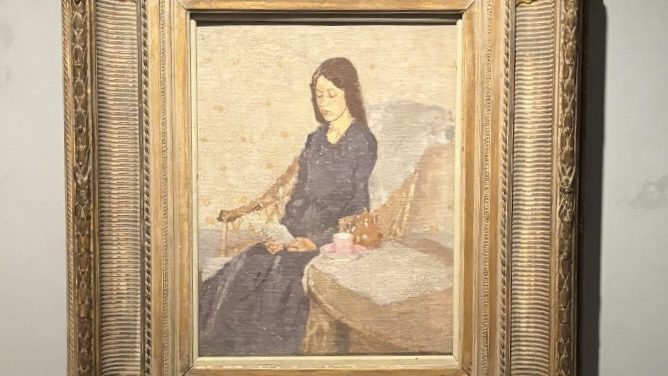
To sit and look at Gwen John’s ‘The Convalescent’ is to become acutely aware of one’s own body, “the shape and weight of each limb”. Each time I visit her, I feel as if I am returning to an old friend with whom I need not speak to be understood. I place my body consciously in relation to the painting, whether also holding paper in my hand to write with or a book to read. Perhaps this feeling of being invited into physical relation with the painting is because the work is itself concerned with attention. It is difficult to discern whether it is a letter or a book she’s clutching in her hands, regarding it as if it tells her nothing new, and yet it holds her gaze like a string held taut to its near snapping point. I imagine, through the stillness, hearing a tremble of the cup upon the saucer, as soft or bright as the shade of pink that coats it. The writer and aesthete Vernon Lee, a close-contemporary of Gwen John, described empathy as ‘in-feeling’, or Einfühlung, where observing subject and observed object become part of a ‘complex.’ The physical interplay of looking becomes itself the substance of empathy. The empathetic act, of which the act of reading is an example, is one which is physiologically invested in by the observer. In a similar way, people read paintings with their bodies too.
Somehow the other empty chair in the centre of the room is part of this inward attention too; in the corner of my eye is an emptiness, and to me the ‘The Convalescent’ balances presence and loss. John herself experienced periods of illness and depression, and the fragility of the pastel colours gives the figure in the painting a sense of physical vulnerability. Yet the intensity with which the figure looks at the paper in her hand balances this fragility with solidity. In a letter, John wrote “it may not be always a misfortune to be ill. One may have thoughts then that one would never have had being well, good thoughts I mean…” A balancing of solidity and fragility lies in this very phrase, and it is as if in illness she can find space and time for a kind of concentration that she might not otherwise have had.
In this room, ‘The Convalescent’ is placed beside a small bronze model of Auguste Rodin’s ‘The Thinker’ – an interesting curatorial decision. For Rodin and John knew one another well – she modelled for Rodin in Paris around 1904, after which they began a passionate, decade-long relationship. This ended with Rodin avoiding her and returning to his wife, who he had remained married to throughout the affair. It is often said that John’s feelings for Rodin were intense and eventually came to overwhelm or ‘suffocate’ him. After the affair ended, John became increasingly reclusive, converted to Catholicism and had a final relationship with a woman named Vera. As the narrative often goes when looking back on artistic circles of the past, John has more often been defined in relation to Rodin rather than by her own creative work. To place ‘The Convalescent’ beside ‘The Thinker’ is to recognise the connection between the two figures depicted. While her piece could, and perhaps should, stand on its own, in conversation with ‘The Thinker’, ‘The Convalescent’ herself becomes a ‘thinker’ in dialogue with Rodin’s bronze model. She offers a different form of thinking to Rodin’s sculpture: the convalescent is placed and contextualised in her thought, framed by the faded and beige-walled room she is painted into. John draws attention to the limits imposed on possibilities for women to explore intellectual and creative pursuits, while also granting her figure an intensity both bodily and expressive in a comparable way to Rodin’s figure. Notably, John experiments, too, with her convalescent outside of the individual painting: she continues making various very similar paintings of the same model in the same position, with subtle changes. This insistence on nuanced iteration of the same subject is a way of valorising the quiet intensity of the piece.
This leads me to write of how I came across John’s ‘The Convalescent’. I had two ‘ways into’ her work: first from my Nana, who told me of John’s work, suspecting that I would be interested in her story and her art. This was when I was much younger, and the memory of ‘The Convalescent’ became buried for a while in my mind, until the Christmas vacation of my first year at Oxford. I was ill and bedbound with flu, yet still trying to prepare for Paper 4 of the Prelims English course. In reading about form at the level of syntax and the sentence in early modernist novels, I stumbled across the first use of the term ‘stream-of-consciousness’ to describe literary form. May Sinclair, borrowing the term from psychologist William James, said that a writer called Dorothy Richardson “gets closer to reality than any novelist” through “Miriam’s stream of consciousness.” After researching Richardson further, (with difficulty, for her work is not readily available now) I bought the first of the thirteen novels in her Pilgrimage series, and borrowed subsequent ones from my college library. There was no image when I ordered it, and when it arrived, the sight of John’s ‘The Convalescent’ on the front cover not only of the first book, but each subsequent novel in the series, rescued from deep in my memory the painting that Nana had told me about all those years ago.
Having since continued reading Dorothy Richardson, I have only become more and more convinced of the way John’s painting and Richardson’s texts speak to each other. Pilgrimage chronicles the life of Mariam, from her time teaching in a school in Germany, to her grief at her mother’s suicide, to her relationship with a married man, to her experience of abortion. Both Richardson and John also seemed to develop a kind of obsession with their singular subject. Richardson began Pilgrimage with Pointed Roofs and continued writing twelve more novels about the same protagonist until she died; John, too, painted eleven iterations of the same woman sitting in the same chair reading a letter. Yet both also seem to have been half-forgotten. While James Joyce and Virginia Woolf are quite rightly household names for their modernist, stream-of-consciousness techniques, Richardson as a writer, whose epic project is comparable in scale to Ulysses and who was a fundamental part of the developments in literary style at the beginning of the 20th century, seems not to be known outside of academic circles. Similarly, John was often overlooked as a creative artist in her own right outside of her relationship with Rodin until recently. While both John and Richardson are increasingly being recognised for their work, there is still a long way to go.
May Sinclair noted that in Richardson’s writing “moments of Miriam’s consciousness pass one by one, or overlapping; moments tense with vibration, moments drawn out fine, almost to snapping point.” While Richardson herself was suspicious of the term ‘stream-of-consciousness’, passages which describe Miriam’s internal thoughts do seem suggestive of a kind of flow. Nonetheless, they also contain a tension or intensity of ‘moments drawn out fine’: “cool streams seemed to be flowing in her brain, through her heart, through every vein, her breath was like a live cool stream flowing through her” (Pointed Roofs, Richardson.) This, as the paragraph quoted at the opening of this article, could also be used to describe ‘The Convalescent’ depicted in John’s painting. It is a piece in the Ashmolean collection I return to again and again, much as Gwen John and Dorothy Richardson themselves returned to their own subjects.