


Photos taken by Gabrielle Killick, used with permission
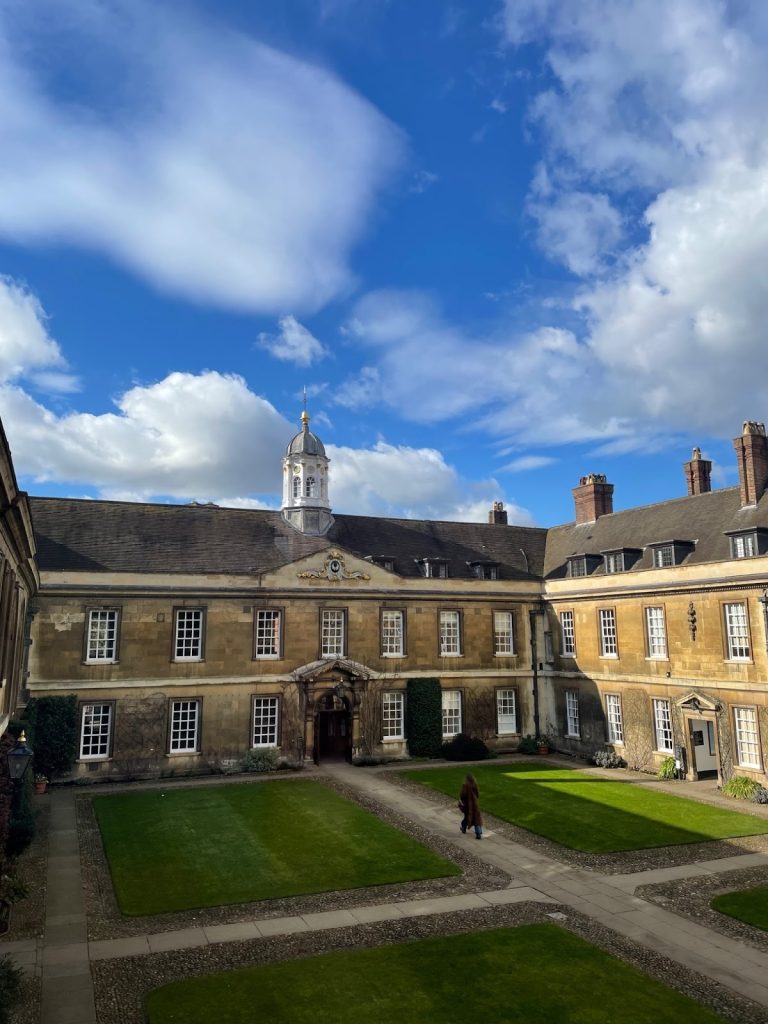
On Wednesday 7 January, The Guardian reported on Cambridge University College Trinity Hall’s policy to target elite private schools as part of their admissions outreach strategy. The decision was met with a backlash; a wave of anger and frustration was felt across the student and academic body, even beyond the ivy-clad walls of Trinity Hall. One academic has called it a “slap in the face”, and another called it a “deeply alarming policy”.
Part of the college’s newest “targeted recruitment strategy” is to approach 50 independent schools in the UK to encourage applications for subjects including Classics, Music, History of Art, and Languages. Some of the lucky few that have made the cut include St Paul’s Girls’, Eton, Winchester College, and Cheltenham Ladies’ College. Recognise a pattern?
Dr Marcus Tomalin, Director of Admissions at Trinity Hall, has stated that these elite schools offer the “strongest applicants” for certain degrees. He also warned against “reverse discrimination”, claiming that the policy aims instead to provide “greater fairness in admissions”. The most contentious statement made, however, was that this move was an effort to improve the “quality” of the students applying.
The policy is baffling on several accounts. Do private school pupils really need more encouragement to apply to Oxbridge? Aren’t they already aware — or made aware by a flurry of teachers, tutors, parents, and peers — of the opportunities available to them? For further evidence, the co-founder of the Private Education Policy Forum Jess Staufenberg has shared in a Guardian article that there was no evidence that private schools needed any more encouragement to apply to Cambridge.
When the admission rate of private schools is 26% for Trinity Hall — a number that reaches 29% at the University-level — the concerns over “reverse discrimination” are as insensitive as they are misguided. For context, only 6% to 7% of UK-educated students are privately educated. It is worth noting that this percentage increases for sixth formers, almost doubling to 12.2%, according to CIVITAS, while the IFS has recorded that 18% of 16–19 year olds attend independent schools.
To give credit where it’s due, Trinity Hall has made considerable efforts in recent years to reduce that gap, with its proportion of private schoolers decreasing from 32% in 2022 to 26% in its most recent data. It is unfortunate, then, that the new policy is casting a shadow over this otherwise impressive progress.
But perhaps the most shocking aspect of Trinity Hall’s policy is its wilful oversight of social dynamics. Privately-educated students are not naturally of better ‘quality’ — a problematic word in and of itself. By which standards do we even begin to judge ‘quality’? If anything, the calibre is set to what is already taught at independent schools, including thinking ‘outside the box’, clarity of expression, and self-reflection.
Years of training, both in school and at home, have moulded private schoolers into eloquent, composed individuals; teaching them how to speak, act, listen, and ask the right questions. Pierre Bourdieu’s concepts of cultural capital, habitus, and misrecognition highlight how social class shapes the individual’s opportunities. Lee Elliot Major suggested that Trinity Hall’s policy may be a classic case of misrecognition, a process whereby social hierarchies are obscured to the extent of being viewed as legitimate or natural. In the Oxbridge system, this misrecognition operates by mistaking elements provided by a privileged education (including ‘extra preparation’ or ‘polished performance’) as signs of innate ability. Even more harmful is the subsequent normalisation of these skills, allowing inequalities to not only go unnoticed, but become justified. Let’s not confuse quality with privilege.
The widespread outrage reveals something deeper about the current political climate, and comes as part of a wider movement that is questioning growing economic inequalities, elitism, and university (in)accessibility in the UK. As universities throughout the country have sought to implement outreach programs for less privileged, marginalised, and/or underrepresented communities, Trinity Hall’s new policy comes as a “slap in the face” indeed, reminding us that hard-fought progress towards equality may prove to be more tenuous than we thought.