


Noah Allerton
On 24 February 2022, Russia launched its full scale invasion of Ukraine. Four years on, the “special military operation” by Russian President Vladimir Putin continues. Yet, “continues” is an odd way of describing a war that has virtually been at a territorial stand-still for almost three-quarters of its duration. The fighting continues, and much of the Western world continues to stand with Ukraine, providing the state with assistance in the form of arms. In the past year, as with many points of the war, there have been both glimmers of hope and glimmers of despair for Ukraine. Unfortunately, there is little reason to hope that 12 months from now, the situation will be any different.
The Background and the Figures
When Putin initially declared his “special military operation” in February 2022, he stated that its specific aim was to liberate the Donetsk and Luhansk regions of Ukraine, otherwise known as the Donbas. This invasion followed the annexation of Crimea by Russia eight years prior, which was described by some as “the smoothest invasion of modern times”. There is no doubt that Putin likely envisioned the same ease for the annexation of Donetsk and Luhansk. At his annual end of year press conference in 2024, Putin said that, with hindsight, he wished that he had invaded Ukraine even earlier than 2022, and that there should have been “systemic preparation” prior to the war beginning. Ukrainian forces have defied Russian expectations, and continue to do so to this day.
In the past year, there has been so much and yet so little development in the situation. Since 2023, Russia has only moved forward in the front line by (net) 1.3%. Despite this, estimates by Ukrainska Pravda find that as of 2 March 2026, Day 1,467 of the war, there have been 1,267,730 Russian military injuries and deaths. BBC Russia has found that the number of confirmed Russian soldier deaths as of 24 February 2026 stands at 200,186; this is almost four times the figure that Ukraine reports for their own forces, which Zelenskyy claimed to be around 55,000. All of these figures, however, are contentious, and the BBC have claimed after cross-referencing with other sources on the ground that casualties may also be around 200,000 for the Ukrainian side. No matter the exact figure, however, it is important to keep in mind that behind every single figure is an actual person that has lost their life in a war that has not changed militarily in nearly three years.
Russia’s Renewed Offensives
At the 2025 Arctic Forum in Murmansk, Putin claimed that Russia was still on track to achieve the goals of its “special operation”. Perhaps “not as fast as some may like”, but nevertheless on track. He continued to claim that Russia would “finish them off”. Ukraine, however, has not gone down so easily.
Russia massively increased its attacks on civilians in the first half of 2025, notably with raging attacks on Kyiv in June 2025 which had the highest civilian casualty count since the start of the war. Civilian casualties in the first half of 2025 were up 54% compared to the same period in 2024. Yet, despite this increased bloodshed, it is estimated that Russia’s offences left them with just a 0.3% territorial advance.
Many reporters in Kyiv began to speculate that this offensive could be decisive in ending the war; Putin himself seemed incredibly confident. Yet now, in March 2026, it is clear that this offensive attempt was a catastrophic failure. Neither side is making much progress in the long term, despite continued speculations of the war possibly coming to an end through a new military offense. Casualties, however, continue to increase as a consequence of these aims; that Russia shall not settle for anything less than a territorial gain.
A New Leader of The Free World
2025 saw the inauguration of a President of the United States who repeatedly claimed that he could end the war “on Day One”. President Donald Trump has argued that this was said in jest. However, two years earlier at a rally in Iowa, he claimed that “I’ll get that done within 24 hours. Everyone says, ‘Oh, no, you can’t.’ Absolutely I can. Absolutely I can”. With his adamancy, it appears evident that Trump, in fact, did not mean this in jest.
Trump has been incredibly vocal about the war in the past year. On 28 February 2025, a month after Trump’s inauguration, he held a televised bilateral meeting with Ukrainian President Volodymyr Zelenskyy in the oval office, accompanied by US Vice President JD Vance. This meeting was meant to end with the signing of the US-Ukraine Mineral Resources Agreement, which would lead to the US receiving valuable Ukrainian minerals in exchange for continued military assistance. The agreement, however, would not be signed until 30 April, and it would not be signed by neither Zelenskyy nor Trump. Instead, the meeting descended into chaos, with Zelenskyy arguing with Trump and Vance on live television. Trump and Vance repeatedly talked over Zelenskyy, and Vance even accused Zelenskyy of not thanking the US during the meeting. This televised display of disunity laid bare the tensions in the relationship between Zelenskyy and Trump for the world to see, and only served to bring further scepticism about Trump’s ability to end the war.
For Russia, this meeting was a perfect opportunity to further criticise Zelenskyy. Former Russian President and Deputy Chair of Russia’s Security Council Dmitry Medvedev claimed on X that “The insolent pig finally got a proper slap down in the Oval Office”, admiring Trump’s diminishment of Ukraine’s struggle. Russia’s Foreign Ministry Spokesperson Maria Zakharova also added on a Russian Telegram channel that “how Trump and Vance exercised restraint and didn’t punch this scumbag is a miracle of restraint”. Russian officials took full advantage of this public display of fracturing relations, a display that surely would have only emboldened Putin before his summer offensive.
The Coalition of the Willing
On 2 March 2025, just two days after Zelenskyy’s White House showdown with Trump and Vance, Keir Starmer announced the “Coalition of the Willing”. This is a coalition of 34 states (other than Ukraine), the EU, and NATO. Despite the involvement of the EU and NATO, Slovakia, Hungary, Malta, North Macedonia, and the US are not members of the coalition.
The coalition was created in order to provide a concrete vehicle for potential security guarantees for Ukraine, and to essentially formalise a coalition of countries providing aid to Ukraine. The potential of a peacekeeping force was also discussed, however this has not materialised in the year since the London Summit. It remains to be seen if the coalition will meaningfully aid Ukraine beyond existing arrangements. In January 2026, the member states, joined by the US, issued the Paris Declaration, providing a list of guarantees to the state of Ukraine in the aftermath of a ceasefire. Until such a day arrives where Ukraine no longer fears Russian aggression, the potential impact of the coalition remains to be assessed.
Alaska: A Disappointment For Ukraine
On 14 July 2025, amid growing frustration within the Trump administration that nothing was changing in the circumstances of the war, Trump announced that a 100% tariff would be placed on all countries that did business with Russia if a peace deal was not developed and agreed to within 50 days. On 28 July, on a visit to Scotland, Trump altered his previous position, and the deadline was to be shortened to “10 or 12 days”. This was “because I think I already know the answer what’s going to happen” with regard to Russia’s response to his threats. Trump in the same press conference added that he had previously “gotten along with [Putin] very well”, but that Putin also “goes out and starts launching rockets into some city, like Kyiv, and kills a lot of people in a nursing home or whatever, you have bodies lying all over the street”.
On 8 August, the deadline day, instead of announcing the imposition of sanctions, Trump announced a bilateral summit between American and Russian delegations to take place exactly a week later in Anchorage, Alaska. This was the first in-person meeting between Putin and a US President since President Biden and Putin met in Geneva in July 2021, before Russia invaded Ukraine. Earlier in 2025, Secretary of State Marco Rubio had met with Russian Foreign Minister Sergey Lavrov in Riyadh for the first diplomatic encounter since the invasion, but neither president was in attendance.
Trump claimed it was “not necessary” for Putin to meet with Zelenskyy before the summit, essentially making Trump the mediator between the two parties. He appeared to remain attached to the idea that any potential peace deal would likely require land-swapping between the two states. Zelenskyy has repeatedly claimed that no peace deal involving the cessation of Ukrainian territory will be accepted, and made it explicitly clear before the meeting that any deal that involved ceding Donetsk Oblast to Russia would be unacceptable.
Before the talks on 15 August, the Kremlin claimed that the talks could last from six to seven hours. Yet after just three hours, reporters were summoned back for an impending announcement from the two heads of state, and nothing close to a peace deal was announced. Both leaders made a short speech, and Trump proclaimed that there would be “no deal until there is a deal”. Neither leader took any questions from the press, and left the stage after 20 minutes. After just six hours on the last frontier, both leaders were leaving the state and returning home.
Later, Trump posted on Truth Social that it had been a “great and very successful day in Alaska!”. Furthermore, he said that the preferred route would be an immediate peace deal, rather than a ceasefire agreement, as these “often do not hold up”. It remained clear, however, that this peace deal that Trump envisioned would continue to involve Ukraine ceding land to Russia. Putin was reported by two senior European officials to have claimed that if the Donbas could be ceded to Russia, including the areas on the Ukrainian side of the current battle lines, there would be an immediate ceasefire and a written promise that Russia would not attack Ukraine or any other European country again. Nevertheless, as highlighted by the New York Times, Putin has broken such promises before.
The summit in Alaska resulted in nothing but diplomatic victory for Putin. Trump had warned of economic sanctions if Putin left Alaska without agreeing to a deal; no such consequences came. European leaders issued a statement affirming that the decision on territory must be left to Ukraine, and that “international borders must not be changed by force”. But Europe has very little influence on the decision-making of Putin, and it is clear that when he departed Alaska, he was likely very pleased that the President of the US seemed on-board with nearly all of his demands.
After Alaska: Stagnation for 2025
On 18 August, Zelenskyy met with Trump at the White House before a multilateral meeting which included five other European leaders, NATO chief Mark Rutte, and President of the European Commission Ursula von der Leyen. The meeting resulted in security guarantees from the attendee states for Ukraine. Reportedly, von der Leyen and Italian Prime Minister Giorgia Meloni had called for “NATO like” guarantees that would reflect Article 5, but Trump ruled out sending troops to Ukraine should a peace deal be agreed.
Over the following six months leading up to the fourth anniversary, however, little has changed. Russia launched renewed offenses in the city of Povrosk, gaining 165 square miles of Ukrainian territory in the four week period leading up to 11 November 2025. Relative to the total 45,322 square miles of territory that has been seized by Russia, this seems insignificant. Yet every square mile that Russia progresses places Ukraine in an increasingly unstable bargaining position, and the case of the cessation of Donetsk and Luhansk grows stronger.
Is an End in Sight?
2026 has possibly proven more fruitful for potential peace. In January 2026, the first trilateral talks of the war were held between Ukrainian, Russian, and American officials in Abu Dhabi. Further talks took place in early February, described by Ukraine’s top negotiator as “substantive and productive”. More talks were then held in Geneva on 17-18 February that concluded “without breakthrough”, and were “difficult” for the Ukrainian delegation. The very presence of trilateral talks seems to suggest an element of progression in the war; however, the talks are nothing more than symbolic unless a peace deal is agreed to.
In February 2026, Zelenskyy reiterated that there would be no cessation of land to Russia as part of a peace deal. Zelenskyy has faced criticism that he has remained president for nearly two years past the regular expiration of his term, yet Ukraine’s constitution does not allow for the holding of elections during wartime. Zelenskyy has argued that if Russia were to grant a two-month ceasefire, he would seek to pass an act in parliament in order to circumvent the constitutional requirement, and hold new elections, just as the US has pressured for.
On 28 February, Russia was reportedly considering withdrawing from peace talks if Ukraine refused to withdraw from Donetsk and Luhansk. On the same day, the US and Israel launched their offensive on Iran. Zelenskyy supported the action, claiming Tehran to be “an accomplice of Putin”, but emphasised that further peace talks would depend on the stability of the region, given the likelihood that the talks would be held in the United Arab Emirates. As of 2 March, the United States State Department has issued an update to citizens to “depart now via commercial means due to serious safety risks” from over a dozen countries in the Middle East, including the UAE. On the same day, Zelenskyy stated that the talks would still go ahead, with Switzerland and Türkiye being discussed as alternate locations for discussions.
It remains extremely difficult to see how peace can be achieved when the two sides remain at almost exactly the same ideological position as they were at this time four years ago. Talks of turning the Donbas into a demilitarised, economic free-zone have been floated by the US, with potential support for Ukraine. However, it is difficult to envision Putin opting for this solution; it goes against every objective of the “special military operation”, which was to liberate the people of the Donbas, and Ukraine as a whole, from the “neo-Nazi regime” which he saw in their government. Even if one considers Putin’s main objective to in fact be to intimidate NATO and to not expand into Ukraine, it seems unlikely that a weakening of the position that Putin has taken for four years would be taken.
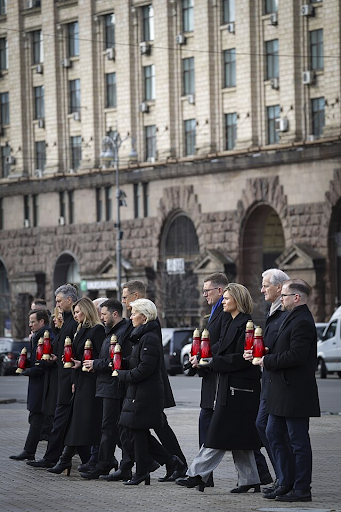
To put it bluntly, the two countries are deadlocked, both militarily and diplomatically. The past year carried great potential for the ending of the war, yet as with many of Trump’s policy promises for his second term in office, the ending of the war “on Day One” simply has not occurred. As of the time of writing, it is Day 1,468 of the war, and Day 407 of the second Trump presidency. The end of the war may seem closer than before with the initiation of trilateral talks, but the reality is that without a major concession from one side of the negotiating table, the deadlock simply shall not break. Leaders will continue to offer support and lay tributes, yet Ukrainian and Russian lives continue to be lost in a war entirely of the Russian government’s making. An end may be nearer than people expect, but the question remains exactly the same as it has been since 24 February 2022: who will crack first, Zelenskyy or Putin?