


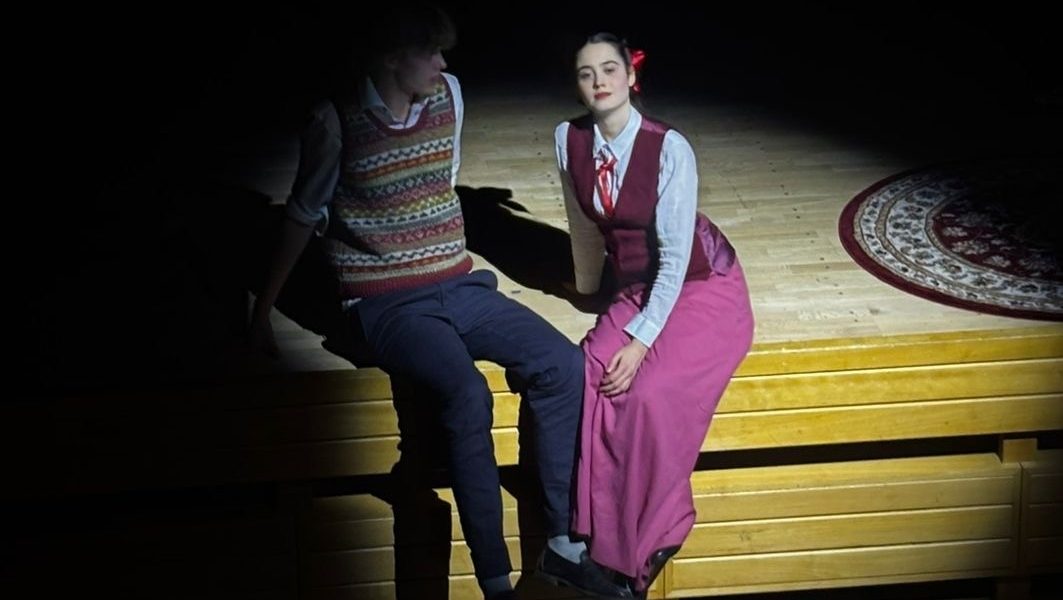
Though St Hilda’s College now welcomes people of all genders, it is clear as I walk down the carpeted corridors that it wears its 115-year, women’s-only history on its sleeve and on its walls, which proudly display portraits of its alumnae founders and pioneers of female education. I sit down to speak with Rosie Sutton (Co-Director, Producer) and Rowan Brown (Co-Director) about their production of Jessica Swale’s Blue Stockings.
The name of the play, I’m told, comes from the term ‘bluestocking’, which was used derogatorily to refer to a woman who was considered too educated. The play follows four young women at Girton College, Cambridge in 1896, at a time when women were allowed to attend the university but could not yet receive degrees.
Rosie mentions how easy it is to forget that women’s rights to education did not always exist, and that despite it being taken for granted these days, “women are still on the back foot” and still fighting across the globe. Here, however, in a cosy, quiet room tucked away in the college, women’s voices are the only ones speaking.
The process of creating the play has been, as Rosie describes it, “women telling women’s stories… We have an almost all female and nonbinary creative team… I don’t know how often that happens. It’s exciting to be in a team like that.”
I mention Shakespearean drama and the absence of women, and we talk about the power and joy in “championing women’s stories,” stories which continue to resonate today.
The feminist origins of the college are “built into the walls,” Rosie explains, because of the way that women’s colleges were constructed differently to men’s colleges. “I can imagine our characters having a class in this room,” Rosie says. “We are their legacy.”
Though we are fortunate to now have the rights that the characters fight for, as International Women’s Day approaches, feminists all over the world consider not only how far we have come, but how far is still left to go.
Oxford University first allowed women to receive degrees in 1920. Cambridge took until 1948 – fifty years after the play is set, and eighty years after women started attending the university.
When we look back on history, so many previously accepted ideas seem obviously wrong to us now. We must consider what it is that we believe today and how it will look to us tomorrow. There is hope that one day equal numbers of women and men in STEM degrees will be so normal it could be taken for granted, or that one day it will always have been obvious to pay women the same as men.
Rosie admits that Blue Stockings is not a perfect play, and both co-directors find fault with the work’s depiction of a woman having to choose between an education and love – “love is not the opposite of knowledge” and to portray it as such, they feel, is a “drastic oversimplification.”
As the cast enters the room for a rehearsal, this statement comes to life. There is a very important kind of knowledge in the room: each cast member knows what they want and need in order to give their best performance. As the scene is rerun, each person has a voice, and their opinions are taken on board. There is also love. There is love for theatre – the excitement and readiness to act is clear – but there is also love for the friendships that have been formed, love for Rosie’s new jeans, and love when one actor says to another, “I love your dress, you look so nice.”
They high-five each other when they’re happy with the amendments made to the scene, and I leave thinking of the sacrifices that were made so that 18 people of all genders could stand together in a room as equals.
Blue Stockings is being performed at The Jacqueline du Pré Music Building from the 5th-7th of March.