
When I first entered The North Wall’s theatre, I found a mess.
Stools and chairs and pieces of clothing and paper lay haphazardly on the floor, but the spotlight drew my attention to the only thing upright on stage: a coat rack with a single hat and a long black coat. This tailored chaos (designed by Amelia Morton) gave me an idea of the pandemonium I could expect when the play began, and needless to say, my expectations were met.
The band officially kicks off the play, consisting of William Eckford on the guitar, Thomas Murphy on the bass, and musical director George Ke on the piano. From the jaunty introduction to the final sign-off, the band truly was one of the most effective aspects of the production. Tonally, all three were consistently on point, providing both whimsy and tragedy as the scene necessitated it. Despite not being the size of a full orchestra, there was never any point where a note or type of sound was missing—it always took me a moment to remember that it was only three instruments I was listening to! While the band was excellent throughout, I found myself most impressed when their music functioned as comedy in both traditional and untraditional ways. The traditional short riffs after a joke almost always elicited a laugh out of the audience, but my personal highlight was when they became a part of the cast at the beginning of the song “Details”—here, all three briefly became sergeants that “spoke” through their respective instruments. Although the scene was short, the comedic timing and effect made it one of the most memorable of the play for me.
The band was my favorite part, but a very, very close second would be the production’s choreography. Director and choreographer Rosie Sutton did a fantastic job of making the full use of the traverse set-up of the stage, allowing the audience’s attention to perfectly follow the actors’ movements regardless of which side of the stage they sat on. No single movement seemed wasteful—each one served a purpose, whether that was to signal bravado and triumph, or confusion and disarray. The placement of characters, even when they weren’t moving, was especially strategic: for example, I quite enjoyed that the prime ministers during a vote of no confidence were in seats aligned with the audience. This made it so that I, within the audience, also felt like a part of the debate that followed between the characters. As fabulous as the choreography was, it would have been nice to see more of the unique space of The North Wall theatre used. This was already done to some extent with characters running down the aisles past the audience, but there was also potential to use the upper rows of seats as a space for the characters.
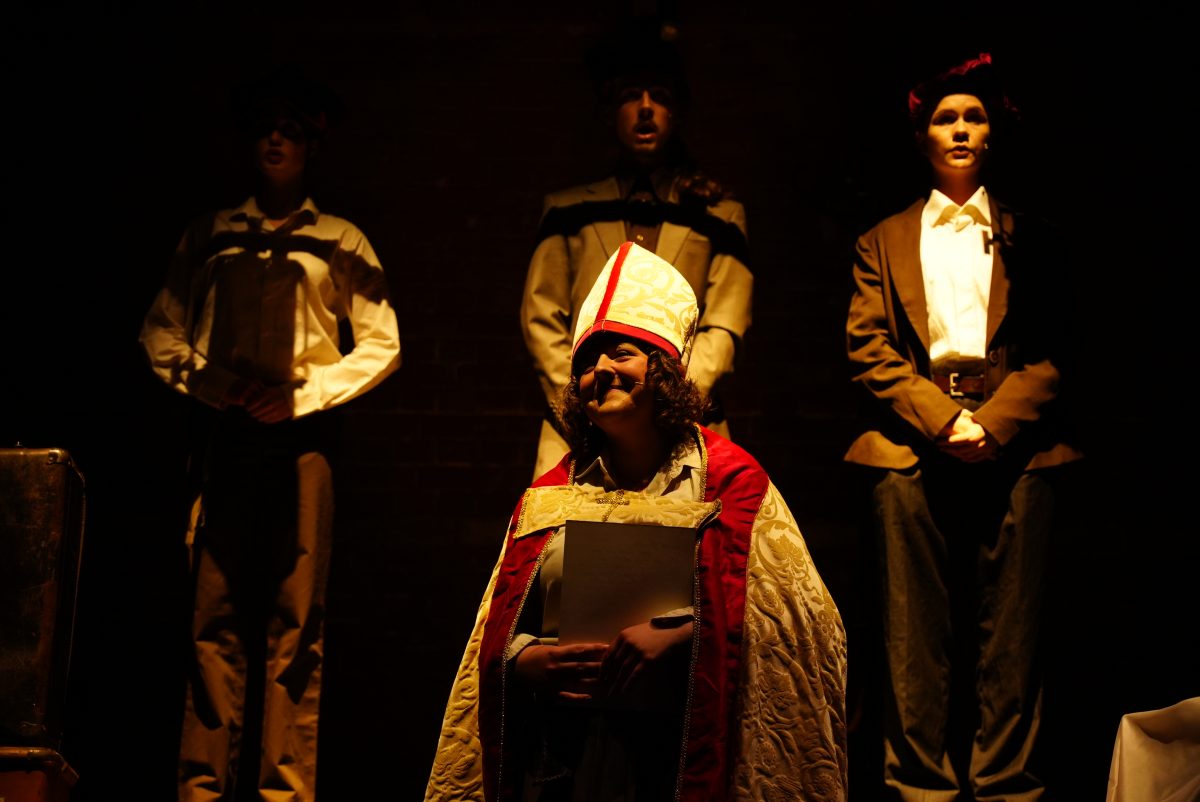
Of course, I could not continue this review without discussing the actors—they had quite the daunting task with this production, as every person was playing at least 8 characters that they had to rapidly switch between. I was initially under the impression that this constant switching would cause confusion, but the swaps were made so skillfully that we were able to immediately tell what character each person was meant to be at any given time. The actors were seamless in the switching of their posture, tone, and accent to give the impression of characters of different age and gender—not a trace of one character that an actor played lingered in a different character the same actor played. These switches were also aided by the costume changes (designed by Elodie Yip), and even subtle changes to the wardrobe, in conjunction with the actors’ shift in mannerisms, worked to give the impression of a completely different character.
I was stunned to learn that this production was Orlando Avogadro di Collobiano’s OUDS debut—he was especially vivacious in all of his roles, and I would never have guessed that this was his first time on an Oxford stage. He especially stood out in his role as Sergeant Morelli, bringing to the character a youthful enthusiasm that the audience couldn’t help but empathize with. However, this character did not stay one-dimensional. In his solo song “Details,” Morelli was shown grappling with the reality of the events that had just occurred, before we saw him bounce back to his regular zeal. After this tonal shift, however, his whimsy gained substance, revealing him to be more than a happy-go-lucky officer.
Harriet Wilson pulled off a similar feat in her portrayal of Pope Paul VI, a close friend of the kidnapped Aldo Moro with an intense, vested interest in his safe return. Throughout her song “God Says So,” her manic energy grew increasingly childish as things refused to go her way, quickly dropping her façade of poise and dignity. In the same vein, Emma Hamilton in her role as Eleanora, Moro’s grieving wife who was unable to find anyone who wasn’t politically motivated to help in the search for her husband, did a fantastic job displaying her powerlessness and the frustration that arose from it. We could empathize with Eleanora’s changes, as this frustration is only exacerbated through her interactions with other characters throughout the play.
In general, it was incredibly impressive how every actor could immediately characterize their role within just a three minute song. Wren Talbot-Ponsonby, Rio Moore, and Avogadro were able to fully establish the sleaziness of their characters as prime ministers in “Signora, Don’t Cry”. Watching them shamelessly pander to a grieving wife for the sake of their own political futures was both comedic and fittingly frustrating. Sophia Lee, in “A Seance,” took the absurd scenario of using a seance as information for an investigation and made it seem reasonable in the context of her character, which was truly impressive feat.
The tonal shifts that each character experienced was aided greatly by the movement and changing of lights, designed by Joe Davies. The timing of the lighting was extremely precise throughout the production, making scene changes obvious and tonal shifts more poignant in conjunction with the actors’ movements and the band’s tempo changes.
On a technical level, I feel I should also point out that the sound levels were consistently strong. I’ve found that in many musicals, it can be difficult to hear the actors over instruments, but I did not find that problem here thanks to the work of sound designer Kayla Helsby. Additionally, every actor had fantastic enunciation while singing, which meant there was never a moment where the words were unclear.
Overall, Alex Rawnsley has written a fantastic musical with compelling characters and a gripping story that I can hardly believe is actually true. There were many narrative choices that were especially creative, like the use of communiques interspersed throughout the production to signal changes in the situation of Aldo Moro’s kidnapping. The Moro Affair is a play that presents the effects of Moro’s kidnapping on both a micro and a macro scale. On the macro level, we see the ripple effects on Italian politics as a whole, and on the micro scale, we see individuals such as Moro’s wife and daughter rendered distraught by the inciting event and everything that follows. Ultimately, I found the latter was a more powerful depiction.
The tale of Aldo Moro’s kidnapping is a startling and convoluted tale that Rawnsley has absolutely done justice to. I look forward to seeing his future original work!
[The Moro Affair, staged by Interrobang Productions, is running at The North Wall Arts Centre, June 4th-6th, 2026.]