
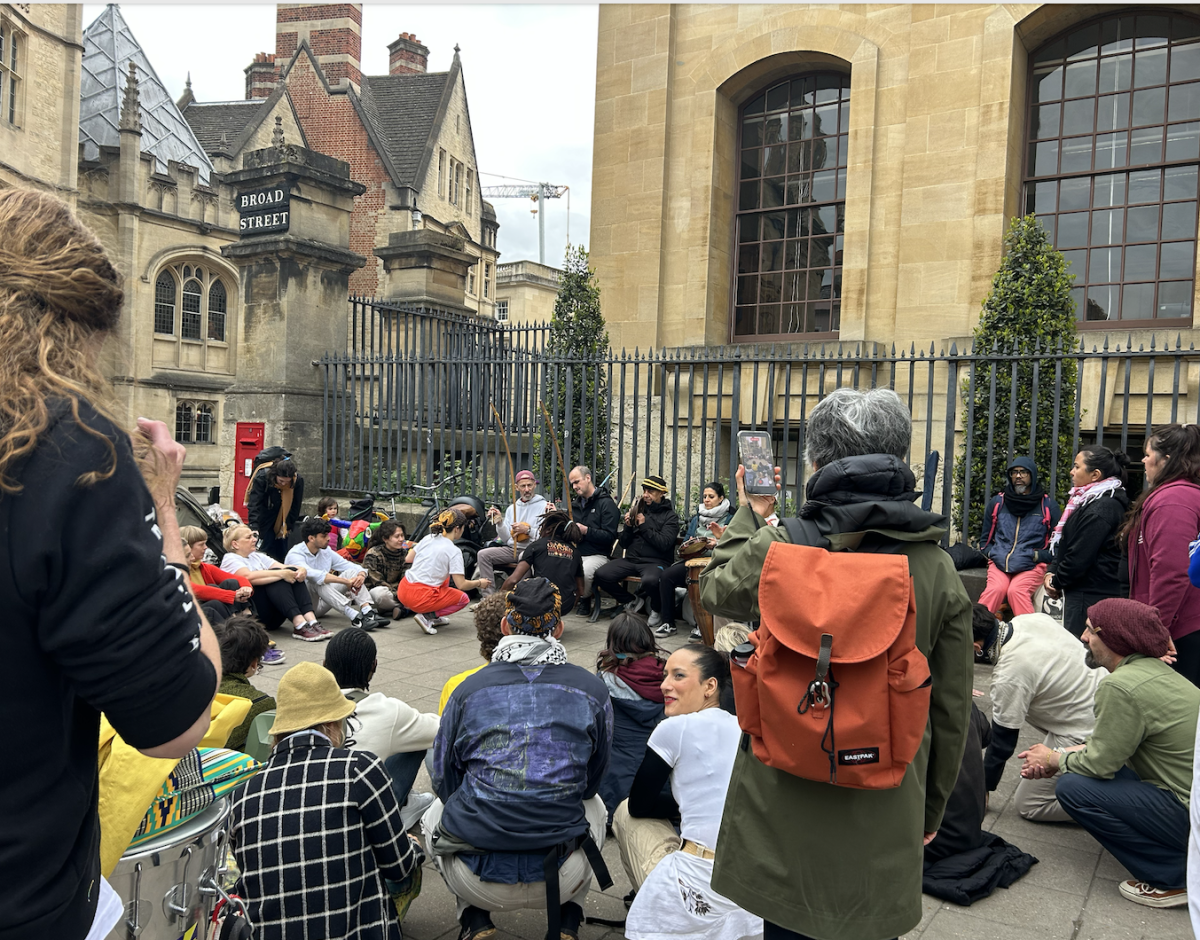
Over the weekend of 15-17 May, a range of activities and workshops took place as part of ‘Agua do Rio, Agua do Mar II’, a festival organised by the Oxford Capoeira Society. But what exactly is Capoeira, who is behind the society, and what do they do?
Capoeira is an Afro-Brazilian art form, a martial art and a performance, which also incorporates music, singing and theatre. It promotes physical and mental wellbeing. Capoeira was developed by enslaved Africans who used it to disguise the fact that they were practising fighting. During the 16th century on plantations, the art was considered a ‘social infirmity’ and was officially prohibited by the Brazilian Penal Code. However, this did not prevent Capoeiristas from practising the art. Instead, they disguised it as a form of dance.

Image by Lleucu Haf, used with permission.
Today, people all over the world practise Capoeira. It takes place in a roda, a circular formation where practitioners engage in the game, alongside instrumental accompaniment and singing. The suppression of Capoeira eventually diminished and during the 1930s, Mestre (Master) Bimba, worked towards restoring it. Bimba was born in 1899 in Bahia in northwestern Brazil, and in 1932, he became the first master to open a formal Capoeira school, called Luta Regional. In 1937, the school received official recognition by the government, and Mestre Bimba had established and legitimised Capoeira as a form of self-defense, athletics, and dance. This also led to the growth of new schools in Bahia, but also elsewhere in Brazil and across the world. Eventually, Capoeira came to the UK through Mestra Sylvia Bazzarelli, who opened the London School of Capoeira with her partner in 1988. Most people caught sight of Capoeira when they appeared in a mobile phone advert performing Capoeira together. With the development of Capoeira, there also came to be many different styles. These include ‘Capoeira Senzala’, practised by Bazzarelli. This kind of Capoeira is a blend of Capoeira Regional and Capoeira Angola, the kind practiced and taught by the Capoeira society of Oxford.
In an exclusive interview, Mauricio Jimenez (Professor at the Oxford Capoeira Society), explained that Capoeira Angola is a traditional form of Capoeira with roots in Salvador da Bahia. He highlighted how this specific lineage of Capoeira comes from Mestre Pastinha, a “fundamental figure and great philosopher of Capoeira.”
Jimenez started Capoeira when he came to Oxford in 2010 to learn English for six months after having been introduced to it by a friend. Originally, he had hoped it would help him learn English in a dynamic way, but quickly learnt it not only offered this, but also a sense of community.
He was taught by Mestre Marcelo Angola, who learnt from Mestre Curió, who in fact, was taught by Mestre Pastinha. To Jimenez, the fact that each generation attempts to preserve the essence of what they received from their mestre is what keeps Capoeira and its community alive. This year, Mestre Marcelo Angola was welcomed by the Oxford Capoeira Society in the festival.
Jimenez also explained that Capoeira Angola relies on communication, with a great emphasis on the dialogue and respect between players, in terms of musical and bodily expression, which can all be seen through the ritual of the roda. He highlighted the element of malícia, which he describes as an intelligence of the game combining cunning, intuition, timing and the ability to read the other person’s intentions, showing the importance of effective communication. This manifests itself in the Capoeira through how players will listen, observe, and wait before responding to the other person in the ‘game’ with them, inviting a “deeper form of bodily communication”. To him, “It is not about causing harm, but about expressing strength without violence and understanding conflict as a dialogue rather than an imposition.” Jimenez also sees it as a ritual, not only a space where two people play, but a space where many elements, music, tradition, bodily expression, creativity and strategy, come together and form a community. Therefore, to Jimenez, the Capoeira is a “deeply human experience.”
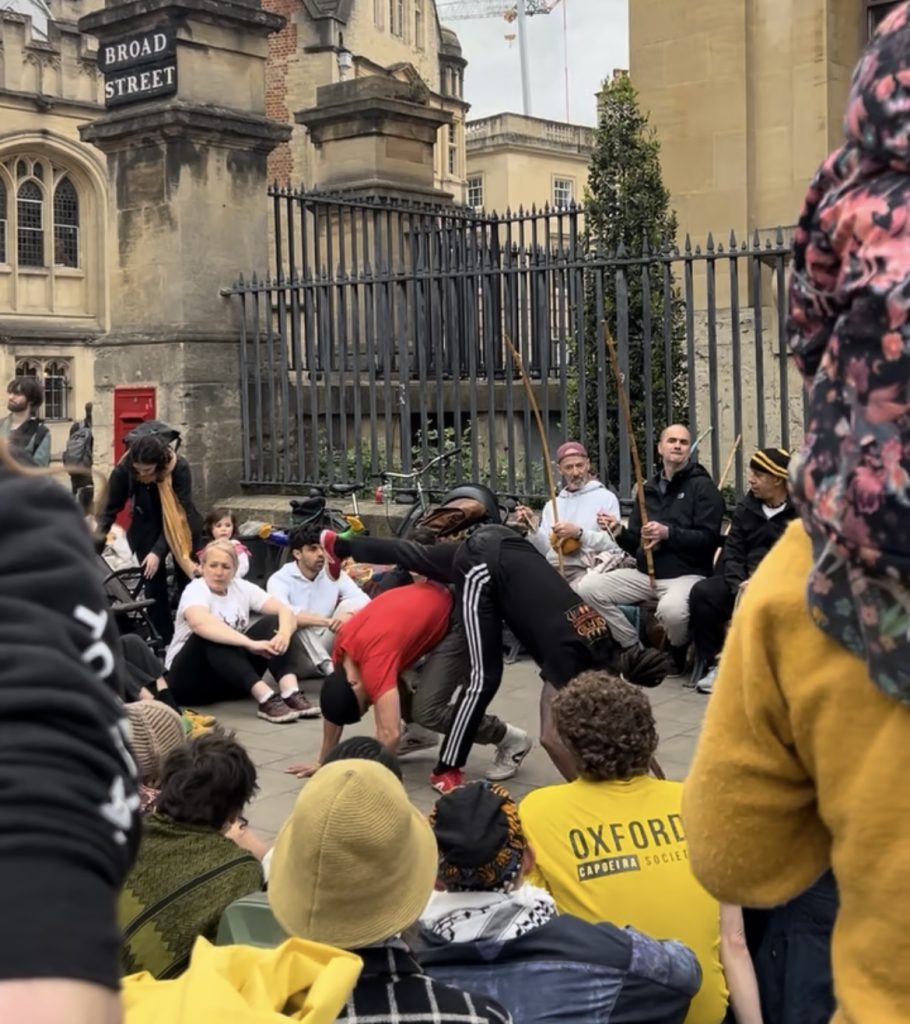
Image by Lleucu Haf, used with permission
The festival held in Oxford, “Agua do Rio, Agua do Mar II”, shows that the tradition and community still thrives in the UK. The name “Agua do Rio” refers to the River Thames, which runs through Oxford. “Agua do Mar” refers to Salvador da Bahia, where the international group, Angoleiros do Mar, was developed, and which Oxford Capoeira Society is now a part of. According to Jimenez, the festival is a way of uniting the tradition across countries, stating, “the water of the river eventually returns to the sea. Through Capoeira, we connect Oxford with Salvador da Bahia.” This was also shown by the many guests that were invited to the festival, with Jimenez bringing together artists connected with different Capoeira projects in various parts of the UK and Europe with the aim of bringing together practitioners, teachers, musicians, and people connected to Capoeira to “share knowledge, train together and celebrate this tradition.”
They invited many guests to teach across the weekend, such as Professora Maria Bonita, a leading figure in London’s Capoeira scene, and a student of Nucleo de Capoeiragem (NdC), an international Capoeira organisation originating from Brazil, under Mestre Claudio Campos, who is based in Bristol. She continues the legacy of Joazinho da Figueira, who used to run it, and was also present at the festival, and brings “decades of wisdom, rhythm, and Afro-Brazilian tradition to the roda”, according to the Oxford Capoeira Society. In addition, some classes were led by Professor Lobinho, who led the Oxford Capoeira society for 14 years, and was recently awarded the title of Professor at an exchange event in Itaparica by Mestre Marcelo Angola.
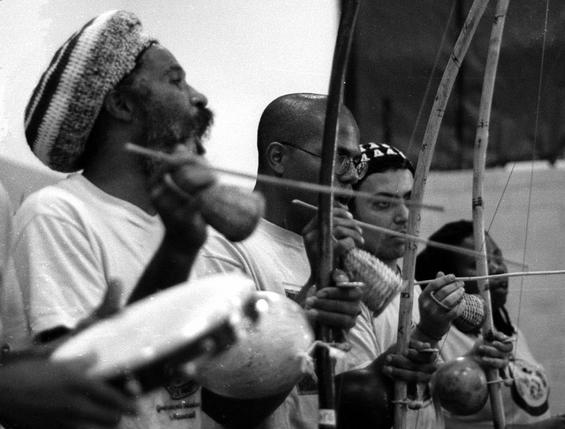
Also invited were skilled musicians, such as Sergio Demorais, a practitioner of Capoeira Angola in Paris, and “one of the most dedicated students of Mestre Marcelo Angelo” as well as an “incredible musician who combines malandragem (which in Capoeira is the ability to quickly understand an opponent’s intentions) with kindness and a clear passion for the art of Capoeira”, according to the Oxford Capoeira Society. To Jimenez, the music is a key aspect of the Capoeira. He expressed that “every game of Capoeira is a story”, and that “the music accompanies that story: sometimes it guides it, sometimes it describes it and, at times, it even transforms it.” The typical instruments used in a Capoeira are things like the ‘Berimbau’, a unique, African originated musical bow, the ‘Pandeiro’, similar to tambourine, the ‘Agogo’, originating from an African word meaning ‘bell’, the ‘Atabaque’, a tall drum played with hands, and the ‘Reco-Reco’, an indigenous Brazilian musical instrument with a cylindrical body made from bamboo or wood and with notches.
Jimenez expressed that a highlight of the festival was the procession through Oxford with a model of a colourful ox. He explained that the ox was a way of connecting the city of Oxford with the Brazilian tradition of ‘Bumba Meu Boi’, where a false bull comes back to life and people run around it. To him, seeing Capoeira mix with the city was a joyful moment, as well as seeing the confidence it inspires in others, as people who are “normally introverted or shy transform during this kind of street performance.” For this reason, Jimenez believes it is important for events like this one to take place in Oxford, as well as other parts of the United Kingdom, because of its ability to bring people together, building new friendships as well as creating spaces for cultural exchange and community. To Jimenez, Capoeira is not just one thing. It is a way of connecting many different elements, and each element of Capoeira has many different benefits, helping with people’s physical, mental, and emotional wellbeing.
According to Jimenez, Capoeira offers a valuable space for dialogue, creativity, and a sense of belonging, which is especially important in a university, with an international and multicultural context such as Oxford. What began as a six-month experience for Jimenez became a life project, and he has now been in Oxford for 16 years, which he largely believes is because of Capoeira. Having been introduced to Capoeira at Oxford himself, he emphasises Capoeira’s adaptability and accessibility, It is an activity which can be suited to each person’s body, rhythm, and experience. He encourages anyone and everyone to get involved.
For the future, the Oxford Capoeira Society’s mission is to be more present within the University, not only as a physical activity, but also as a cultural, artistic, and musical practice that can contribute to University life.