
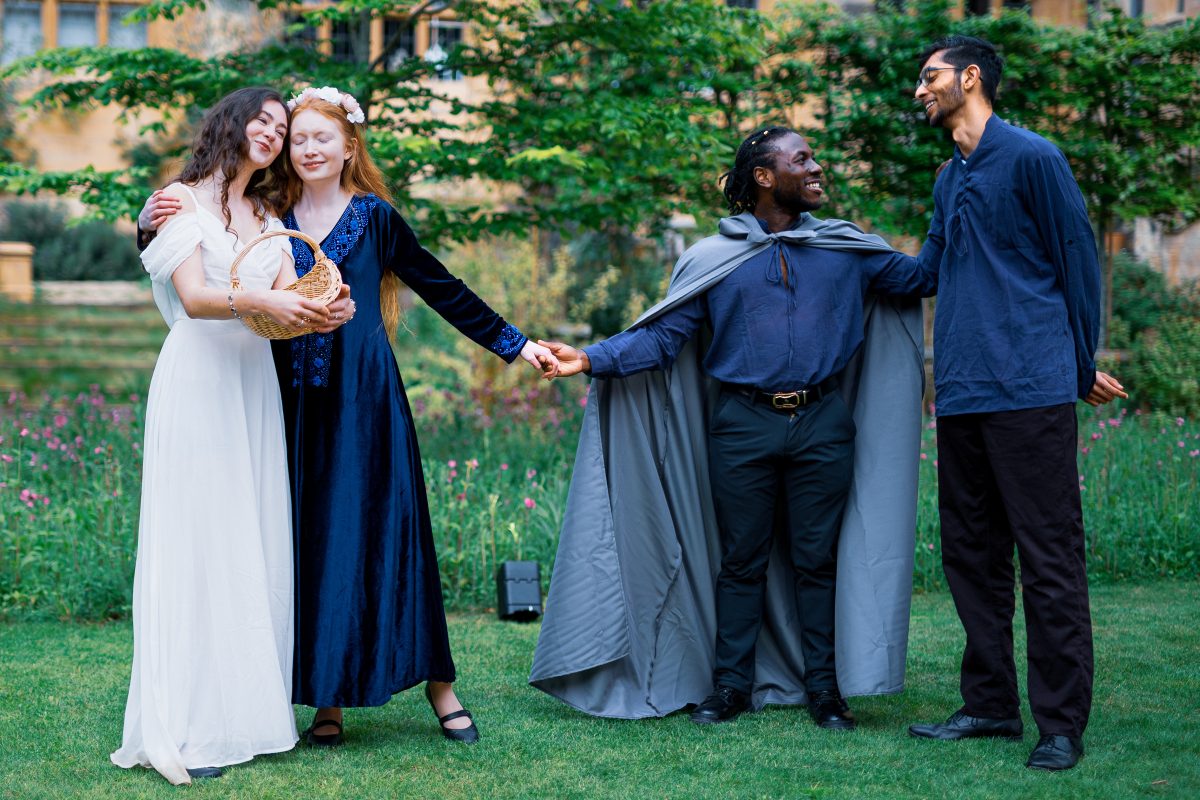
Directing a play opens one’s heart to a vast new spectrum of emotions, from the thrill of opening night, to the rush of pride watching your actors take their bows, to the odd bursts of sudden distress that all melt away as the bumps in the road smooth over for a wonderful show. The garden play adds an extra layer of complexity to it — not only are the human elements of the show to be considered, but you also have to contend with the heavens. Every night I prayed to Jove and Diana and all the pagan gods of the play I was staging (The Two Noble Kinsmen, Hertford-Mansfield Garden Play, Week 3) for clear skies — and, luckily enough, we managed to perform our full run outdoors. Huzzah!
The garden play’s history at this university goes back nearly a century, but that doesn’t mean it’s getting stale. Shakespeare is always on the menu, with the three favourites — A Midsummer Night’s Dream, As You Like It, and The Twelfth Night — all having made their return this year to the great outdoors at Oriel, Green Templeton, and Lady Margaret Hall, respectively. In many ways, these plays are comforting hallmarks of the festive jollity of this tradition. They are all about generating pleasure and encouraging the audience to develop and enjoy their own impressions (as they like it, what they will) — and, if worst comes to worst, to think ‘this weak and idle theme, | No more yielding but a dream’ (AMND, 5.1.417-8). We’ve also had a rich variety of other plays on, such as Queens’ knock-out production of Guys and Dolls, The Importance of Being Earnest at Harris Manchester, The Picture of Dorian Gray in Trinity, Pride and Prejudice and Ajax at New College, and Magdalen’s production of Jerusalem (which, in addition to my own production, brings up the tally of garden plays featuring Morris dancing this term to a solid two!). Overall, it’s been a pretty exciting time, whether you were in the mood for early modern laughs or if, in the words of Thomas Yates’ review, ‘the airy-fairy nature of a Shakespearean comedy’ didn’t quite cut it.
I’ll admit firsthand that I am probably not the most objective commenter to ask about the reason for Shakespeare’s prevalence in the garden play repertoire; he is kind of my thing. There are conventional arguments I could roll out to make the point — he was the soul of his age and for all time, captured emotional reality in a timeless manner, invented the human (well, according to Harold Bloom), and so on and so forth. For all these reasons, they are excellent vehicles for capturing the vim and vivacity that renders any production worth its ticket price, if done well. But staging him outdoors really does make you wonder – especially when you’re at an evening production, towards the end of which you’re freezing beyond the point of coherent thought – what makes you stay till the end?
Beyond the moral duty of respecting the actors’ effort and time, as well as the sense of ticking things off the list (you paid for a ticket, so you may as well finish the show), Shakespeare poses a quantitative and qualitative challenge in his continual re-staging, the usual articulation of which is ‘Really? Him again?’ In school, disliking Shakespeare becomes a form of rebellion against his well-cemented place in the curriculum. In the garden, paying to watch a Shakespeare play enables not just the kind of judgement incurred by the quality of performance, but of the validity of what is often, inevitably, discomfort, considerate though the provision of cushions and blankets at many productions this year has been. Hey ho, the wind and the rain indeed – my advice for attending garden plays is to keep a close eye on the weather forecast and to bring a warm coat and umbrella. In such conditions, brought to you by the lovely British weather, Ganymede, Touchstone, and Aliena’s tiresome trek through the forest becomes amusingly relatable – and, in The Two Noble Kinsmen, the Jailer’s Daughter’s plaintive ‘I am very cold’ at the beginning of her last soliloquy has an empathetic ring to it.
By the time Feste sings his final song, we are more than ready to muse on the passage of time – however much pleasure we may have received, we are more than ready to hightail it back to our accommodation to ruminate on our sensations over a hot cup of tea (unless, of course, you were performing during the May heatwave: if so, you have my sympathy). Duke Senior’s pleasant account of finding “tongues in trees, books in the running brooks, | Sermons in stones, and good in everything” (As You Like It, 2.1.15-7) offers an alternative to the academic literature awaiting tired students in their dorms, but in peak exam and revision season, you need to justify spending that time away from your desk. In short, the garden play offers the biggest challenge to Shakespeare’s predominance in student drama, doing battle with the elements, the academic season, and the Bard’s own reputation.
TNK, as I fondly abbreviate it, was, as far as Shakespeare can be, niche. Save for a few nerds as Bard-headed as I am, nobody I told about the show had heard of it before – now, I fervently hope, they will never forget it. I recall how, while assistant directing the Jesus College Shakespeare Project’s Much Ado About Nothing last term, during which I feverishly promoted auditions and then tickets for TNK, Peter Sutton raised an eyebrow at my unmitigated enthusiasm for this little-known text. Of course we had our trials and tribulations, not the least of which was wrestling with textual moments of practical impossibility (e.g. we could not make a rose bush rise from beneath the stage as was in the original script, a technical moment facilitated by the Globe’s handy little trap door), but we came through with a bang, Morris dancing and all. The other challenges of wrestling with the great outdoors (e.g. the bugs and the inevitable cold the actors valiantly braved in their splendid costumes) made the experience all the more bracing. I think I only managed to survive tech rehearsal running around Mansfield Garden in a T-shirt at 10pm through sheer adrenaline. We took this rarely-staged play and put it to the Garden Play Test, and based on the reviews, I think we made it worth the while; according to Peter Sutton, we ‘certainly made a case for it.’ If the cast and crew are reading this, I want to extend another vast round of applause and gratitude to you all. Soak it in.
“I had a thing to say,” said King John, “but let it go”.
The sun is in the heaven, and the proud day,
Attended with the pleasures of the world,
Is all too wanton and too full of gauds
To give me audience. (King John, 3.3.35-9)
Thus I conclude my argument, which has wandered off on its merry way to the Forest of Arden, or the woodlands surrounding the Athens of TNK or Dream. Kudos to everyone who put on the works of all those other great writers who fill our stages, but I think it’s safe to say that Shakespeare’s words will undoubtedly fill many more gardens in the years ahead.