


Director Patryk Wisniewski’s translation and interpretation of Ramón Griffero’s Stories from an Abandoned Warehouse is the first time that this piece of fringe resistance theatre has been adapted onto the English stage.
Initially performed in the titular abandoned warehouse – ‘El Trolley’ – Griffero’s original play was a form of resistance art, writing back against General Augusto Pinochet’s oppressive dictatorship (1973-90) in Chile. The play’s premise is, on paper, quite straightforward: a rag-tag group of “Residents” have their lives turned upside down upon the arrival of the “Council,” spearheaded by the Pinochet-esque autocrat Don Carlos (Henry Cane). While this historical context is not necessary for an enjoyment of the play, a knowledge of it certainly enriched my appreciation of the significance of Wisniewski’s theatrical experiment.
The play is deeply allegorical, yet toes a delicate balance between the expressionistic without becoming incomprehensibly abstract – which I appreciated, as someone who tends to prefer more down-to-earth pieces. The Residents largely comprise of more abstract embodiments of characters, from Jonathan Huss’s distressed ‘Old Man’ (a symbol, it would seem, for the memory of an older way of life before the Council’s regime) to Sjors Verduin’s laboured and weary ‘The Water’ (a symbol of the Residents’ resources, gradually depleting in strength over the course of the play). These abstractions juxtapose with the Council, comprised of more tangible, named figures: Don Carlos, Gabe Armstrong’s Mendibez, and so on.
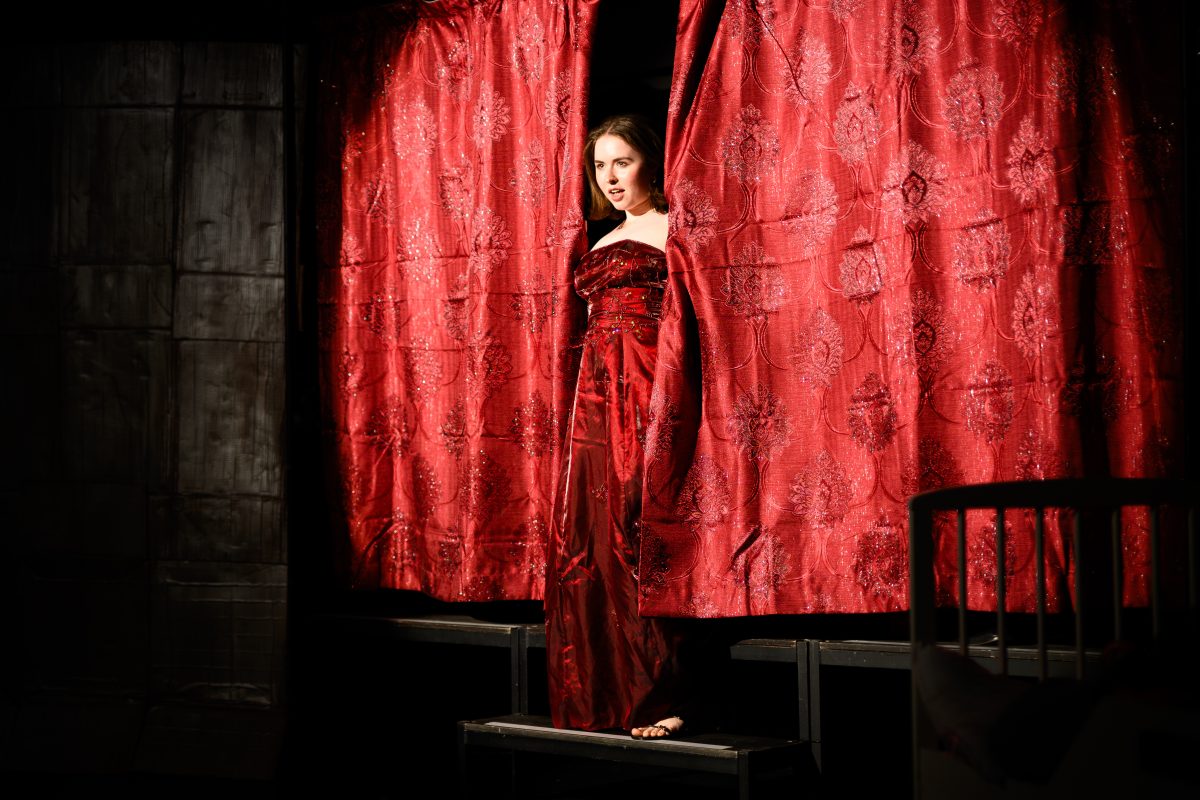
The production symbolises their divide through the use of a raised platform covered by a stage curtain, which opened and closed to symbolise a changing relationship: Carlos’s authority is initially symbolised by his disembodied, wildly gesticulating hand, before the curtain opens and we are met with the full force of the Council. Cane’s Carlos makes for a commandeering, convincing dictator; he sits upon his throne with an air of regality and awe.
In the programme, the director highlights that his adaptation experiments with a practice of what he terms deliberate “overacting” – a style that foregrounds the high emotionality of a piece such as this. By eschewing realism completely, Wisniewski’s production can lean heavily into the expressionistic, facilitating the play’s aforementioned venture of rendering characters closer to abstract representations rather than real and specific people. Everything is overexaggerated, from Drury’s Camilo pathetically bursting into tears the second that he thinks Lollo’s Carmen will leave him, to how vehemently Diandra Kocan’s ‘Madame’ despises Nicole Choi’s ‘Woman’ and her baby.
Particular standouts, however, were the wonderfully hilarious Lady Carla (Genevieve Kidd) and Mr Fermin (Seb Foster), particularly bougie members of the Council. Between Kidd’s OTT innuendos and Foster’s stiletto boots and fake nails, both characters imbued this “overacting” with an element of camp that was endlessly entertaining to watch. This camp led itself to a very amusing “party” scene, in which the Council and Residents danced together in ruffs and masks – perhaps symbolising the “honeymoon” phase and excitement of a new regime. Very quickly, however, the tone sombred, with a series of spotlit monologues lamenting the oppressive changes brought about by the Council. Credit, here, is due to lighting designer Alexandra Russell.
Sometimes, this exaggerated style of performance came at the expense of a healthy dose of “show, don’t tell” – particularly towards the end of the play, where the fascist allegory becomes incredibly unsubtle, and very on-the-nose. All-in-all, I found it made for a highly investing and entertaining watch. The narrative of Stories may not be particularly complicated, but its delivery is what gives the performance heart.
The production also plays with audience engagement. The director notes that he wanted to recreate the strong feelings of complicity conjured by the original performance – the shared oppression between the immediate audience and the Residents by a repressive authoritarian regime. The choice of such a close-quarters space as the Pilch enables this blurring of the line between spectator/spectacle (I think back to a very similar phenomenon in a play performed here last year).
Grace Weinburg’s character ‘The Child’ facilitated this intermediation. From her dusting the audience’s shoes (my own included) as she tidies up the estate, to her holding up a cue card for us to ‘Applaud’ the glorious Don Carlos. Funnily enough, these moments of cued applause became increasingly unprompted as the performance progressed; eventually, the audience were evidently as indoctrinated as the Residents. Weinburg’s was a particularly standout performance for me; from the moment she rises from her crib (yes, you read correctly), she becomes a dynamic stage presence, symbolising (and aptly embodying) the petulance of a youth who naively believes the false hopes and promises of the Council.
Wisniewski brings a far-flung play out of the shadows of a Chilean warehouse and onto the English stage. By translating the play, he makes the core concepts of the drama simultaneously translatable; indeed, Griffero’s depiction of fascist oppression becomes startlingly relevant to the direction in which present-day British politics are headed. Bummer note aside, the time, effort, and research that it has taken to perform Stories has not gone unnoticed. It is my sincere hope that Wisniewski’s efforts will bring Griffero’s play the attention – and discussion – that it not only deserves, but demands.
[Stories from an Abandoned Warehouse, staged by Crazy Child Productions, is running at the Michael Pilch Studio, 13th-16th May, 2026]