


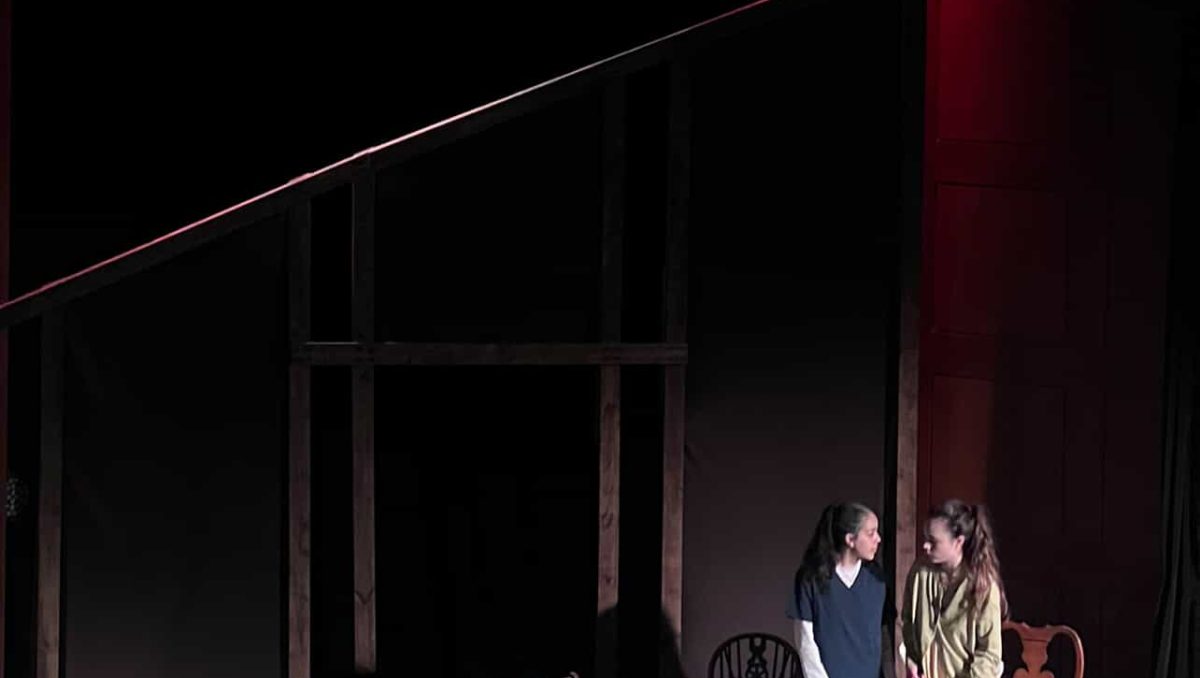
The Burton Taylor Studio; the Michael Pilch Studio; the T. S. Eliot Theatre; the Keble O’Reilly Theatre; the Oxford Playhouse. If you’ve spent much time on the Blue’s Culture pages (which you really should, they’ve got some great stuff over there) these names will undoubtedly be quite familiar to you. Alongside Oxford’s various chapels and college gardens, they form the bedrock of the student theatre scene, the venues every production looks at to host their latest show. Last week, however, a new space joined their ranks: Magdalen’s Grove Theatre, hosting Lighthouse Production’s excellent Things I Know To Be True, has now opened to a theatre audience for the first time.
Venue is perhaps one of the most easily overlooked aspects of a performance’s impact, but an essential one to consider from a director’s perspective. ‘Black box’ spaces such as the BT and Pilch studios offer that most enticing of things, a ‘blank canvas’ for creativity, while their small scale creates a high level of engagement and intimacy between performers and audience. But the two are very different spaces from a staging perspective: the Pilch has four doors which can be used for entries or exits, facilitating a far more expansive feel for plays that try to create the sense of a world beyond what the audience can immediately see (of the productions I’ve seen or been involved in, Cyrano, The Resistible Rise of Arturo Ui, and Monstrous Regiment spring to mind). The BT, meanwhile, has only one door, with its standard tiered seating arrangement giving directors two entrances, either side of the bank of audience chairs, to work with.
To put it rather more succinctly: each venue has a character. Each venue is best suited to a slightly different type of production. And the Grove has a very specific mission: to provide a ‘stepping stone’ between Oxford’s smaller experimental spaces, the lecture theatres of college buildings, and the prestigious termly Playhouse slots; a space in which students are ‘not tolerated, but welcomed.’ Those words came from Peter Kessler, best known in the university for his long-standing role as curator of the Magdalen Monday Movies (MMM) project. This term, however, he’s been heavily involved in opening the Grove Theatre (a rechristened Magdalen Auditorium) to a new medium, and took me around the space to showcase some of the adjustments made. Thanks to its role hosting weekly film screenings through MMM, the Grove has an array of technical capabilities out of reach of most other student performance spaces. A recent technical refit saw support for 4K video, filming and live-streaming performance, and specially-designed acoustic panels added to the building. It also has the advantage of being designed purposefully as a cinema space when it was first built as part of the Grove Buildings complex in the 90s. Anthony Smith, who led the project, had moved to the position of Magdalen’s president from his role as head of the BFI, and Kessler pointed out to me the traditional theatre elements Smith had had incorporated into the auditorium building: proscenium arch, curtains, and lighting gantries.
As a result, the Grove, from an architectural and technical perspective, is up there with the Playhouse in terms of its theatrical capabilities. Having reviewed Lighthouse Production’s previous show, Lemons Lemons Lemons Lemons Lemons, I was intrigued to see how they used the space, and it certainly did not disappoint. Lemons’s video backdrops demonstrated an interest in visual elements, which Lighthouse Productions have carried forward spectacularly here. The Grove’s projector gave us the beautiful image of the tree in this Australian family’s back garden as it goes through the seasons. The arch was used to subtly indicate a shift from inside to outside the home, and the greater depth of stage allowed for memories to be represented ‘in the flesh’ in the background of scenes. But most immediately striking was the framework of a housefront the team constructed, upon whose gauze walls the images were projected. It was the most ambitious set I have seen outside the Playhouse, and, as Kessler emphasised to me, that is exactly his vision for the Grove.
Several points of interest suggested themselves to me for future productions, too. The proscenium arch gives the space an extraordinary height, and the notable space before it could almost allow for two different ‘aspect ratios’, one (wide and flat) in front of the arch and one (tall and thin) behind it. The temptation to make something of the empty space above the actors’ heads, too, will surely lead to something spectacular. Meanwhile, experimentation with the film elements MMM has left the Grove so suited to will undoubtedly become a fruitful avenue for future productions to explore, while providing a wider variety of experience with different set-ups for Oxford theatre’s hardworking technical departments. Kessler also emphasised the level of support available for students wanting to put on shows from Magdalen staff; one unexpected way this expressed itself was in the use of a sharp cutting knife on stage, which I imagine many venues would have vetoed entirely.
All in all, it is a genuinely exciting space for making theatre. And with the Schwarzman opening its doors to student productions in the coming academic year, it seems that Oxford’s theatre scene is set for a significant shake-up. Of course, the usual spaces will remain thriving theatrical centres in their own right. The BT remains Oxford’s best stage for small-scale work; the Pilch for staging experimentation; the T. S. Eliot for the creativity its slightly cramped front-of-stage inspires; the Keble O’Reilly for technically challenging stagecraft. But the Grove, with its top-of-the-line sound and lighting, traditional architectural backdrop, and grander scale, is certainly a theatre worth watching out for.