


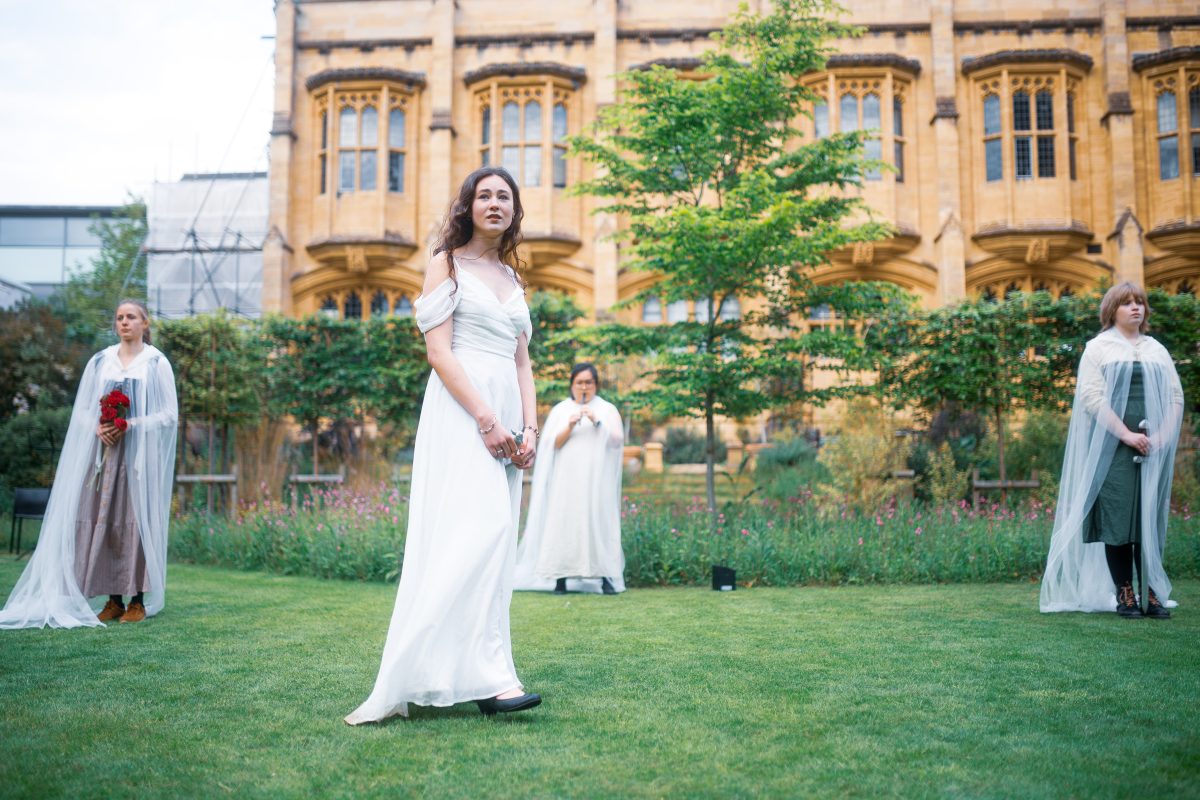
“Is this winning?” Emilia pleadingly asks, querying what we all wish to know by the end of the play. Can there really be a winner after such futile, damaging quarrelling?
The Two Noble Kinsmen, co-written by Shakespeare and Fletcher, was inspired by Chaucer’s ‘‘The Knight’s Tale’’. It follows two cousins, Arcite and Palamon, who, while imprisoned in the court of Theseus and Hippolyta, both fall deeply in love with the beautiful and virginal Emilia after observing her through their small window. Their fighting over her leads to Theseus setting up a lawful tournament to decide who will win her hand in marriage. The ending cannot be conjectured.
The subplot of the jailer’s daughter is a fascinating one, consisting of her furious love for Palamon, whom she lets escape, and her subsequent madness when she discovers that her love is unrequited. Her father and her wooer ultimately trick her into a loveless, nonconsensual marriage by pretending that the wooer is indeed her beloved Palamon. The play is very rarely performed and there was no better time to watch it than in the ‘‘bloomed May’’, the morris dancing reminiscent of May Day celebrations only a week ago.
We walk through Mansfield College to the garden where ‘‘for our crowned heads we have no roof’’; surrounding flowers and singing birds add to the strange whimsy of the play. There is a palpable intimacy in the relatively small audience size, and the open space which makes the ‘backstage’ area utterly observable. Moreover, the middle aisle heightens our closeness to the characters, our seeming involvement in the action as they move amongst the audience.
Before the play begins, a single flute is played by Hannah Wei, enveloping us into the Elizabethan context of the play’s first performance. Owen Robinson’s composition of the two songs: ‘wedding song’ and ‘funeral song’, within the performance is impressive, and they are effectively audience absorbing. As a play that has a great deal of scripted singing, having some of the actors start the performance as singers interweaves the music nicely into the plot.
We are immediately struck by the image of Emilia (Imogen Green) as her white dress of purity stands out against the other dark costumes; she draws attention despite the fact that as the other characters walk down the middle aisle, she comes last, humbly taking the role of flower girl and spreading petals as she goes.
Fitzroy ‘Pablo’ Wickham is convincing as Duke Theseus, who asserts his dominance by speaking louder and taking up more space than any other character. We never lose the perception that he is definitively the character with the most power and control over the others. This is perhaps most noticeable as Hippolyta (Rowena Sears) answers his question of whether she is delighted about seeing men fight: “never so pleased, sir” with comedic displeasure.
Ryan Silien as Palamon brings the aspects of comedy to life, and most laughter came as a result of his hyperbolic reaction to Arcite (Nikolas Harhoff-Nagi)’s suggestion that the fair maids will “weep their banishments”. Whereas Palamon is constantly shifting, sometimes lying on the ground, Arcite is comparatively stoic and the juxtaposition between the characters is instantly witnessed. There is something humorous in the way that both kinsmen escape the ‘jail’ (a kind of metal frame room divider) with such ease. The repeated embracing between the two cousins exposes the fruitlessness of their battling. They aid each other with putting on their armour, ironically supporting the other with what will subsequently be used against them. Love lies at the heart of their animosity.
One of the great joys of this performance is the amount of subtle storytelling that happens only through the use of the actors’ hands. From the beginning we are presented with the strength of female solidarity as Hippolyta and Emilia cling onto each other with familiar intimacy, as do the three desperate Queens. In complete opposition, Hippolyta holds her husband’s hand awkwardly, and with a comparative distance. Besides him, she retains a certain meekness and has a continual frown of insecurity and discomfort. As Arcite takes Emilia’s hand, she backs away, turning towards the one she trusts; the only other woman in the court.
Paloma Diaz, as the unnamed jailer’s daughter, is exceptional. She is easily the most spirited within the play, and although on her own in most of her scenes, they are some of the most intriguing and heart-wrenching. She loses her shoes and as her mind becomes increasingly undone, so too is her hair from its original tight plait. The image of her, knees down in the grass, hungry, cold, and alone, is a striking one. Diaz’s gaze, so distant and far above the audience, produces an eerie air that ends the first half.
After the interval, it became noticeably darker with ever-diminishing sunlight, fittingly setting the mood for the heightened emotion and melancholia of the second half. The blue and red lighting divided the contiguous scenes of Arcite and Palamon’s prayers to their respective gods, the reverse colours of their costume shirts.
Lily Zhang’s portrayal of the schoolmaster is witty and energetic. She directs the dancers for their morris, each with bells strapped around their wrists in a way that is implicative of the fools and jesters that fill Shakespeare’s other plays. The dancing was impressively synchronised, and completely belonging in the garden setting, alleviating the uneasy atmosphere created by the jailer’s daughter’s madness.
Arcite and Palamon’s tight friendship is preserved even at the cusp of their battle as they run towards each other for one final handshake, the distance between them continually growing and shrinking. In the climax of the plot, it is them that hold one another, centre stage.
Emilia is appropriately centralised as the character who has every stake in the plot, but no say in it, and Imogen Green’s performance is stand-out. By the time that her new husband has been decided, her petals from the beginning have been well and truly trampled on; squashed into the grass by all of the exits and entrances, her freedom along with them. Her prayer to Diana is heart-wrenching and we will root for her success rather than that of either of her suitors.
Even as the jailer’s daughter is reunited with her father, the wooer, and the doctor, the illusion of her still being alone onstage pervades – the other characters hold back, not wishing to be sucked into her ‘lunacy’.
And here is the genius of this production: the jailer’s daughter runs through the audience to embrace Emilia in a way that acknowledges the pain and anguish that both women have suffered at the hands of those they have no power against. Director Annabelle Higgins notes in the programme: “if you leave the show thinking Palamon and Arcite are truly noble, it might make us wonder whether we’ve done our jobs right”, and it is in this hug that her reading of the play is truly cemented. Characters who don’t otherwise interact, Emilia and the jailer’s daughter must comfort each other amidst the misery that these two ‘noble’ cousins have caused.
The actors perform one last morris, but it feels sombre this time around. Their shadows flicker on the walls of Mansfield College, walls built in the time just predating the women’s suffrage movement. They dance, and then suddenly we are left in complete darkness. The epilogue, like the prologue, is unspoken, and thus there is a complete focus on the characters themselves – their complicated array of emotions.
Congratulations to director Annabelle Higgins and producer Richard Morris who brought fresh takes to the old play, and uncovered such weighty subtexts with skill. Hypnotic.
[Two Noble Kinsmen, staged by Hertford X Mansfield Garden Productions, is playing at Mansfield College Garden, 7th-9th May, 2026]