



Film adaptations walk a very tight rope, trembling as they try not to over-balance and plummet into one of two valleys of failure. On the one hand, there is the valley of redundancy: this is most often the consequence of the decision “to reproduce the [original]” – or at least parts of it – “beat by beat”, observed for example in the live re-make of How to Train Your Dragon (2025); the using up of time and resources to produce something with no more creative value than what inspired it. On the other hand, there is the failure of which “Wuthering Heights” is accused by audience members aplenty – a departure from the source material so pronounced that the overlap between the works would not suffice to draw a Venn diagram from.
Harsh? I would say so. The focal point of Emerald Fennell’s adaptation is the tumultuous relationship between characters Catherine and Heathcliff, the very same placed at centre stage by many readers – and most film-length adaptations – since the book’s publication. Given the popularity of this romance as a focal point, I think that to base a criticism of Emerald Fennell’s film on her making the “emotional subtext [of the book] as explicit and viscous as possible” is to miss the nub of the actual problem. Fennell’s “Wuthering Heights” is viscous, and it is explicit – and there is nothing wrong with that. The writing and direction embrace the emboldening title of a re-imagining from start to finish; the film’s costuming and set design are lavish, flirtatious with anachronisms, dream-like at times, and, when viewed altogether, very camp. From its very title, Fennell indicates that this is her intention, and from scouring the web for production interviews, I found next to nothing indicating otherwise. I would even suggest that viscosity and explicitness are two of Fennell’s strengths.
The criticism I propose, instead, is best conveyed by reference to a Venn diagram.

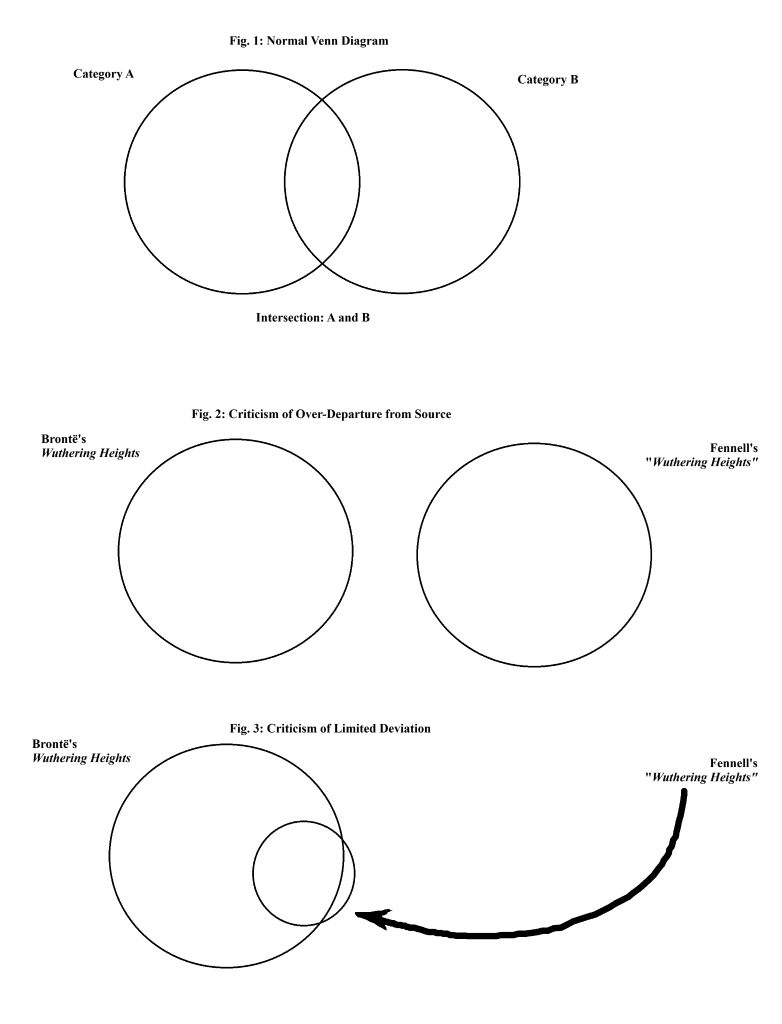
Why on earth is Fennell’s choice of material to treat derivatively so limited?
Make no mistake. This is not a criticism of falling into the valley of redundancy – at least not in the sense usually applied to adaptations. It is a criticism of the limited scope of Fennell’s signature style of deviance. Fennell’s films bring into awe-inspiring and uncomfortably focal excess the latent sensuality of a setting that contains or is associated with repression. My main point of comparison here is Saltburn, which bounces between the innocent, sexless, honey-coloured spires of Oxford, and the cushioned walls of a wealthy family’s estate. All the while, jealous, obsessive, and often obscene idol-worship emerges slowly from its initial disguise of college romance. “Wuthering Heights”, for as much of it is brought on-screen, takes advantage of the modern audience’s advanced palate for sex to push the boundaries of public display to a new extreme. Voyeuristic masturbation, in real-time, is the audience’s first taste of Catherine and Heathcliff’s adult relationship. Once again, Fennell joins obsession with romance in a very telling way. That much is creditable – that is where the film is made, unmistakably, her own. But that is where the making stops.
If my criticism were purely scope-based, I admit that it should apply just as much to other adaptations of the novel. Emily Brontë’s intricate expansion of the web in the second half of Wuthering Heights proper, creating a second generation of Earnshaws, Heathcliffs, Lintons, and everyone in between, is scarcely dealt with in popular culture, leaving stock images of the ill-fated, tragic soulmates Catherine Earnshaw and Heathcliff to occupy the cultural psyche. My edition of Wuthering Heights has 316 pages – in my notes, I write that “halfway thru (sic) the book at 167 and we’ve finished the movie”. This in itself, I want to emphasise, is not my criticism. I could not snub “Wuthering Heights” for being a mise en abyme if no previous adaptation has truly escaped said abyme either. Enclosing her title in scare quotes is about as explicit a disclaimer Fennell could have given – as openly acknowledged in her interview with Claire Valentine McCartney, the film is an attempt to “make sense” of just one “tiny piece” of the novel’s vastness. If she wants to make the most of a small part of the book for a contemporary audience, more power to her.
What I shall criticise Fennell for is that her style of abyme-escapism would be so well-suited to the remainder of the text, and this neglect makes the entire film lacklustre in context. It is a sexy and stylish film, but from Fennell I would expect more than sex and style – I hoped, I think fairly, for innovation. A director whose signature is extracting and drawing out from her source the taboo topic of sex, and demonstrating with discomfitting proximity that we the audience are perhaps not as comfortable with the subject as we like to think, could have taken the opportunity presented by such a thematically rich text to bypass what Rahul Menon of ScriptMag dubs “[terror] of [her] own source material”. She could have put to the audience’s scrutiny – and tested our postmodern, non-censorial sensibilities – an equally frank handling of the topics of abuse, of familial incest in physical, mental, and figurative forms, of perversion of nature and its optionality and of sadism. New and demanding ground? Yes. But Fennell is a capable director, so why not make the demand? Instead, as Rahul notes, Fennell’s take skirts even the more contemporarily common social subjects of racism or classism, both included just as explicitly by Brontë as the less “popular” social subjects.
What a fabulously subversive film we might have had – and, in terms of the qualities unique to an adaptation, what a great addition of value to the film canon – if Fennell had brought her proven capability and eye for subtlety to the tapestry of interwoven taboos that is the novel Heights. But, returning to the question of whether the quality of an adaptation affects its quality as a standalone film – although I should say, once and for all, that I think not – I am afraid that sex is the only live bird in Fennell’s film. Her nest is otherwise, to quote the novel, “full of little skeletons.”