
The first trailer for Christopher Nolan’s The Odyssey currently has 47 million views on YouTube. The second, after less than a week, 24 million. His last film, Oppenheimer (2023), grossed nearly $1 billion and formed one half of the Barbenheimer phenomenon that was credited with ‘saving cinema’ after COVID.
Nolan is a blockbuster director. Homer’s Odyssey is one of the most famous stories of all time. There are innumerable conversations to be had based only on the footage we’ve seen so far. What allows a story to survive 2,000 years? How do we approach adapting works from such extraordinarily different times to our own? To pick one point: the armour we’ve seen matches our conception of ancient Greece, but, in classic Cleopatra-lived-closer-to-us-than-the-pyramids fashion, Homer was of course writing about events which were ancient history to him, too. Odysseus is described wearing a Mycenaean boar tusk-scaled helmet in the Iliad; that Nolan has chosen to clothe his warriors in something closer to post-Homeric hoplite armour demonstrates how essentially Greek the story has become in our cultural imagination, but also how easily we slip into monolithic cultural cliches of Spartan warrior, Roman legionary, Viking berserker. Is it bad filmmaking to avoid challenging these stereotypes, or is visual familiarity with the material more important so the audience can concentrate on the story?
There is such an extraordinary breadth of topics to discuss. So why is it that the headline quote from Nolan’s recent interview with Stephen Colbert is that ‘superheroes of our time come directly from Homer’s epics’?
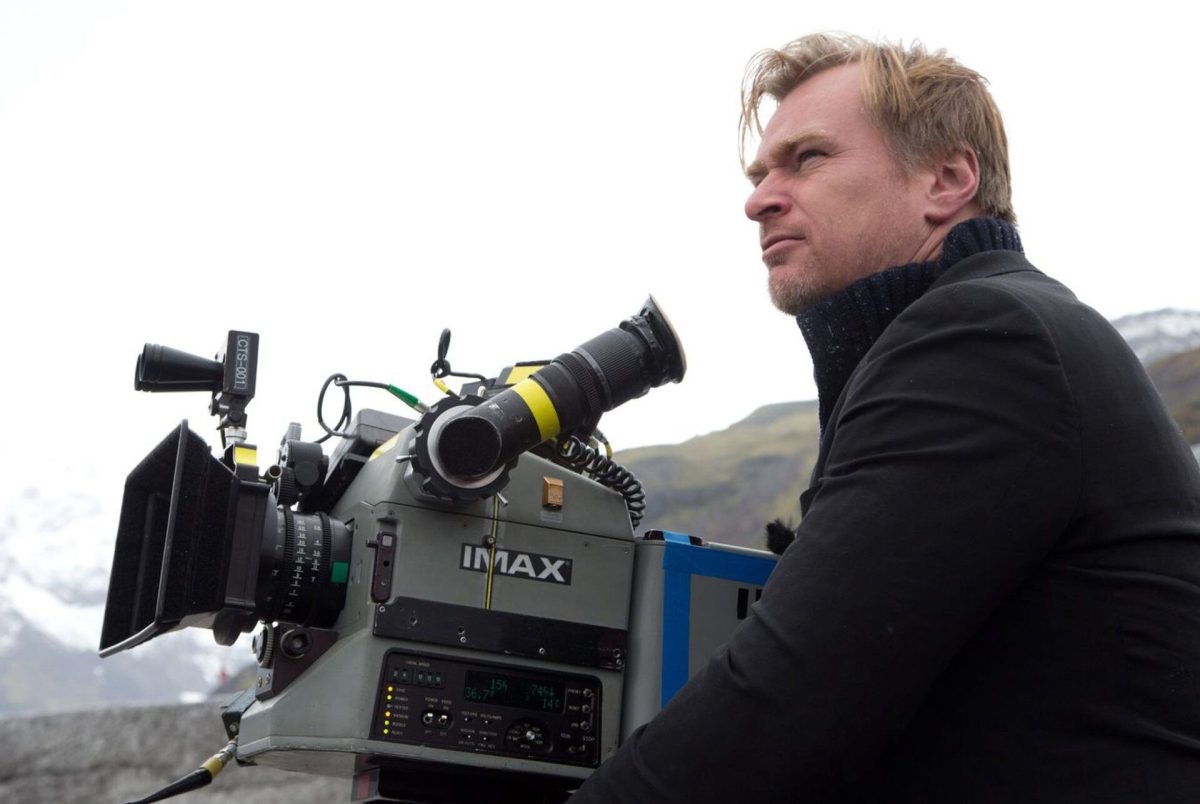
Their discussion is more wide-ranging than that, of course. The cameras used in filming were built specially by IMAX to dampen the sheer noise created by the running film (IMAX is the largest and highest-resolution film currently available for use), which prevented the format from being used effectively for close-ups before. Discussing the gods, Nolan makes the interesting point that ‘this is a world where people saw gods in everything everywhere […] what we’re trying to do is take the audience and put them in that world and put them in that mindset’. The superhero connection is a valid one, too: Colbert introduces the topic by noting Tom Holland’s, Anne Hathaway’s, and Robert Pattinson’s histories in the genre (with Nolan adding Matt Damon as Jason Bourne). The most insightful contribution is Nolan’s – as befitting the interview format – that ‘there’s very directly this desire for us to feel or believe that gods could walk amongst us and I think the modern comic book is kind of our expression of that’.
But it is Nolan’s comment that the Odyssey is ‘the Marvel of its day’ that sat uneasily with me. This is the Odyssey: ‘the bedrock of Western literature, the story of stories’, as Colbert himself calls it. As much as we have rightly expanded, and continue to expand, our literary canon, there is little to argue with in that statement: Homer’s works spawned countless continuations, derivations, and imitations, chief among them, of course, Virgil’s Aeneid, and has stood at the head of Western literature’s master-narrative for more than 2,000 years. Does it not feel cheap to compare that extraordinary, civilisation-shaping impact to Iron Man?
I am not arguing for a return to the cultural curriculum of yore; of Latin, Greek, Chaucer, and Shakespeare. Of course not. This simply feels like the tipping-point of superhero cultural saturation. The MCU has never come close to rescaling Avengers: Endgame’s heights; its greatest contribution to culture in the last six years seems to have been ever-wearier thinkpieces on its decline, alongside obligatory coverage of Avengers: Doomsday’s pained promotional material. Marvel themselves know how flat the Multiverse saga has fallen. Joe Russo, discussing Endgame’s upcoming theatrical rerelease, revealed that ‘[they’ll] be re-releasing the film with footage that is set in the Doomsday story that we have added to Avengers: Endgame […]. It’s an opportunity to create a bridge from Endgame to Doomsday in a very unique way’. That is to say, they are declaring the intervening seven years of material irrelevant to the series’ future.
Both The Batman (which of course starred Pattinson) and its spin-off The Penguin show won critical acclaim, true. And James Gunn’s Superman was fine enough. But it is difficult to think it could have launched a DC film universe off the back of its own merits, without hundreds of millions of pounds of Warner Bros. money manoeuvred into place behind it regardless of the actual audience reaction. We are in the middle of the greatest lull the superhero genre has ever seen and still Christopher Nolan – the Christopher Nolan, the highest-profile film director of this generation, and perhaps the only one capable of grossing near $1 billion with no pre-existing intellectual property behind him – feels the need to contextualise the Odyssey, one of the most enduring narratives in history, through a cultural phenomenon still less than twenty years old and whose peak is long behind us.
If any film should be able to sell itself on its own two feet, it should surely be Christopher Nolan’s The Odyssey. Instead, we are obliged to continue seeing the superhero genre as the cultural touchstone of the 21st century. I was an MCU fan myself, no doubt about that. But surely the time has come to question its continued cultural dominance.