


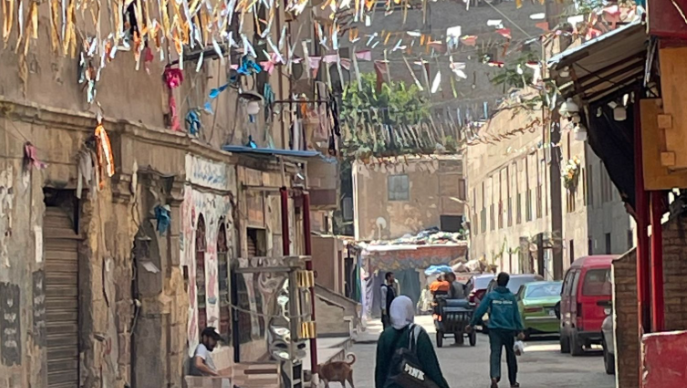
Walking through the streets of this city within a city is a somewhat eerie experience. It takes my mother and I a while to get our heads around it, as the guide calmly points to a low concrete building.
“So these, these are all graves.” He says.
“And people live there?” I ask.
“Oh yes.” He answers.
Indeed, for a place named the City of the Dead, it is bursting with life. Our guide calls out to shopkeepers, garage owners, and little kids playing football in the street, as we wind our way through the ancient cemetery. We stop, every now and then, to inspect a centuries-old mausoleum housing a long-dead Mamluk sultan.
But the City of the Dead has had a long history, and although recent investment has caused a reversal of the area’s fortunes, for many years the district was not quite so prosperous.
The History of Cairo’s City of the Dead
The City of the Dead in Cairo first began as an Islamic cemetery in the 7th century. In Egyptian culture, there is a 40-day mourning period following a death, a tradition deriving from Ancient Egyptian practice. 40 days was the length of time the body was embalmed in salt before burial (although the whole process took 70 days). The continuation of this mourning period into the present day means graves require a built structure next to, or around them, in order for the family to stay and mourn there. These tomb complexes can often be quite large, roofed, well-built, and of course, relatively uninhabited. Over time, immigrants coming to Cairo found the City of the Dead a preferable place to live compared to many other more crowded and more expensive options in the city. If the family that owned the tomb agreed, a kind of mutually beneficial system could be arranged. The immigrant family would take care of the tomb in exchange for living there, paying little to no rent.
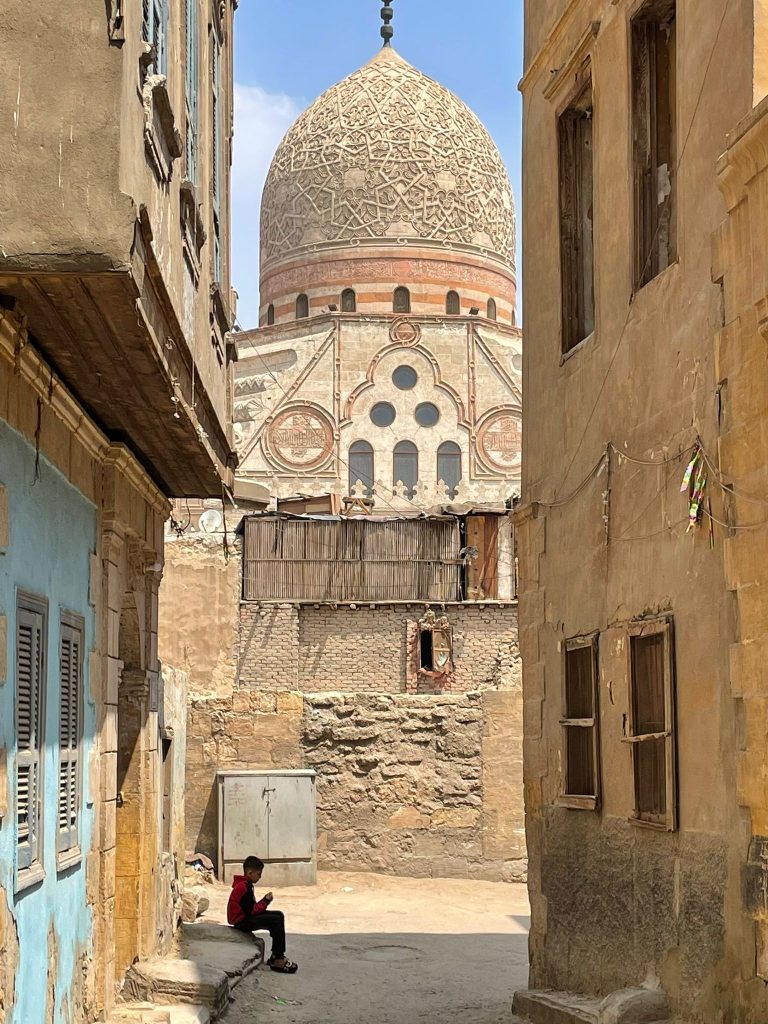
By the Medieval period, the City of the Dead was the place to be. The great Mamluk sultans had decided to build their huge mausoleums there, dotting the cemetery with mosques and madrasas (schools that served rich and poor students). A particularly notable example is the Sultan Quaytbay Complex. It consists of a mosque/madrasa, residential buildings, a drinking trough for animals, and a smaller tomb. It is a beautifully decorated building with stained glass, marbled, patterned floors, and sweeping minarets. Importantly, the Mamluk sultans invested a great deal in developing the area. The City of the Dead filled up with inns to provide a much-needed pit stop for merchants travelling through the Sahara. Market stalls set up to trade with the merchants passing through. Drinking troughs and stables were built for the animals of the caravansaries.
However, since its medieval heyday, the City of the Dead has fallen into decline. In 1459, permanent dwellings were banned by official decree, after a large swathe of the population died from plague. After this, various other hubs were built in Cairo, draining money out of the City of the Dead. First Downtown, then Heliopolis, then Maahdi, then New Cairo, these new, modern districts became each in their turn the centre of city life. The City of the Dead fell into poverty and disuse.
Recently, a further problem has impacted the craftspeople working in the city’s traditional sectors. China. Bronze lamp maker Mohamed el-Yamaami reveals the problem: “The majority of them [bronze lamps] used to be made in workshops [around here],” he adds, “It provided the livelihood to many people. Now China makes them for cheaper”.
Khan El-Khalili is one of Cairo’s oldest markets. It is a huge bazaar which for centuries was filled with stalls selling hundreds of products all made by Caireen craft: perfume, spices, jewellery, and scarves. However, nowadays the bazaar is stuffed with Chinese imports: plastic pyramids, hieroglyphic key chains, and “I ♥️ Egypt” T-Shirts. “The tourism drop has decreased our sales, there are more goods coming in from China, and no schools teach children these crafts,” says bookshop founder Mohamed Abd El-Zaher.
Many blame poor government investment and the lack of interest among the younger generation in learning traditional crafts. However, new investment in the City of the Dead might be reversing these market traders’ fortunes.

Modern Revival: EU Investment and Conservation Projects
In 2018, the European Union granted 1.3 million euros (£1.1 million) towards conservation of the Mamluk monuments, hoping to drive the area’s socio-economic development. Christian Berger, head of the EU delegation in Egypt, stated that, “our intention is to support this type of project that benefits immediately vulnerable groups and disadvantaged groups, projects that have a broader socio-economic impact.”
The project was titled Heritage for the Living in the “City of the Dead”. It aimed to restore key historical sites, for example, the beautifully decorated Hawd (drinking-trough for animals) of Sultan al-Ashraf Qaytbay. The project also strove to invest generally in the promotion of local business and social welfare programmes, aiming to improve the quality of life for the residents and encourage tourism to return to the area. As restaurant-owner Issem Abou Rami states, “Before the projects, there was rubbish all over the streets […] Now a truck comes every day to collect it.”
The woman behind it all is Agnieszka Dobrowolska. Dobrowolska founded ARICHiNOS Architecture in 2008. She was originally involved in designing residential and multipurpose buildings, such as hospitals. But in the late 2010s, Dobrowolska turned her attention to conservation. In 2016, ARCHiNOS joined the Heritage for the Living project, restoring Sultan Quaytbay’s funerary complex. This was then used as an artistic and cultural hub. In November 2024, two Egyptian artists, Iman al-Benna and Omar Gabr, painted a large mural titled Desert of the Mamluks in the neighbourhood. And on 8 May 2026, a full-day programme is scheduled, Under the Canopy of Cairo’s Domes, which includes walks, talks, arts, crafts, and music in the City of the Dead, with Agnieszka Dobrowolska leading one of the walking tours through the Northern cemetery. “We seek to attract tourists who are off-track from the mass tourism destinations. People who might appreciate and enjoy the unique urban character of the necropolis,” Dobrowolska said.
The conservation projects have now ended, with parts of Sultan Qaytbey’s “royal suburb” restored in June 2025. However, the work does not stop there for Dobrowolska and her team. ARCHiNOS and the EU have worked not just to return the Mamluk’s ancient monuments to their former glory, but to bring Egypt’s declining traditional crafts back to life.
“When we first came here, our main object was to conserve the monuments,” Dobrowolska stated, “And we quickly realised that we cannot simply conserve the monuments, in disrespect to the people who live and work in the area.” This was an important realisation and led to a massive expansion of the project.
“I’m very happy Agnieszka and her team came here,” states local carpenter Khaled Abdel Hamid. “Thanks to them, many people have come here to see our handicrafts. They have revived this place.”
I certainly noticed the revival upon my visit. There were garages, cafés, and market stalls spilling out into the streets. The hum of everyday life filled the air as people called out to each other, haggled with fruit stall owners, and zipped past on mopeds. Perhaps Dobrowolska’s work and the funding from the EU have acted to reverse the declining fortunes of this area, stimulating the economy and putting it back on the tourist map. Two case studies stand out in particular.


Modern Revival: Traditional Craft
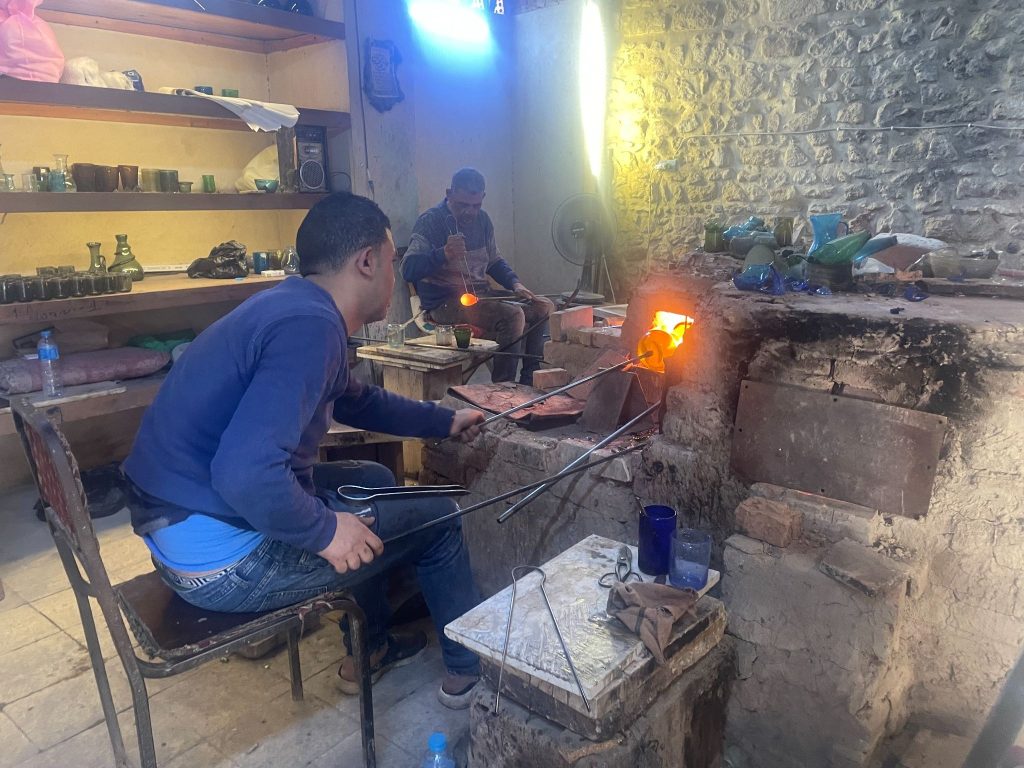
On the wall of Khaled Ahmad Ali’s glassblowing workshop is a certificate revealing EU investment into this “Space for Arts and Crafts in Sultan’s Monument”. The art of glassblowing has been a longtime tradition in the family, and Mr Ali is now teaching his sons,
working to preserve the profession from extinction. They work with a stone oven on the right-hand side of their shop, and their newly finished products sit for sale on shelves lining the left. The diversity and creativity of their designs are breathtaking, with vases, glasses, lamps, decorations, and beads all available in a variety of colours: green, white, blue, and brown.

MISHKA is a cornerstone example of the recent regeneration in the City of the Dead. Founded by Dobrowolska herself, MISHKA is a jewellery and leather workshop. The non-profit uses traditional techniques to produce pieces inspired by the Mamluk architecture of the City of the Dead. MISHKA was set up in 2018 to provide work for local women. It aims to not only produce beautiful pieces, with training provided by renowned leather product designer Bill Amberg, but it also supports its 80 women workers to build a better life for themselves. Aida Hassan, 45, has worked in the leather workshop for three years, and said she is happy to be earning “1,500 pounds ($96) per month — and sometimes more“.
The hope is that such businesses will regenerate this often stigmatised district. They have done well. Some of their pieces have made it into the very highest echelons of society, with Spain’s Queen Letizia sporting a pair of MISHKA earrings during her visit to the Egyptian capital in 2025. Recently, the organisation has opened a physical shop next door to their workshop within the City of the Dead.


So has the City of Dead come back to life? After centuries of poverty and struggle, will investment and commitment from the EU and Dobrowolska be enough to turn the fortunes of this declining district around? It certainly seems to be working so far. During our tour, our guide was surprised to see another group visiting Sultan Quaytbay’s mausoleum. Perhaps, conservation and restoration will put this forgotten gem back on the map. The programme certainly has the potential to revive traditional Caireen crafts and return the city’s ancient markets to the high-quality, homegrown products of generations past.