


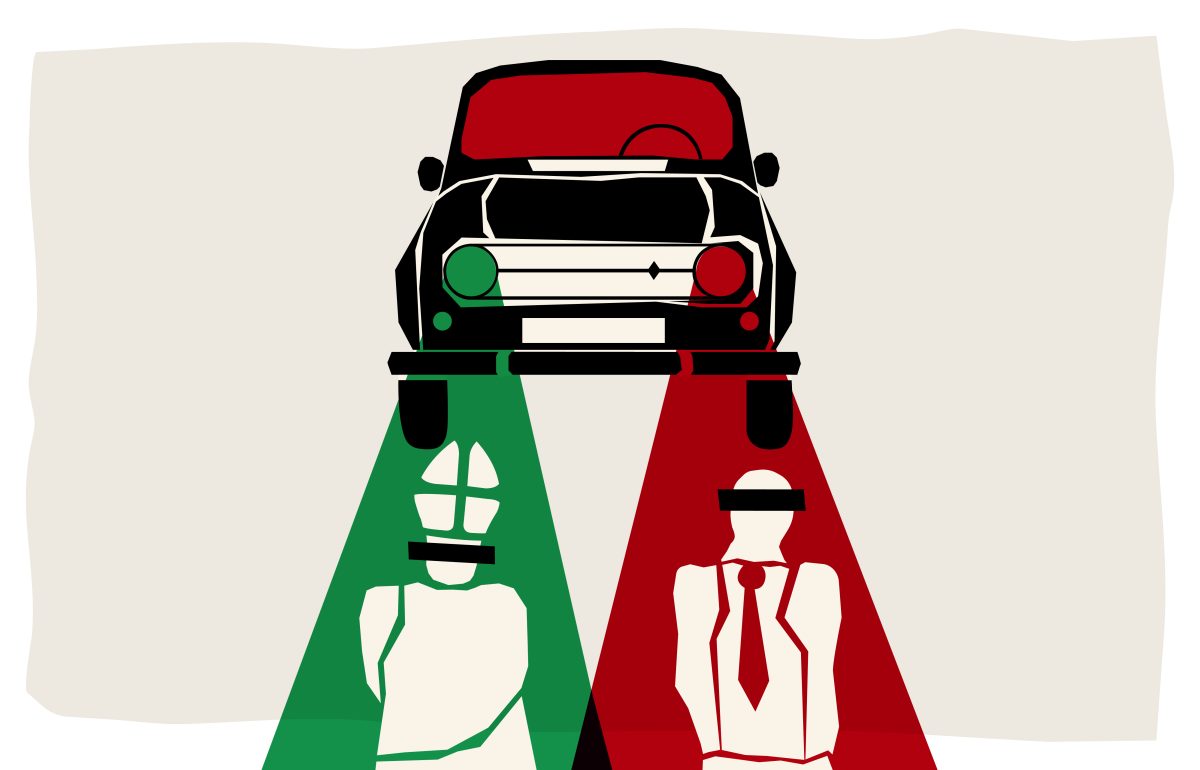
“Could this be a musical?”
Have you ever had this thought while watching a film? After reading a book, seeing a painting, or learning about a historical event? Regardless of where this thought process started, the answer is probably yes. The second question is “Has someone already done it?”, to which the answer is, unfortunately, usually yes as well. I’ve lost count of the number of times I’ve been excited to plan a musical based on German cautionary tales, or gruesome 80s monster flicks, or haunting gay-iconic documentaries, only to find out that I’ve been beaten to the punch. Imagine my surprise, then, when I discovered that no-one has ever musical-ised the 1978 kidnapping of former Italian prime minister Aldo Moro! Until now.
The first musical I wrote at Oxford was a retelling of various Greek myths called Songs of the Silenced, co-written with the brilliant Savinay Sood. The show was a cabaret which re-imagined Greek mythology from the perspective of their sidelined and underwritten female characters. Stories inspired by Classics are pretty well-trodden ground for musical theatre (Hadestown, Seven Brides for Seven Brothers), but my second writing venture was less so. It was the catchily titled A Series of Introductory Lectures on Psychoanalysis: The Musical, featuring lovestruck lesbians and a buxom drag king Sigmund Freud. Despite the odd concept, the play did well enough at the Camden Fringe to win an OffWestEnd award, a victory marred slightly by the fact the announcer couldn’t correctly say the title. (But can you blame him?)
So there is no bad topic for a musical, so anything can be a musical, so everything should be a musical. Right? Wrong.
The history of musical theatre is filled with real doozies of bad-topic-for-a-musical musicals—I mean absolute corkers. You have those that have “aged poorly” (read: are racist) like The King and I or the very popular yet shudderingly bad Miss Saigon. You have those that are shameless cash-grabs such as the sanitised MJ: The Musical or the hilariously titled Annie 2: Miss Hannigan’s Revenge. And then you have my personal (least) favourite: 1971’s Lolita, My Love. Yes, that Lolita.
These are obviously terrible ideas. But so is a musical about the westernisation of Japan, or the invention of the printing press, or the failure of the Weimar republic, yet these are the subjects of some of the most exciting works in the genre. So what actually makes a good or bad topic for a musical?
Maybe the answer doesn’t lie in the topic itself, but rather the structure of the story. Musical theatre is, typically, a restrictive structure: usually around 17 songs, including a big opening number, an “I Want” song for the protagonist, a “Charm” song for the B-plot character, an “11 o’clock number” for the featured actress, et cetera. Some stories naturally fit this formula, and thrive as musicals. Wicked, for example, is both wonderful and completely by-the-book in terms of structure. Some stories don’t fit the formula, such as Adam Guettel’s breathtaking Floyd Collins, which mostly focuses on a man trapped in a cave, singing with his own echo. Some musicals don’t really have any overall story at all, like the song cycle Songs for a New World. So if the thing that makes a good concept for a musical isn’t subject matter or structural formula, then what is it?
Instead of looking at how different these examples are, maybe we should look at what they have in common. A musical is a play in which the actors sing—sometimes they only sing and sometimes they also dance. The great innovation of Rodgers & Hammerstein’s Oklahoma was a score that actually moved the action of the play along, rather than just being a series of tunes loosely strung together by a plot. This is called an “integrated” musical, and was (and still is) treated by many as the measure for a good musical: the songs happen within the story, not apart from it. In contrast, Scott McMillin argues in his 2011 book The Musical as Drama that some musicals work well precisely because the songs are apart from the spoken story. Singing can be a more charged mode of communication than speaking, and McMillin argues that this allows extreme contrasts not accessible to “straight” (i.e., non-sung) plays—contrasts between real and not real, literal and allegorical, present and future et cetera. What both of these schools of thought agree on is that good musicals need songs for their story and/or dramatic effect. So if we’re taking our example book/film/painting from earlier and we cannot picture any possible way to explain what we love about it without using song, then perhaps we have a musical on our hands.
So, why Aldo Moro?
This is a story told very rarely outside of Italy. Indeed, I only learned about it a little over a year ago. One of the most powerful and prestigious men in Italy is kidnapped in broad daylight by a rag-tag bunch of radicals, and then the government… sort of does nothing. It’s an enchanting and baffling story of intrigue with the glimmering pre-echoes of “post-truth” politics, but could it be a musical?
The first thing I learned about Moro’s kidnapping was this: the police had been struggling for any leads on his whereabouts, until they suddenly uncovered a new tip. This tip was the name of a town, “Gradoli”, and they had obtained it from a séance. Fabulous. Hearing about this was the moment I decided that the story had to be a musical: it’s so funny, so mysterious, and so Italian that it had to be a song. Whether the tip was useful or not, I won’t spoil (you’ll just have to watch the show) but somehow the story gets much stranger from that point on. In fact, the story is littered with little scenes like this, including an almost comically inept police investigation and a tearful balcony plea from Moro’s best friend, Pope Paul VI. These events all actually happened, but they’re so implausible and heightened that it gives them a slightly magical-realist quality and a natural musicality. Furthermore, these real-surreal episodes are usually short and separate from each other, complementing a more bitty musical theatre structure, borrowing from the vaudeville and variety show traditions. The sheer number of interesting case studies in the story has meant that our cast of 6 is having to play somewhere around 50 named roles— the shadow of Operation Mincemeat looms large.
The strangest part of writing a new play/musical, is the bit when it stops being a mental image of little figures kickline-ing in one’s head, and starts being embodied by real people. It’s a little uncanny, and extremely embarrassing. It’s like people reading your diary, out loud, at you, and then actively assessing whether your diary is good or not. But this strangeness is lessened when the diary is in the hands of wonderful actors (as, I’m pleased to report, our cast most definitely are). Rehearsals are underway, headed by director Rosie Sutton and musical director George Ke. Their task is to turn a shocking and mysterious story, which I have cobbled into a shocking, mysterious, and hopefully funny libretto and score, into an arresting and entertaining piece of theatre. If the first rehearsals are anything to go by, I think they are right on track.
So, could the kidnapping of Aldo Moro be a musical? Yes.
Should it? I’ll let you be the judge.
[The Moro Affair is playing at The North Wall Arts Centre, 4th-6th June 2026.]