
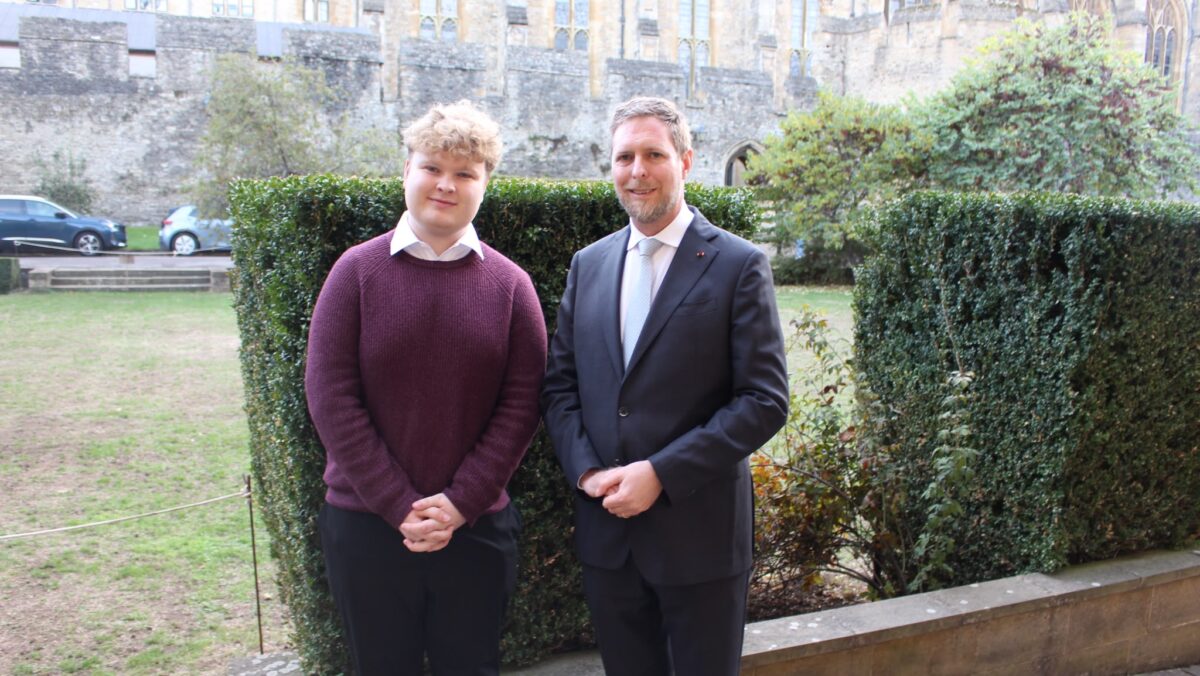
On Thursday, 22 October, I had the pleasure of interviewing Leka, Prince of the Albanians. Leka serves as head of the House of Zogu, the former royal family of Albania; Leka’s grandfather, Zog I, served as King of Albania until Italy invaded in 1939, with the formal abolition of the royal family occurring under Albania’s post-war Communist government.
Leka was born and brought up away from Albania in Johannesburg, also spending time in the United Kingdom, being educated at Royal Military Academy Sandhurst in Berkshire. He has spent his professional career serving in diplomatic and advisory roles within the Albanian Government, as well as serving through the humanitarian mission of the Queen Géraldine Foundation, named after his grandmother.
To start the interview, I began by asking His Royal Highness about the current situation in Tirana. Since 13 October, students have been protesting against the Albanian Government, in a demonstration that began with stones being thrown at the Ministry of Education and chants of “Ministry of Crime”. On Day 5 of the protests, 17 October, Prince Leka issued a statement expressing his support for Albanian students, and articulating that The Royal Court called for “calm, dialogue and respect for fundamental rights. The voice of young Albanians must be heard and their future protected”.
Prince Leka reiterated this sentiment in our interview, stressing that like any other citizens, the students are “taxpayers, and they have a right to express their concerns”. He described the current situation as a deadlock, where the students “do not want dialogue, they want change”, whereas the Albanian government is, in his view, taking an “authoritarian approach” and limiting the ability of democratic principles to be upheld.
These protests, which are being classified by some as part of the “Flamingo Revolution” in Albania that began earlier this year seeking to oust Prime Minister Edi Rama and achieve greater anti-corruption reform, are not the first time that Albania has experienced widespread anti-corruption protests. In 1997, major civil unrest occurred over the collapse of pyramid schemes, with Albanians losing as much as $1.2bn. As a consequence of this, in June 1997 a referendum on restoring the monarchy was held in tandem with a snap election, with the official result declaring 66.7% against restoration. Prince Leka’s father, Crown Prince Leka I, claimed 65.7% voted for restoration however, and a demonstration of his supporters took place on 3 July 1997, with one person being killed.
I asked Prince Leka whether he believed there were similarities between the protests occurring now and the protests that took place in 1997. He began by saying, bluntly, that we are in a “new generation”. 1997 was a “discussion of existence”, whereas the students in 2026 are “fighting for the future, for new opportunities”. He also stressed a worry, however, of how these demonstrations will affect the Albanian reputation abroad, with a hope that they could act as “reform” for Albania’s international image by showing that Albania is “truly a democratic state”.
Zooming out from Albania, we are seeing protests across Europe in the current climate. Elsewhere in the Balkans, at the time of publication, Serbia heads to the polls today under a background of almost two years of student protests, which began on 1 November 2024 with a railway station collapse at Novi Sad that killed 16 people. The students have mobilised into a political party, the “Student List”, which is neck and neck in the polls with the ruling United Serbia coalition. Elsewhere, the scenes across France on 17 October started as protests against poor staffing standards at schools, and evolved over the course of a month into a movement against poor public spending more broadly.
I asked Prince Leka whether he thought that this anti-establishment sentiment that appears to be sweeping across Europe, both in terms of grassroots student protests and the formal political sense seen through the success of far-right populist parties such as the Alternative for Germany (AfD), was applicable as a cause to the protests in Albania, or whether they were an isolated event. He stressed the emergence and importance of social media, and that there are now “tutorials on how to react” to rights being infringed upon. He stressed, however, the uniqueness of the Albanian situation to the rest of Europe, emphasising that there are serious issues of corruption and “government arrogance” that are not necessarily present everywhere.
He also voiced concerns for the Albanian diaspora in this time of rising populism across Europe. He stressed that many feel, despite being hardworking citizens of the countries they have emigrated to, under threat from “nationalistic or xenophobic propaganda”. I followed this up with a question regarding Suella Braverman, former Home Secretary and current Reform UK Education Spokesperson, who that evening was speaking at the Oxford Union on a motion advocating for the UK’s withdrawal from the ECHR. In 2022 and 2023, Braverman made comments about Albanians in the UK; that it was “Albanian criminals” allowing for small boat crossings, and that the UK was facing an “invasion” of migrants on small boats, who (in 2022 when the comments were made) Albanians made up the largest proportion of.
In the context of this, I asked Prince Leka what message he had for the Albanian diaspora, not only in the UK, but across Europe, in the face of this rise of populism. He said that he came out against Braverman’s comments in 2022, and that simply because Albanians are “not well represented in international lobbies and groups of intellectuals” does not mean that they can be “targets to be singled out”. He clarified, somewhat humorously, that there was no threat to the sovereignty of the United Kingdom from a country with “only 2.5 million people”, a number smaller by a magnitude of five times than the total number of immigrants living in the UK.
For my final question, I then turned from the UK to Europe. Prime Minister Rama has argued that he is the person to bring Albania into the EU, with him winning the 2025 parliamentary election on the message that Albania would join the EU in or by 2030. On the question of feasibility, Prince Leka agreed that Albania certainly could, and it would be in the best interests of Albania to, be a European Union member by 2030. He also argued the reverse, that it was in Europe’s best interests for Albania to be an EU member by 2030. His disagreement came from a dislike of “the arrogance of Rama that he is the only person who can achieve it”.
I finished my interview with His Royal Highness on a much lighter note, by asking him his highlight of Oxford. He said it was undoubtedly the people, and seeing student life unfold, as well as challenging questions, and the achievements of those of us who are lucky to be students at this University. Prince Leka’s visit to Oxford provided a historic occasion for Albanian students, and his Q&A with the Diplomatic Society and International Relations Society before my interview saw him received in full honours by the Director of the Oxford Centre of Islamic Studies, Dr Nizami.
Prince Leka provided valuable insight on the state of Albania, and the Albanian diaspora more broadly, at such a time of instability in Europe, and the world. It was fantastic to hear from such a distinguished diplomat, and a unique experience to interview a member of a former royal family, where the legacy of the royal family lives on to sustain the public knowledge and value of the institutions in modern day life.