


I met Pedro Osuna in October of last year when he came to speak to my musicology cohort about composing for TV and film. At just 29, his career speaks for itself.

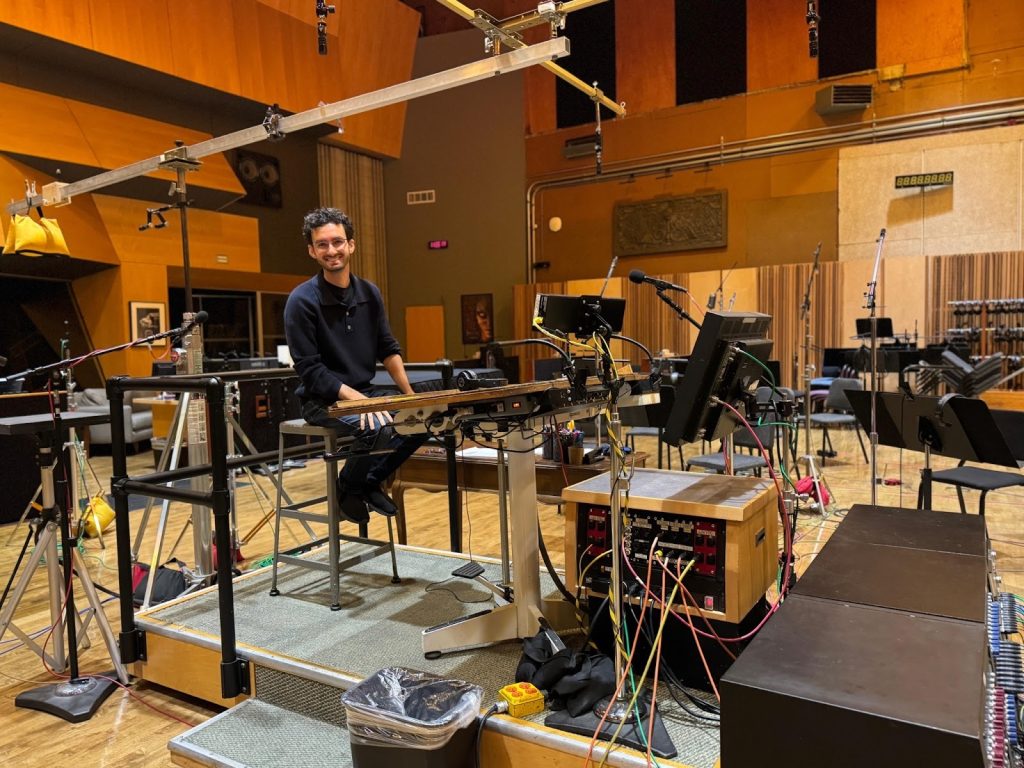
Photo by Marielle Abaunza, used with permission
Pedro grew up in Granada, Spain, but moved to Boston in 2015 to practice composition professionally at Berklee College of Music. He later became the youngest Berklee student to contribute to the score of an Academy Award Nominated film (Klaus, 2019) and dove headfirst into the Los Angeles music scene after graduation, working on projects like Lightyear (2022) and Thor: Love and Thunder (2022). He is now recognised as the youngest person to orchestrate a 007 film with his work on No Time To Die (2021), and his debut film, Argentina, 1985 (2022) went on to win a Golden Globe. He received a Latin Grammy nomination for his contributions on the Amazon MGM show Every Minute Counts. His music has since been commissioned and performed by ensembles and artists worldwide, including the Royal Philharmonic Orchestra, Grammy Award-winning soprano Hila Plitmann, Suuvi, and guitarist Pablo Sainz Villegas, and in a broad array of venues, from the Walt Disney Concert Concert Hall to the Alhambra in his hometown.
We got a chance to speak over the phone later that week, after he had returned to his home in the United States. He was in Vegas preparing for the Latin Grammy Awards when I called.
Julia: Have you gotten to do anything fun in Vegas?
Pedro: We had a little event yesterday, a reception for nominees. I got to catch up with a bunch of friends and make some new friends, and that’s about it! Also, The Wizard of Oz at the Sphere, the music sounded incredible. I was looking at the music credits, and it was just the top of the top film and music people on the planet.
We had the opportunity to chat in the Schwarzman after he had delivered his talk, and again at a Keble College formal later that same night. My Keble friends will be glad to know that the hall reminded him of Hogwarts. I was still curious to know how he got his start with music, and what guided him towards his current pursuits.
Julia: You started playing so early, violin at 5 and piano at 7, is that right? I was wondering, as a musician who starts so young, how did you get into the film side of things? How did your love for music start to intersect with cinema?
Pedro: Well it’s funny because nobody has asked that. When the movie thing happened, I guess both things were equally fun. Music was never the thing I had to do, movies were never the thing I had to do. So they were things I just loved. Probably around 15 or something like that, I think I was watching The Nightmare Before Christmas – and one day I realised, oh my god, someone did this. Someone got out of bed to put together this beautiful thing that I get to enjoy over and over again. I want to do this. Then maybe I got more intellectual about it, and thought this really brings together everything I love: collaboration, spontaneity, telling stories, movies, music, composing, creativity. So I fell in love with the craft of film music, and of course concert music because they’re so connected. When you write a musical, an opera, a film score, a concert piece, they’re very different but they’re all part of one thing that you do. One muscle. So the love was always together, but the film/ music love developed a little later.
Julia: Before you began working in that niche… did you have any other genres that you were particularly interested in or that you listened to? Maybe something you do more for fun, that feels less like work to you?
Pedro: I was gonna say no, and classical! But then I realized, I was a rapper when I was 15. As a teenager I found writing songs therapeutic, and a way to express what was going on, what I was going through. I fell in love with this girl and my buddy, who was a rapper, said you must write how you feel and rap it- and here’s the software you should use, here’s the mic you should buy, and there’s this thing called a compressor, it makes your voice sound better- and that was my first contact with recording. So I guess, different varieties of music. And I remember watching the secret life of Walter Mitty and hearing space oddity by David Bowie – it’s such a great song in that movie – and just getting home and recreating everything. To make a sound-alike, like a demo of Space Oddity but I wanted to understand it. So it wasn’t really niche, the love was wide for music. But the niche was the combination of skills and interests that really aligned with how my brain works and what I really love.
Julia: So you were in Granada, when you were 15? And you ended up at Berklee, what was that like for you? How was the journey from Granada to Berklee? And now of course you’re based in Los Angeles. How has your journey with music changed as your geography has changed?
Pedro: I think the biggest thing about Berklee was that it really widened the horizons. When I was in Granada, I was ready to be someone’s assistant copyist for my whole life. I was so excited to be part of anything, and to just get to work and see some money coming in. Of course, it wasn’t enough to pay rent- but I was working remotely for other composers, assisting, just making myself useful in any way I could, and learning from them. I have great mentors. I just spoke to one of them this morning, and it’s been 11or 12 years since we’ve met. So we’re all still friends. And actually, one of them is here in Las Vegas for the Latin Grammys as well, so I’ll probably see him today or tomorrow, and I’m very excited because he is the one that hired me on that movie that you just mentioned. When you have a teacher who has a Grammy and Emmy and who is still so humble, so nice and just really cares – all of a sudden they give you permission, they say “oh, you’re doing the work! You know the craft, you can do whatever you set your mind to, and you should be telling stories.” And all of a sudden you think, maybe I could be the lead composer. Maybe I could work directly with directors and tell stories for the rest of my life. And I think it’s huge. People that raise the bar for what it means to be a composer, for what you need to know, what you need to study. And the other thing is peers, meeting peers that were just so much more musical, so much smarter, so much more brilliant- and I just wanted to be as good as them. So that, again, raised the bar for me. And I had much more room to grow than I ever imagined. So I’m very grateful to teachers and peers over there.

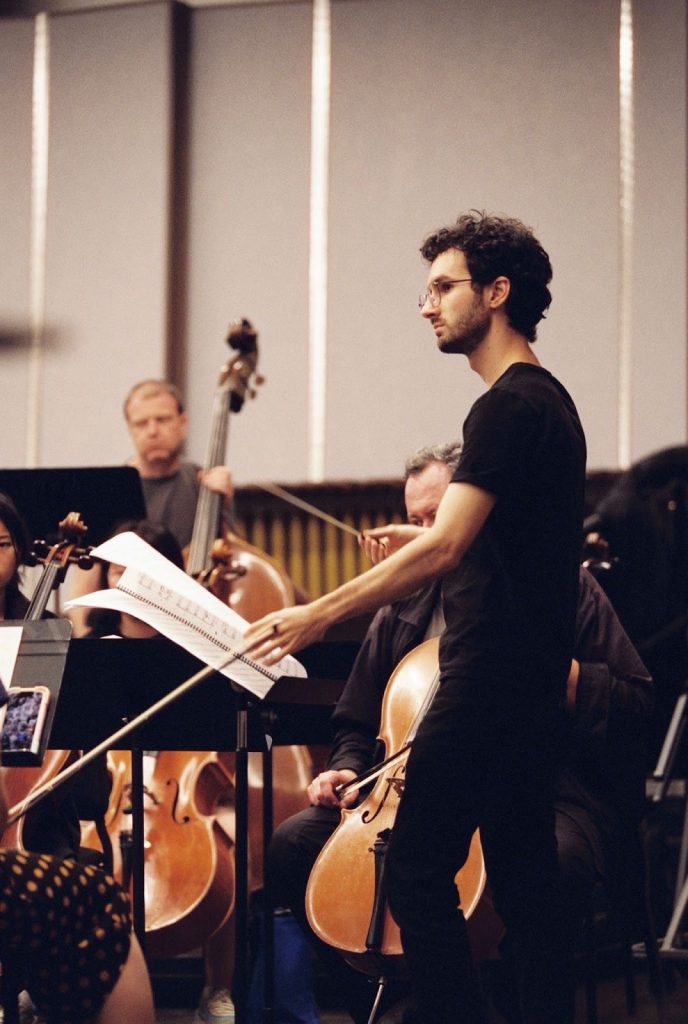
Photo by Noah Radant, used with permission
We spoke about working in high intensity institutions, how it can be inspiring to be surrounded by so much talent but how it can sometimes feel as though the work is never truly done – especially in the worlds of music and writing.
Julia: I can imagine with something as complex as what you do, with orchestral music and with composing specifically, as opposed to – I write folk, right, so it’s me and one instrument. And it still feels like the work is never done. So when you have that many more factors, just the amount of instruments and voices, the directions that it can go, how do you decide when you’ve finished a project? Do you feel like you come to a resolution at some point?
Pedro: I think it’s very intuitive. I don’t know if you really feel like you’ve finished it. You could keep tweaking it forever but something more polished is not something more worth listening to, or more worth watching. Because sometimes the first thing is more fresh. It’s more honest, and therefore more human, more creative and interesting. So sometimes you feel it’s ready, sometimes the first draft is already so purely imperfect that it is perfect. Sometimes I revise for months and I tweak and tweak until I feel like it’s really right. So it really depends. I love revising and I do it a lot. I like things to be very tight musically, in terms of form, in terms of structure. So I don’t know if it’s ever done. I mean, Beethoven did 100 drafts of the Eroica before he finished it. But Mozart didn’t. He did the drafts in his head. So it’s a messy process where you just dig in and then just start to move things in the musical space, and all of a sudden you see light, you see that it’s becoming a thing and then when you finish it, it feels like it’s outside of you. And that’s when you know that you’ve got to let it have its own life.
Julia: I really like that. It seems like the way you are describing your writing process is very visual, do you think that helps you compose for a visual format?
Pedro: Maybe. I think I treat music like people. Movies are about people, and so perhaps more so than the visual it’s just the psychological. Or the natural, or observing.
I referred back to his friends in Vegas, running into mentors at industry events.
Julia: Do you feel like it is a small world, of composing for film?
Pedro: Absolutely. The ones that stay… if you look at the ones who are there for 30, 40, 50 years, it’s a very small world. If you see who’s coming and going it’s a much wider circle. John Williams says Hollywood is the survival of the strongest, not of the fittest, and for him to say that means something. And a friend of mine was saying the other day, we’re still here. We’re in LA – we were doing a housewarming party for a friend who recently moved in, he’s one of the new people coming into the industry – and she told me we’re still here, and so many of our friends are doing something else or are in different cities, and we love this so much we just would never dare leave it. And there’s nothing wrong with leaving, and Philip Glass was a cab driver into his 40s so there’s definitely not one way to do what we do, but it’s a very small circle. Especially when you start to move into a place of doing things really right, of taking good care of people, of being very careful, very cautious, very protective of every single part of the process. Then it gets smaller because I think it takes a little bit of time to learn to do things that way, and the people who do it with that level of care, I mean obviously it’s a lot. So it feels like it shrinks a little bit.
I also asked Pedro very broadly about any hopes or goals he has for his career, for his personal creative fulfilment in music or otherwise. I asked if he might share about any projects he is working on, currently and in the future.
Pedro: Well I’m working on a film that I’m very excited about, but I can’t say much so I’ll say that after that, I would love to work on something that really scares me. Something that I haven’t done before because of the size of the form. It could be a musical or it could be an opera or even a ballet. I was offered a commission that is something between those worlds, but I’m not sure if I’m going to do it yet because I have something pretty specific in mind. So I think that’s something that really excites me right now.
Finally, I asked if he had any advice for me and my peers, or anyone interested in pursuing a creative career.
Pedro: I would say, study the greats as much as you can and copy, steal, copy, imitate, imitate, transcribe, until your craft is good enough that you can really go back to get to know who you are, and who you were in your first years of life and where you come from. Because then you’ll come back to this place of honesty with a polished craft. But don’t ever lose sight of that, of who you are, where you come from, what you love. Don’t respect music, love it. Don’t think it is this sacred thing. You can bend genres, you can make music that, you don’t know what it is. Because we’re just cavemen making paintings on the wall to express something, so as long as it comes from within it’s going to touch something, someone. So I would say stand on the shoulders of giants by learning from what you love, and then go back to what you loved. Through that I think the music will find its place.