


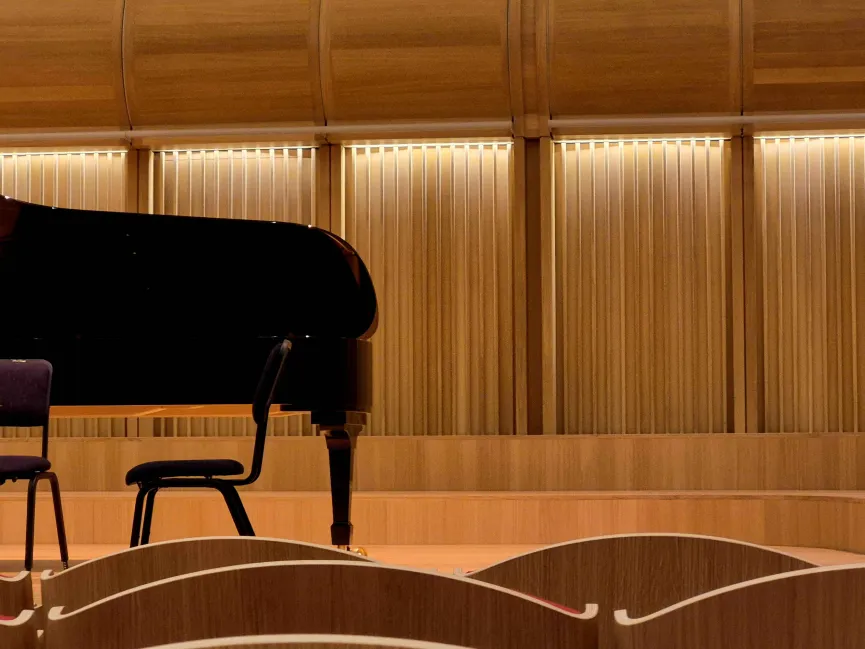
The Sohmen Concert Hall at the Schwarzman Centre opened last Friday with an eclectic programme, which took the audience on a journey ‘from Vienna to Broadway,’ transitioning from piano quintets to American folk spirituals to show tunes. The purpose of this idiosyncratic programme became clear as the night went on: it showcased both the vitality of the performers and the capacity of the concert hall to support them.
The Sohmen seemed to be a plain old box of wood and concrete at first, with a muted beige colour scheme that did not inspire anything particular in me, but the longer I spent there, the more small details I noticed that made me appreciate the space further. The rounded surfaces, the rectangular acoustic panels, and the sweep of the seats gave the room a gentle sense of motion, as though it were rising and falling on unseen swells. The movement was not ornamental; it belonged to the sea of sound the hall was built to hold.
The programme was introduced by the pianist Tom Poster, who explained it through the life of Erich Wolfgang Korngold, the composer of the first piece, who escaped an increasingly fascist Austria to work on film music in Hollywood. His Piano Quintet in E Major, which I had admittedly not heard all three movements of before that night, immediately struck me as a particularly difficult piece to perform. It is dynamic and richly textured; leaping freely between keys, tempos and time signatures. All of this is in service of the wide sea of human emotion that the piece traverses over its thirty-four minutes: longing, brooding, the excitement of young love. It is a piece so large that it felt like it might fall apart at any moment. The near-athletic talent of the musicians of the Kaleidoscope Chamber Collective, however, ensured that their rendition sailed on harmoniously even as the score conducted storms their way.
After the intermission, we entered into a totally different musical world, that of American folk and Broadway. The musicians, however, carried the same enthusiasm and artistry, frequently smiling or laughing after difficult parts of the performance, in displays of infectious passion. A very welcome addition to the concert was Adam Cole on the double bass, who provided a thorough line for the idiosyncratic mix of songs by bringing out the percussive qualities of his instrument.
The musicians, as I hope to have shown, did a fantastic job, but I am here to review the Concert Hall itself. All of this richness, this depth of sound, was conveyed to the audience by the hall itself. The acoustics easily rival those of the Sheldonian, with the added advantage of not wrecking one’s backside. The experience of music cannot really be abstracted from the place in which it is performed, and I never felt like I was missing out on the story the musicians were trying to tell because of any factor of sound or physical discomfort. I could pick out each part of the quintet due to the crisp sound. Francesca Chiejina’s voice echoed as it would in a cathedral as she sang Strauss lieder and traditional spirituals, the space actively heightening her already stellar performance.
The Sohmen Concert Hall fulfils the promise of the sort of modern architecture that people sometimes love to mock, which is utility. From the sound design to the airflow, which uses the hot room from the concert hall to heat the rooms above, the Sohmen is truly an ingenious piece of design functionally. Even if it isn’t superficially beautiful, which I frankly still do not find it to be, it acts as a conduit for great beauty, as demonstrated by this opening concert. Later performers have much to contend with following this memorable opening, but the hall’s design itself ensures they are not without support.